In Search of Deeper Learning

Title: In Search of Deeper Learning: The Quest to Remake the American High School

Author: Jal Mehta and Sarah Fine

Completed: July 2023 (Full list of books)

Overview: While listening to an older Getting Smart podcast, I heard about this book exploring an interested topic, “How can we help students learn more deeply?” This book covers that in a thorough and academic way. There’s a lot of great information in here (possibly the most highlights I’ve ever taken on a book), but it is not a fast read. Pulling part of this for a teacher training course or discussion with teachers as part of continuing education could work well. During several parts of this book, I wished I had a book study group to discuss it with or other teachers to plan ways to implement some of the aspects.

The recurring theme was that students learn best when allowed to play the “whole game at the junior level.” Giving students the opportunity to do the real work of professionals, but with more supports and feedback. They compared it to sports (among other analogies), where we don’t expect the little league team to play against the professionals, but they are still playing the same game. As students get better at certain skills, we can expect/demand more from them and they get closer to producing professional results.

Highlights:

  • (What our current system looks like, leaving much room for improvement) In a tenth-grade English class, students slumped their way through a scene from Othello, reading out loud only when threatened with detention and spending much of the period filling out a worksheet that told them to summarize what they had read. In an eleventh-grade biology course, students spent thirty minutes passively listening as their teacher read out the directions for a highly structured experiment, the outcome of which everybody already knew.
  • Data also consistently demonstrate that the longer students are in school, the less engaged they feel: 75 percent of fifth graders feel engaged by school, but only 32 percent of eleventh graders feel similarly.
  • we were also coming to recognize that our most successful teachers, electives, and extracurricular spaces, wildly varied as they were in methods, goals, and populations, all held one trait in common: they integrated different virtues of learning.
  • our own distinct vision of deep learning—not simply in school, but in life—emerges at the intersection of three virtues: mastery, identity, and creativity. In the spaces that teachers, students, and our own observations identified as the most compelling, students had opportunities to develop knowledge and skill (mastery), they came to see their core selves as vitally connected to what they were learning and doing (identity), and they had opportunities to enact their learning by producing something rather than simply receiving knowledge (creativity). Often these spaces or classrooms were governed by a logic of apprenticeship; students had opportunities to make things (newspapers, collections of poetry, documentary films, theater productions, debate performances) under the supervision of faculty and / or older students who would model the creative steps involved, provide examples of high-quality work, and offer precise feedback.
  • Deeper learning is an umbrella term that has emerged over the past decade to encompass a range of desirable attributes of schooling, attributes rooted in the premise that schooling needs to move beyond rote learning and shallow testing.
  • Paulo Freire, in 1970, decried the tendency of “banking” models of pedagogy, where children are treated as empty vessels in which teachers “deposit” knowledge, and argued for “problem-posing” as an alternative.
  • In contrast, engaged students make a psychological investment in learning.” They continue: “Meaningful learning cannot be delivered to high school students like pizza to be consumed or videos to be observed. Lasting learning develops largely through the labor of the student, who must be enticed to participate in a continuous cycle of studying, producing, correcting mistakes, and starting over again. Students cannot be expected to achieve unless they concentrate, work, and invest themselves in the mastery of school tasks. This is the sense in which student engagement is critical to educational success; to enhance achievement, one must first learn how to engage students.”
  • about four out of five classrooms we visited featured tasks that were in the bottom half of Bloom’s taxonomy, asking students to recall, comprehend, or apply, rather than to analyze, synthesize, or create. Another way of putting this: if we stapled ourselves to a student for a day, we likely would encounter one class, or occasionally two, that presented genuine opportunities for critical thinking or analysis.
  • they felt obligated to move through material quickly but not necessarily deeply. In science in particular, labs were often rushed efforts to demonstrate what the textbook said rather than opportunities for real investigation.
  • A 2015 Gallup poll of nearly a million U.S. students paints a similar picture. The Gallup poll finds that engagement decreases the longer that students are in school: while 75 percent of fifth graders report being engaged by school, the number drops to 41 percent by ninth grade, and 32 percent by eleventh grade. Since students have to be at school to take the poll, even the 32 percent underestimates the level of disengagement, because the most disengaged students have dropped out of school and are not in the data.
  • Students gave a range of familiar reasons for this boredom, including that the “material wasn’t that interesting” (82 percent) and “lack of relevance” (42 percent). Teachers’ pedagogical choices were another reason for their disengagement. Pedagogies that we know to be most common in high schools, like “teacher lecture,” were rated as engaging by only 26 percent of the students. Conversely, modes that are less frequently used, like “discussion and debate,” were seen as engaging by 61 percent of the students.
  • Here the problem was confusing “hands-on” for “minds-on” and it involved doing in ways that did not help students see the underlying conceptual structures of their fields or disciplines.
  • Professional fields, like law, medicine, engineering, and many others, recognize that the work they are doing is complex and thus have developed professional value systems and structures appropriate to knowledge workers: they are selective in whom they recruit, develop a knowledge base that undergirds their work, provide lengthy training in that knowledge, and then require those who enter the field to demonstrate this knowledge and skill. By comparison, education in the United States took a different path by placing power in the administrative class and under-developing the needed professional mechanisms: teaching is an unselective field, featuring short training and low entry requirements, which are frequently waived altogether when there is a teacher shortage. The result of this non-system is wide variation across classrooms, just as we observed. Teaching in the United States also does not have a career ladder that includes opportunities for advancement and for the establishment of highly paid master teachers, which some other countries have. The consequence is that it is hard to draw a talented, capable, and diverse workforce into teaching, which, in turn, only exacerbates the desire for administrative control, perpetuating the downward spiral.
  • when these ideas have been transported into public schools, particularly large high schools serving a more diverse array of students, they have tended to be radically watered down: home economics classes, life-adjustment education, and vocational education, all of which have drawn on the practical but eschewed the academic. Schools have taken the part of it that was easier to do—offering more practical courses to less academically inclined students—but not the harder part: using the practical as a springboard to academic
  • the 1960s National Science Foundation curriculum, Man: A Course of Study (MACOS), which invited students to study another culture as part of an anthropological examination of what it means to be human, died at the hands of a fundamentalist backlash.67 MACOS is just one example among many of the ways in which efforts to have students confront difficult questions have been rebuffed by the more conservative elements of our electorate. Thus creating deeper learning is not only about improving pedagogy but also about building demand for a different approach to learning.
  • one eleventh-grade science teacher ruefully reported, “Forty-seven minutes is just enough time to get the kids really interested and engaged in whatever you want them to be learning, and then the bell rings and you have to start pretty much from scratch the next day.”
  • To close the gap between espoused values and enacted practices, schools need a specific and granular vision of deep learning and a carefully crafted organizational design that enables them to realize it.
  • Achieving deeper learning is challenging because it requires significant unlearning. For traditional teachers, moving toward giving their students deeper experiences in their domains entailed substantial loss: of some breadth in pursuit of depth, and of control, as teachers realized that being a teacher didn’t always mean talking in front of the class.
  • Some teachers were able to bring deeper learning to their core classes by taking a very different stance toward learning than most traditional teachers.
  • their “20 percent” projects. Inspired by Google’s practice of encouraging employees to spend a fifth of their time pursuing ideas of their choosing, these projects share a single core requirement: use the last ninety minutes of each day to design and create something that will benefit the Dewey High community.
  • “It was a revelation for me: these kids were out of school for the day and they could do whatever they wanted, but making stuff was equivalent to, if not better than, play,”
  • they also arrived at the idea of “teacher as designer”; teachers, they believed, would best be able to actualize their potential if they were empowered to craft curricula that reflected their unique knowledge, skills, and passions.
  • Separating younger students from older ones, drawing artificial boundaries between subject areas, and allowing adults to predetermine the pace and substance of knowledge acquisition: in Dewey’s view, these practices all but guaranteed that the learning process would be devoid of meaning and depth.
  • Everything from lockers and bells to academic departments and final exams was on the table for reconsideration—and the vast majority of these features did not survive. Instead, the school is set up to support endeavors that are collaborative, interdisciplinary, flexibly structured, and sustained over long periods of time.
  • For teachers, working at Dewey High means that instead of teaching alone and occasionally meeting in subject-specific departments, they enter into yearlong partnerships (sometimes trios) that bring together the disciplines: biology with media arts, humanities with Spanish, math with physics and carpentry, and so on. With ongoing support provided by colleagues, these teams design and teach semester-long projects that sit at the intersection of their interests and areas of expertise.
  • the key idea was to produce artifacts with real social utility. Mr. Sexton sees this vision as their contribution to building a democracy, “We’re trying to create a context where people are collaborating together to create products of lasting value, which often morph into products of use to the community,” he said. “That’s what civil society is about.”
  • “What gives humans meaning in life is a strong sense of identity around a purpose or passion, creativity and mastery in relation to a valued pursuit, and connectedness with the world and others.”
  • this “part to whole” paradigm of learning mirrors the world of the workshop, where apprentices, assigned to increasingly difficult projects, turn to their mentors when they run up against challenges that require skills they have not yet developed. It also maps onto the world of the startup and other contemporary job environments, where people acquire new skills as the need arises. This approach has significant advantages, because it puts students in the mode of seeking to produce real things from the start.
  • I think that schools now are in thrall of Taylor and efficiency—the more kids are on task for more time, the better; 100 percent is the goal. That’s not the way adults work. If you walk around and look at the adults here, they’re engaged in being adults and in adult conversations while getting their work done. Kids need that too.
  • This is also one of the key reasons why Inspire may have failed to gain traction; as a whole, the school lacked rich examples to which teachers and students could anchor their aspirations. Reflecting on this reality, Mr. Friedman likens the attempt to implement project-based learning without having witnessed its end products to the act of panning for gold without knowing what the metal looks like.
  • in contrast to Inspire, Dewey High zealously provides. All newcomers, be they recent college graduates or ten-year classroom veterans, participate in the “New Teacher Odyssey,” a two-week intensive summer institute where they practice designing projects under the guidance of the school’s most skillful practitioners. When combined with the apprenticeship-style support created by co-teaching with veterans and weekly opportunities for collegial feedback throughout the year, new teachers are given the professional tools they need not only to build technical skills but also to internalize the school’s core values.
  • Many schools are open to the vast array of goals that could be part of a good education, and the many providers who promise to deliver them. The result, however, is that most schools end up trying to do a little bit of everything—a tactic that often results in a whole lot of nothing. Finding themselves overwhelmed by the competing priorities and new initiatives that administrators foist on them, teachers lose focus or simply start selectively ignoring what they are asked to do.
  • the schools in the network generally shake their head when it comes to contracting with external providers. Although teachers and students regularly venture into the world beyond the school’s walls, partnering with community members and local organizations, Dewey High’s leaders rarely bring in outside organizations to provide professional development or to run programs. Dewey High also downplays the pursuit of sky-high achievement on standardized tests. When it comes to offering Advanced Placement classes, the school simply says no; the AP program’s emphasis on content coverage within the traditional academic disciplines runs directly counter to the vision of deep interdisciplinary projects. “We broadcast [our lack of AP classes] from the mountaintops,” says the school’s director. This public stance is critical because it means that families who choose to join the school are forewarned that AP will not be part of their adolescent’s high school experience.
  • what about math, where certain concepts serve as critical gateways to others? Dewey High has no good answer to this question, which may help to explain why the schools in its network, as well as virtually all of the other project-based schools that we observed, chronically struggle when it comes to integrating math into their model.
  • Suppose you had standards for content and skills and understandings. You wanted everybody to be reading at a sixth-grade level or something like that, and you set that as your goal. Come the end of the year, not everybody’s reading at a sixth-grade level. What do you do, then? What do you say to the kid who’s not reading at a sixth-grade level? You say, “You haven’t measured up.” That’s crazy, because development is not curricular. Development is individual and personal. Different kids develop at different rates and develop different skills at different times. The important thing is that those skills develop in relation to kids’ passions and their willingness to try something new.
  • When we interviewed Mr. Hughes in 2011, he had nothing but scorn for the idea of using quantitative data to guide the work of schools. As far as he was concerned, Mr. Hughes told us, “data” was a four-letter word—a tool used for control and micromanagement by the state.
  • Do we want high schools to be places where students look to the future by venturing into the unknown, or do we want them to be places where students master the timeless building blocks of disciplinary knowledge? Should we care more about cultivating passions and dispositions, or about building cultural literacy and a shared foundation of skills? Should the field empower teachers to be “adventurous” in their work, or, given that adventure entails the nontrivial possibility of failure, should it instead provide clear frameworks for what and how to teach as a hedge against inconsistency?
  • well-known charter networks like KIPP, Achievement First, and Uncommon Schools, these schools differ in their particulars but share a common set of precepts: strict discipline, which involves penalties for small infractions such as dress-code violations; high academic expectations, organized around state standardized tests and college preparatory exams; and strong norms of classroom control, including, famously, the requirement that students actively track speakers with their eyes in an effort to avoid distractions.
  • Critics also point to recent studies indicating that many of the students who graduate from no-excuses schools start college but do not graduate, which suggests that high levels of control and prescriptiveness do not necessarily serve students well in their postsecondary and adult lives.
  • like many similar schools, No Excuses High has significant trouble retaining its students. The school does not publish and would not provide us with figures about its retention rates, but one senior estimated that she had started with fifty students in her fifth-grade class and that only about half of them were still at the school in twelfth grade.
  • In classrooms that were not as strong, we identified a tendency toward breadth over depth, certainty over exploration, and control over passion.
  • they have used electives to offer the new courses in engineering, African American literature, and Latin American history; they have used extracurriculars to encourage journalism, literary writing, and debate; they have used the period after seniors’ college applications are in to let Mr. Tobbs develop student-driven presentations; and they have devoted two hours per week to developing projects. What they have not done is make many changes to their core disciplinary classes:
  • “Even if we loosen those surface level structures, we are not going to let them fail. In college, they very well could fail. So I think it’s important to let them semi-fail in a place that’s not going to let them completely fail before they completely fail in a less supportive environment.”
  • IBDP still represents a small niche in the landscape of American high school curricular reform: only 2 percent of U.S. public schools offer the program, compared to the almost 78 percent that offer AP classes.
  • the assessment tasks that lie at the core of the IBDP specify a granular vision of deeper learning outcomes—that is, they paint a detailed picture of the kinds of knowledge, skills, and dispositions that are worth developing and the kinds of subject-specific activities that can support their development, as well as provide rich models of what proficiency looks and sounds like. In so doing, the IB is solving a problem that we witnessed time and time again in non-IB schools—much talk about “deeper learning” and “twenty-first-century skills,” but no clear picture of what such concepts mean in terms of actual classroom instruction or student outcomes.
  • one of the critical limitations of the IBDP is that it does not in and of itself force a disruption of teacher-centered instructional practices. Essentially, while the IBDP specifies in granular detail what content and skills are worth learning and how learners should demonstrate mastery, it does not specify with similar richness the kinds of teaching practices will best support progress toward these outcomes.17 This omission, paired with the fact that—unlike project-based learning—IB’s vision represents a subtle rather than a radical shift away from conventional thinking about the goals of high school education, means that without robust school-level supports it is all too easy for teachers to continue seeing themselves as content experts whose role is to “profess” fixed bodies of knowledge to their students. The history and reputation of the IB as a program aimed at preparing students to thrive in elite universities, where skillful lecturing is celebrated, exacerbates the problem. As one seasoned IB teacher wryly notes, some teachers who are new to the program see it as a mandate to become more teacher-centered:
  • the school’s leadership encourages teachers to celebrate students’ growth over time regardless of their actual achievement
  • students pick up on their teachers’ commitment to supporting them. As one student says, “I can ask my history teacher for help and he’ll never look at me funny—it’s extra work for my teachers, but if I ask them for it, they’re excited that I want to know, which I love.”
  • expectations for coverage, which meant that classes needed to move quickly across a variety of topics. Laboratory experiments were usually squeezed into one class period. The Crusades got a week; the Cold War got two days. Consequently, deeper historical or scientific investigations were scrapped in favor of moving across more content, and the quantity of material covered was so great that students had significant trouble remembering it.
  • As a science teacher who had a Ph.D. from MIT told us, the problem with science in school is that you are mostly demonstrating to yourself what is already known; real science, she said, is all about the unknown.
  • as the competition for elite credentials intensifies, students, quite rationally, begin to pursue the credentials rather than the underlying knowledge and skill. As he writes, “When they see education through the lens of [its exchange value], students at all levels quickly come to the conclusion that what matters most is not the knowledge they learn in school but the credentials they acquire there. Grades, credits, and degrees—these become the objects to be pursued.…
  • Reba Page’s book Lower Track Classrooms can help us to understand these classes. Page’s research suggests that lower track classes generally assume three patterns: the “skeleton” pattern, in which a superficial version of upper-track material is covered at a slower pace; a “relevance” pattern, in which fun, timely, or real-world content is used to try to interest the students; and a “skills” pattern, in which students are drilled in basic skills.
  • she didn’t see her teachers as people “implementing the will of the district,” but rather as people whose passion for books could be contagious: “You know, if you’re passionate about Of Mice and Men, and that brings you joy, that will translate to your teaching, and then the students will feel passionate. But, if I’m making you teach Of Mice and Men just because.… Some people are [made] really uncomfortable by that book. They don’t know what to do when they get to the character of Crooks. They don’t know how to handle the relationship between Lennie and George. They hate the book. Is that good for kids?” At the same time, she said, she was trying to move away from teachers picking books only because they liked them; she wanted teachers to articulate why a particular book would be useful in developing a particular skill that they had commonly agreed was important.
  • in many high schools there is more deep learning happening in “peripheral” activities than in “core” disciplinary classes.
  • A 1915 article quoted a high school principal arguing that the extracurricular activities “pulsate with life and purpose” while the formal curriculum “owes its existence to a coercive regime, loosely connected and highly artificial.”17 Coleman’s
  • High school theater is an example of what learning scientist David Perkins calls the “whole game at the junior level.”39 Perkins’s point is that in variants of games like little league baseball, players do not spend a year learning to catch and another to pitch and another to bat. Rather, they play the whole game from the start, just at the level at which they can play it. The idea is that playing the whole game at the junior level helps the players see how baseball as a whole works, as well why they would want to put practice time into learning the specific skills.
  • This was different from what we observed in many academic classes. In science, for example, students, even when they were doing labs, were mostly going through a series of steps to demonstrate a principle that had already been discovered by previous scientists. In a sense, this is the opposite of real science—actual scientists explore what is not known as opposed to trying to verify what is already known.
  • The following elements make theater a powerful learning environment: Purpose and performance Choice Community Interdependent roles Use of heads, hands, and heart An arc of learning Apprenticeship Offering the whole game at a junior level There are good reasons to think that these same elements are critical in other extracurricular contexts.
  • how can the work of these teachers inform a broader effort toward deeper learning? We identified these teachers by focusing on three primary criteria: cognitive challenge, engagement, and participation. With respect to cognitive challenge, we sought out classrooms where the task that students were confronted with was in the top half of Bloom’s taxonomy—with students asked to analyze, synthesize, or create—or were in levels three or four of Webb’s depth of knowledge scale, which similarly focuses on complex thinking as opposed to recall or application.1 With respect to engagement, we were interested in the ethos of the classroom: was it a place where there was energy in the room, where students spoke with both knowledge and enthusiasm about the work they were doing? Did their body language and vocal or written contributions suggest that they were “in task” as well as “on task,” rather than counting the minutes until the bell rang? Our third criterion was participation. We picked classes where at least three-quarters of the students were actively engaged with the task; running a great class for a few students isn’t enough.
  • In its earlier iteration, said Mr. Wolf, the skill-building part took most of the semester, and the project happened only in the final three weeks. But when a team conducted a review of the course, they found that students did not find the skill-building part particularly engaging or relevant, because it was divorced from the context in which it would be used:
  • In line with Dewey, who urged that the teacher should be an active researcher of her own practice, and a reformist superintendent who in 1893 advocated teacher learning so that students could “drink from a running stream rather than from a stagnant pool,” Ms. Marino frequently adjusted and experimented with her own practice.
Table 7.1 A Different Stance: Traditional versus “Deeper” TeachersTraditional teachers“Deeper” teachers
Educational goalCover the materialDo the work of the field; inspire students to become members of the field
Pedagogical prioritiesBreadthDepth
View of knowledgeCertainUncertain
View of studentsExtrinsically motivatedCreative, curious, and capable
Role of studentReceiver of knowledgeCreator of knowledge
Role of teacherDispenser of knowledgeFacilitator of learning
View of failureSomething to be avoidedCritical for learning
EthosComplianceRigor and joy 
  • The ways in which these teachers taught were highly varied. Consistent with the aphorism from the National Research Council report—“asking which teaching technique is best is analogous to asking which tool is best—a hammer, a screwdriver, a knife, or pliers”—the pedagogical approaches that these teachers employed differed depending on their disciplines, goals, and teaching philosophies.
  • Across the variety of settings that we studied, some clear commonalities emerged among those learning environments that students and teachers described as the most powerful. In all of these environments, learning started with a purpose—something that was not preparation for life later but could grab the interest of a young person in the present. Students were treated as producers, that is, as people who could offer interpretations, solve problems, develop products of value, and otherwise create in ways consistent with the norms of the field or discipline. Subjects were treated as open-ended rather than closed; there was a belief that what students were discovering or creating had significant value, not that knowledge had been previously discovered and needed only to be transmitted. Students were invited to “play the whole game at a junior level”—that is, while there were opportunities to work in depth on particular subsections, students were immersed in whole projects, such as putting on a production, designing experiments, or engaging in mathematical problem-solving.
  • In other words, the most powerful learning experiences we observed were neither at the progressive pole of self-guided learning nor at the conservative extreme of direct instruction. Rather, they assumed the model of apprenticeship or induction, in which students became motivated by a domain and worked to develop or make something within that domain, but did so under the watchful eye of expert mentors.4 Our findings are consistent with two recent syntheses of decades of work on project-based learning and problem-based or inquiry-oriented learning, both of which find that such modes can have strongly positive results if (and only if) they are organized with appropriate scaffolding and necessary direction from more knowledgeable others.
  • Much as Finnish teachers have to complete a research thesis as part of their training, it would be good if prospective American high school teachers similarly had to produce research—one project focused on an educational problem, overseen by education school faculty, and one piece of disciplinary research in their fields, overseen by faculty in the disciplines. For those aiming to teach less classically academic subjects, such as modern instantiations of vocational education, we would expect that they would spend time similarly apprenticing in real-world equivalents. The core principle here is not that teachers need to become more academic, but rather that they need to immerse themselves in the real-world versions of the subjects they aspire to teach, which, depending on the domain, may or may not sit within the university.
  • The most compelling teachers in our sample had a median experience level of fifteen years. In part this is unavoidable, because it takes time to accrue skill.13 But these teachers also described very long periods of trial and error, in which their transmission mode of teaching had to be gradually undone and replaced by a different mode of pedagogy. The example of Mr. Martin, the first-year math teacher who had spent a year co-teaching with one of the strongest teachers in our sample, suggests that this learning trajectory might be greatly accelerated if new teachers were apprenticed to master teachers. This relationship was successful in part because it was true co-teaching—the two teachers planned together, taught together, and debriefed together, with the ratio of teaching gradually shifting more to the newer teacher over time.
  • The fourth element—visibility of student work—was another mechanism to de-privatize the classroom and to act as a check on the rigor of what was being produced. At Dewey High, this came in the form of public exhibition of projects. Seeing the work of one’s students and one’s colleagues’ students not only exerted some modest pressure for performance but also promoted collective dialogue among faculty about the nature of high-quality student work.
Table 8.1 Reimagining the Grammar of SchoolingExisting grammar of schoolingNew grammar of schooling
PurposeAssimilate preexisting contentEngage student as producer in variety of fields and worthy human pursuits
View of knowledgeSiloed and fixedConstructed, interconnected, and dynamic
Learning modalityTeaching as transmissionLearning through doing; apprenticeship; whole game at junior level
RolesOne teacher, many studentsVertically integrated communities: teachers, students as teachers, and field members providing expertise
Boundaries between disciplinesStrongPermeable
Boundaries between school and worldStrongPermeable
Places where students learnSchoolsVarious, including schools, community centers, field sites, online
ChoiceLimitedOpen, multiple
TimeShort blocks of fixed lengthLonger, variable blocks, time for immersive experiences
SpaceIndividual classroomsLinked spaces, variable spaces
AssessmentSeat time, standardized testsCreation of worthy products in the domain: projects, portfolios, performances, research
Organizational modelLinear, top-down planningDistributed leadership; spirals of inquiry
Stance toward communityDefensive; keeping outWelcoming; inviting in 
Posted in Education, Lit Review | Tagged , , | Leave a comment

Excellent Advice for Living

Title: Excellent Advice for Living: Wisdom I Wish I’d Known Earlier

Author: Kevin Kelly

Completed: June 2023 (Full list of books)

Overview: This is a long collection of short pieces of advice (don’t go in excepting stories or any sort of narrative). Some are obvious, some are insightful, and some will probably be much more meaningful to me at other stages in life. There are around 450 total quotes and below are the handful that are most meaningful to me currently. If you like these, the book is worth a read. You can probably get through the whole thing in an hour or dwell on each and draw it out.

Highlights:

  • Being enthusiastic is worth 25 IQ points.
  • Prototype your life. Try stuff instead of making grand plans.
  • Collecting things benefits you only if you display your collection prominently and share it in joy with others. The opposite of this is hoarding.
  • We lack rites of passage. Create a memorable family ceremony when your child reaches legal adulthood between eighteen and twenty-one. This moment will become a significant touchstone in their life.
  • If you ask for someone’s feedback you’ll get a critic. But if instead you ask for advice you’ll get a partner.
  • To make something good, just do it. To make something great, just redo it redo it, redo it. The secret to making fine things is in remaking them.
  • At first, buy the absolute cheapest tools you can find. Upgrade the ones you use a lot.
  • Friends are better than money. Almost anything money can do friends can do better. In so many ways, a friend with a boat is better than owning a boat.
  • When someone is nasty, hateful, or mean toward you treat their behavior like an affliction or illness they have. That makes it easier to have empathy toward them which can soften the conflict.
  • To quiet a crowd or a drunk, just whisper.
  • Don’t create things to make money; make money so you can create things.
  • Learn how to tie a bowline knot. Practice in the dark. With one hand. For the rest of your life you’ll use this knot more times than you would ever believe.
  • Your best response to an insult is “You’re probably right.” Often they are.
  • If your goal does not have a schedule, it is a dream.
  • Finite games are played to win or lose. Infinite games are played to keep the game going. Seek out infinite games because they yield unlimited rewards.
  • If you stop to listen to a musician or street performer for more than a minute you owe them a dollar.
  • Always read the plaque
  • You can be whatever you want to be so be the person who ends meetings early.
  • Purchase the most recent tourist guidebook to your hometown or region. You’ll learn a lot by playing the tourist once a year.
  • You will thrive more —and so will others— when you promote what you love rather than bash what you hate. Life is short; focus on the good stuff.
  • To get your message across follow this formula used by ad writers everywhere: simplify, simplify, simplify, then exaggerate.
  • As long as an idea stays in your head it is perfect. But perfect things are never real. Immediately put an idea down into words or in a sketch, or as a cardboard prototype. Now your idea is much closer to reality because it is imperfect.
  • Invent as many family rituals as you can handle with ease. Anything done on a schedule—large or small, significant or silly—can become a ritual. Repeated consistently small routines become legendary. Anticipation is key.
Posted in Lit Review | Tagged , , | 1 Comment

Seattle Walk Report

Title: Seattle Walk Report: An Illustrated Walking Tour Through 23 Seattle Neighborhoods

Author: Susanna Ryan

Completed: May 2023 (Full list of books)

Overview: This book is a love letter to all the unnoticed parts of Seattle (and to a large degree, cities in general). It encourages you to slow down and see all everything around you. There are interesting happenings everywhere and this book, along with Unseen City, help me notice all the little curiosities in my neighborhood.

This is a very quick read. I got through it in a day when I needed a break from In Search of Deeper Learning. If you live in Seattle, it’s fun to see what Susanna noticed while walking around your neighborhood and no matter where you live, this illustrated book encourages you to wander around noticing everything you typically ignore while walking past.

Highlights:

  • Yesler Way Trolley ran from Pioneer Square to Leschi from 1887 until 1940 and was Seattle’s most popular route on warm summer days when people would picnic at Lake Washington
  • UW 1936 Graduate W. Ronald Benson invented yellow highway paint
  • Panama Hotel and Tea House became Seattle’s on “National Treasure” in 2015 for its significance to the Japanese American community. Many personal items that were left behind during the Japanese-American internment of WW2 are currently on display.
  • Seattle Public Library’s Central Branch is made of 9,994 pieces of exterior glass
  • Over 10 million people visit Pike Place Market each year, more than the population of Sweden
  • Over a million bikers pedaled across the Fremont Bridge in 2018 and near 1.2 million in 2019
  • B. F. Day School opened in 1892 and is the oldest continually operating school in Seattle
  • Luther Burbank introduced the Himalayan Giant Blackberry to the US in 1885 making them newer to Seattle than the light bulb, bicycle, or Jelly Bean.
  • Luther Burbank created many plants including Elephant Garlic, the Plumcot, and Russet Burbank Potatoes
  • The top of a fire hydrant is called the bonnet
  • Picardo Farm P-Patch in Wedgwood was the first P-Patch. In fact, the “P” in P-Patch is for Picardo
  • Brown street signs indicate a Parks Department road, honorary street name, or an Olmsted boulevard. Lake Washington Blvd is the latter, designated after the Olmsted Brothers firm that recommended so many of Seattle’s parks
  • In 1899 a totem pole was stolen from a Tlingit Village to be displayed in Pioneer Square. It was burned in 1938 and replaced with a replica in 1940 that stand to this day
  • Seattle has 21 Sister Cities. Kobe, Japan became the first in 1957
  • Kubota Garden was created in 1927 by gardener Fujitaro Kubota (1879-1973) who had no formal training. It’s been a public park since 1987
  • The Hat and Boots in Oxbow Park were for a western-themed gas station from 1954 and moved to the park in 2003
  • Ward House is the oldest building in Seattle, built in 1882
Posted in Adventures, Lit Review | Tagged , , | 5 Comments

Kimchi Recipe

I’ve been making vegan kimchi for several years now. During my “year of fermentation” I tried several different variations and kept the basic recipe in my head. This worked fine until I made a huge batch… and didn’t make it again for about six months. I realized I needed to keep track of it for myself, plus several friends asked how I made it.

There are at least two techniques for making kimchi. Since I came to it from making sauerkraut, my technique draws heavily from that tradition. This recipe is based on weights. The vegetables are all “baker weight”-style based off the weight of the cabbage. I give the percentage and an example, but don’t think you need to use 2kg of cabbage. Whatever weight of cabbage you have will work fine, just adjust the other ingredients accordingly.

  • Cabbage: 100% (eg 2000g)
  • Carrot: 12.5% (eg 250g)
  • Radish: 2% (eg 40g)
  • Green onion: 2% (eg 40g)
  • Garlic: 0.7% (eg 14g)
  • Ginger: 0.35% (eg 7g)

Sometimes I add other vegetables or leave out the radish/green onion. Once you have all the veg going into it, chop or shred these and put them in a large bowl. Start mashing them to release some of their liquid. After those are combined, add the salt and gochugaru. Again based on weight, but this time the total weight of all of the above (2351g):

  • Salt = 2% (eg 47g)
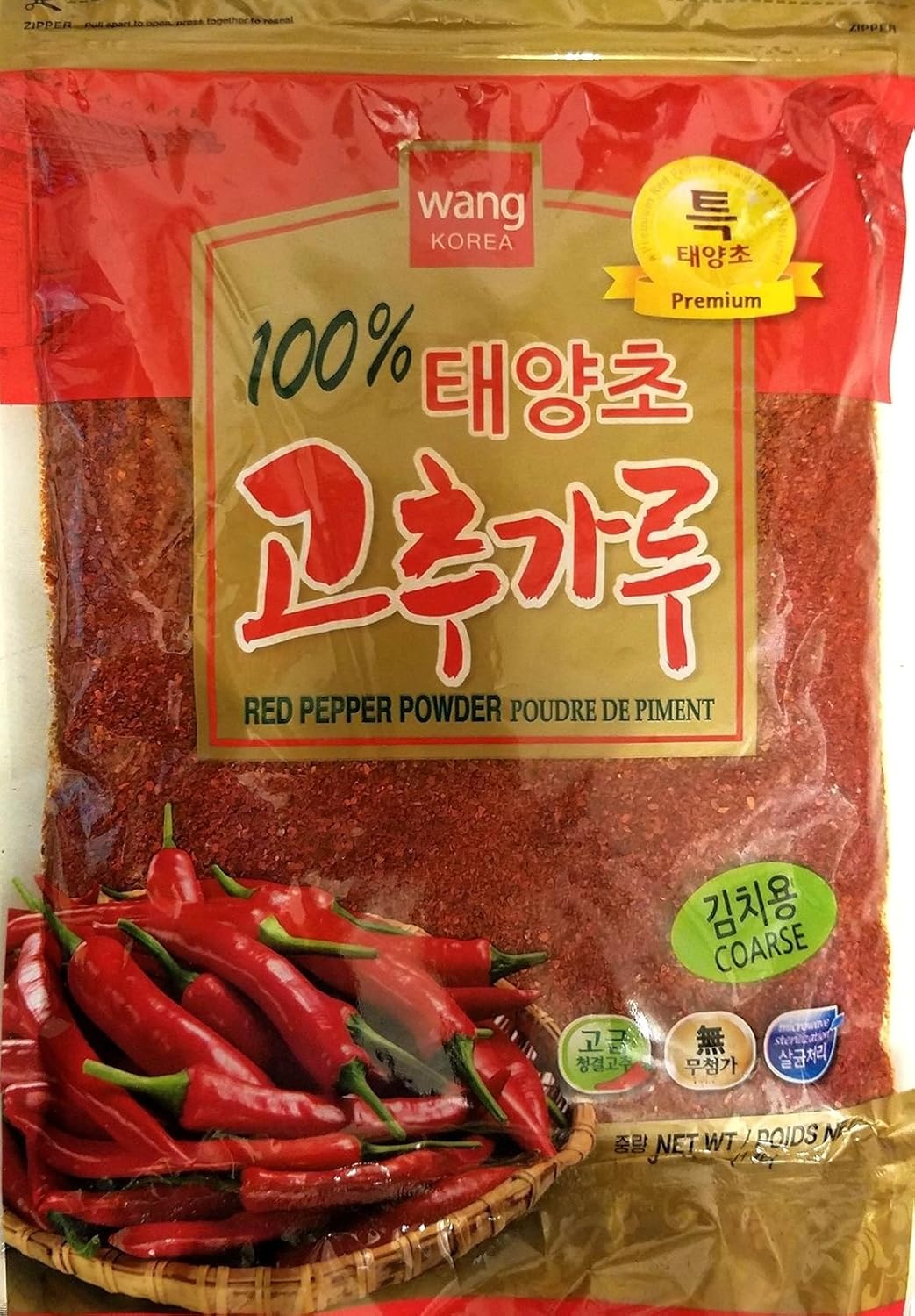
  • Gochugaru = 0.4% (eg 9g) – This was the most challenging ingredient to find. I got the one pound bag from Wang Korea. Near Seattle, it’s available at Uwajimaya and DK Market

Mix in the salt and gochugaru, keep mixing and mashing. Eventually you want enough liquid to completely cover all the vegetables while they are in a fermentation vessel. This could be something fancy and specifically designed for fermenting in or something simple. I used to use large jars with a ziplock bag filled with saltwater on top to hold down the vegetables. Later I found these lids and springs which make fermenting much easier. I discussed these and show photos of them in use on the fermented hot sauce post.

Once there’s enough liquid to cover the vegetables, let it sit in a dark cupboard for a week or two to ferment. If you have some sauerkraut or kimchi already, pouring a little of the brine can help kick start the fermentation, but isn’t needed. You will smell it after a couple of days. Let it continue to ferment. Try it after about a week and see how the flavor is. If it’s good, move it to the fridge at that point, otherwise let it ferment longer.

Occasionally, you’ll get something growing on the surface while its fermenting. There shouldn’t be any fuzzy growth. If there is, compost it and start over. You might also see small matte white areas. As long as it’s not fuzzy, it’s probably kahm yeast which can simply be removed. It doesn’t harm the kimchi.

If you try it, let me know how it goes and whether you add any other vegetables. Enjoy and happy fermenting.

Posted in Cooking | Tagged , | Leave a comment

Born to Run 2

Title: Born to Run 2: The Ultimate Training Guide

Author: Christopher McDougall and Eric Orton

Completed: April 2023 (Full list of books)

Overview: This is the training guide I wish I had back in 2010 or whenever I really started getting into longer runs. I was living in Boise and started running a little farther into the foothills. After about a year, I had some minor knee and ankle issues so I looked for potential solutions. I started shortening my stride, landing on my forefoot, and increasing my cadence. This last one I accomplished by running through the foothills with a metronome app tick-tick-ticking in my pocket. I’m sure it annoyed everyone around me but it worked. This book would have saved me so much time researching and experimenting.

At this stage in my running, it is less useful. There is still a lot of good information in it and I will try some of the strengthening exercises, but now, I’m just running for fun. My form is good enough that (so far) I’ve been avoiding injuries. I’m running in shoes that are barely shoes. So I feel I’m running the way they recommend.

There were many fewer anecdotes about racers in this book than the first Born to Run. If you’re looking for more stories about wild people running amazing races on the edge of total disaster, the first book is the one for you. If you’re looking to get over an injury or improve your form, this is the book. They even offer a free training guide that connects with a phone app to help you learn. Finally, although I agree with most of the advise in the book, I’m not an expert in biomechanics. These things seem to have worked for me… but a lot of it sounds cult-y or like some late night infomercial. Probably worth a read for most runners and definitely worth it if you’re looking to change your running form.

Highlights:

  • Your running should feel Easy, Light, Smooth and, on fast days, Fast. If it doesn’t, you need to look under the hood.
  • IF YOU CAN CRANK OUT A CRISP SIX MILES ON A SUMMER DAY, THEN YOU, MY FRIEND, ARE A LETHAL WEAPON IN THE ANIMAL KINGDOM.
  • That’s the bitter irony: endurance gave our brain the food it needed to create extraordinary technology, but now that technology is undermining our endurance.
  • To reboot your running and follow in Caballo Blanco’s footsteps, you just need to focus on these three goals: Flatten your Footwear. Quicken your Cadence. Find a Friend.
  • studies have shown that runners who bought shoes based on gait analysis are up to five times more likely to suffer an injury.
  • As beginners we go slow, thinking we’ll get faster as we get better. But that’s doing it backward: first, we need to develop raw speed, and that will give us the strength and skill to run longer.
  • Callie is Choctaw, and she remembered that her people looked at running as a prayer, not a punishment.
  • You’re always told to train your abdominal core but never your foot core, which is probably even more important.
  • she noticed that her legs hurt more on downhills than ups. That’s when it hit her: What if she treated the entire planet like a hill? Get up on her forefoot,
  • If you want to determine the top speed a runner can move and still have plenty of air, make them sing. To calibrate the next faster gear, increase the pace until they can barely talk. Ramp it up again, so they can only bark out a few words at a time.
  • Running fast can help autocorrect your biomechanics, he explained, while slow leads to sloppy.
  • study after study had shown that running shoes did nothing to prevent injuries or improve running performance. One withering report found that the more you paid for your shoes, the more likely you were to get injured. Nike’s own top scientist discovered that all the extra cushioning they were sticking in their shoes actually increased impact shock instead of reducing it.
  • Dr. Benno Nigg is co-director of the University of Calgary’s prestigious Human Performance Lab. Back in 1985, he floated the notion that maybe it was harmful for the foot to roll inward on landing, or pronate. Big Sneaks seized on the idea and flooded stores with Stability shoes. But in 2005, Benno recanted, calling the anti-pronation theory “completely wrong thinking” that led to “blunders in sport-shoe
  • four key features of natural footwear: 1) Wide toe box: no pinch on either side of your foot 2) Ample length: 1.5 inches of space past your longest toe 3) Low heel (or “Drop,” or “Heel-to-toe offset”) 4) Minimal cushioning (or “Stack Height”)
  • The Three-Day Rule was Chris’s yardstick: continuing to run when you know you won’t be able to walk for seventy-two hours means it’s time to question why you’re running in the first place. If it’s because you’ve got something to prove, then it’s only a matter of time before you get injured for real or quit for good.
  • Nothing makes a long run easier than breaking it into a bunch of mini-destinations.
  • Movement Snacks! Besides the selection we’ve included, Julie and Jared have plenty more movement snacks on their website. If you’re ever feeling a little blah and not in the mood for a run, grab a few friends and work through a Movement Snack selection.
  • By making them a team, it took just twelve days to transform guys who’d never do a workout into guys who’d never miss one.
  • the biomechanics: running with a jog stroller is a self-correcting running-form instructor, because it rewards a straight back, squared hips, steady cadence and short, consistent stride. Pushing (or pulling) a stroller teaches you to pitter-pat your feet and lead with your core.
  • Big events are dwindling, and smaller, local groups are on the rise. “The height of racing was ten years ago. People are now finding a greater sense of community and connection from running together, rather than racing,”
  • The No. 1 reason people join a group and consistently show up, it found, is “self-categorization”—seeing faces that look like yours.
  • Turn Out for Other Clubs: “We do Unity runs all over town,” Virginia says. “We’re running best-friends with Black Men Run, Black Girls Run, all kinds of different groups and causes.
  • Cesar handed the leashes to my daughter Sophie, who’s never owned a dog. He gave her a few pointers (head up, arms relaxed, stay in front, walk with purpose), and we began climbing a steep dirt trail. The dogs followed quietly until Sophie glanced back and pulled the leashes a little tauter. Immediately, the dogs began scattering.
  • Tightness is not a flexibility issue! “So many runners try to address tightness with stretching and yoga, but it’s really a tug and pull from muscle imbalances,” Eric says. “Stretching won’t help. But form and strength will change everything.”
  • You DO NOT want to foam roll or stretch the ITB. The ITB is a very thick fibrous band that can’t be stretched very well. Rolling just keeps it irritated.
Posted in Lit Review, Running | Tagged , , , | 2 Comments

Community Loaves Hub

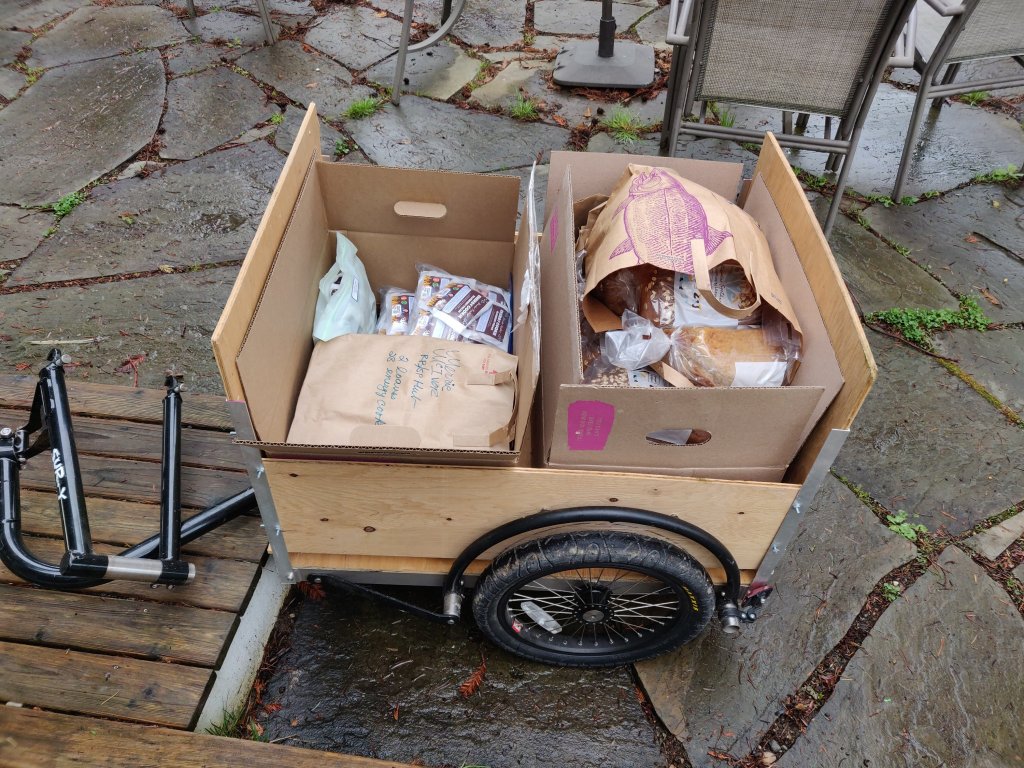
I’ve been baking with Community Loaves for about 2.5 years and although I don’t bake as often as when I started, I’m still excited to bake bread for local food banks and community members in need. Recently I got the opportunity to take on a new role with the group. As of last weekend, I’m the Hub Host. This means twice each month bakers in my area bring their bread and cookies to my house and I get to drop them off at Rainier Valley Food Bank. It also means that once a month when our flour orders come in, they get dropped off at my place for bakers to come collect.

Today I dropped off 26 loaves of bread and 77 “energy cookies” which was close to the limit of what my bike trailer could carry. I’m excited to continue baking and delivering bread and look forward to the time I need to make multiple trips to the food bank to move all the bread.

Posted in Biking, Cooking | Tagged , , , | Leave a comment

Humor, Seriously

Title: Humor, Seriously: Why Humor Is a Secret Weapon in Business and Life

Author: Jennifer Aaker and Naomi Bagdonas

Completed: March 2023 (Full list of books)

Overview: A fun look at how and why humor can show up in business settings with research to back up their statements. They have clearly spent a lot of time studying humor and talking with experts. As someone who thinks most situations have at least one small aspect to laugh about, it was wonderful to learn this sort of attitude can help build community and comradery.

Highlights:

  • when we refuse to take ourselves so seriously, we relieve the stress standing in the way of serious work, create more meaningful connections with our colleagues, and open our minds to more innovative solutions.
  • we’ll explore four distinct styles of humor and help you identify yours. Because who doesn’t love a good typology?
  • As kids, we laugh all the time. The average four-year-old laughs as many as three hundred times per day. (The average forty-year-old, by comparison, laughs three hundred times every two and a half months.) Then we grow up, enter the workforce, and suddenly become “serious and important people,” trading laughter for ties and pantsuits.
  • We don’t need more “professionalism” in our workplaces. Instead, we need more of ourselves, and more human connection—especially as in-person meetings are replaced by video chats and more relationships are sustained entirely by email. Often, all it takes is a hint of levity to shift a moment, or a relationship, from transactional and robotic to relational and authentic.
  • Levity is a mindset—an inherent state of receptiveness to (and active seeking of) joy.
  • Humor channels levity—just as exercise channels movement—toward a specific goal. We all have natural preferences in each realm: You might prefer yoga, soccer, or cycling, just as your sense of humor is drawn to certain styles of jokes, impersonations, or physical gags. Humor, like exercise, is something you can hone—something that requires skill and effort.
  • Comedy is the practice of humor as a structured discipline. Like sport, comedy requires a dexterous command of technique and a great deal of training. Stand-up, improv, and sketch each require their own set of specialized skills, just as basketball, soccer, and hockey require different types of athletic ability. Only a select few compete at the professional level; not everyone wants to be on this level, and not everyone can.
  • They become more generous with their laughter. They notice opportunities for humor that would otherwise pass them by. The mindset of looking for reasons to be delighted becomes a habit.
  • researchers Karen O’Quin and Joel Aronoff asked participants to negotiate with an “art dealer” (research assistant) over the purchase price of a piece of art. Half of the research assistants made a final offer that was significantly above the participants’ last bid, stating simply “My final offer is X.” The other half offered the same amount, but said with a smile, “My final offer is X…and I’ll throw in my pet frog.” Here’s the kicker: For the final offers accompanied by the pet frog line, buyers were willing to pay, on average, an 18 percent higher price. What’s more, the buyers later reported enjoying the task more and feeling less tension with the seller.
  • a Pew Research poll, showing that viewers of humorous news shows like The Daily Show and The Colbert Report remembered more about current events than people who consumed information from newspapers, cable news, or network news. And in one study, researchers found that people who watched a humorous film clip before taking a brief short-term memory test recalled more than twice as much information as people who took the same test after simply sitting doing nothing for the same duration.
  • John Sherman says, “If people are laughing, it means they’re paying attention.”
  • As the abolitionist clergyman Henry Ward Beecher noted: “A person without a sense of humor is like a wagon without springs. It’s jolted by every pebble on the road.” We all need a buffer against life’s shake-ups, big or small, and humor is one of the best we’ve got.
  • PRINCIPLE #1: AT THE HEART OF HUMOR IS TRUTH
  • PRINCIPLE #2: ALL HUMOR CONTAINS SURPRISE AND MISDIRECTION
    • 1. EXAGGERATE
    • 2. CREATE CONTRAST Contrast—juxtaposition between two or more elements—is another tool in your comedic toolbelt.
    • 3. USE SPECIFICS If there is one thing you’ll learn fast from pitching jokes in an Upright Citizens Brigade sketch writing room (aside from the fact that your teacher, Will Hines, inevitably has the best pitch every time), it’s that specificity, detail, and color can take a comedic bit from good to great.
    • 4. MAKE ANALOGIES Just as contrast can create humor, so can comparison.
  • In a series of famous studies on direct mail response, professor and author Siegfried Vögele found that 90 percent of people read the postscript before the body of the letter. Meaning that your PS is likely to be your recipient’s first impression, not the last.
  • That’s why he keeps a copy of the CIA’s Simple Sabotage Field Manual, a set of guidelines devised by U.S. government officials to sabotage terrorist organizations from the inside, in his briefcase. Originally developed by the OSS during World War II, the Simple Sabotage Field Manual is a guide for, as the CIA puts it, “teaching people how to do their jobs badly.”
  • a sample of some of the tactics our nation’s best intelligence officers recommend you use to undermine the operations and efficiency of a terrorist cell—or a typical American board meeting: When possible, refer all matters to committees for “further study and consideration.” Attempt to make the committees as large as possible—no fewer than five people. Make speeches. Talk as frequently as possible and at great length. Illustrate your “points” by long anecdotes and accounts of personal experiences. Haggle over the precise wording of communications, minutes, resolutions. Bring up irrelevant issues as frequently as possible. Refer back to matters decided upon at the last meeting and attempt to reopen the question of the advisability of that decision.
  • In the wise words of the Dalai Lama, “Laughter is good for thinking because when people laugh, it is easier for them to admit new ideas to their minds.”
  • He challenges them to come up with bad ideas. “If I say, ‘Go brainstorm good ideas,’ ” says Teller, “then people will think, ‘Oh, God, everything I say has to be a good idea.’ ” Using the word “good,” he says, puts limits on the way his team thinks. But if he specifically requests “the silliest, stupidest ideas,” people often come up with crazier—and often better—solutions. These brainstorms are full of ludicrous ideas and raucous laughter, but they also yield brilliant results.
  • This degradation of trust in leadership has firmly implanted itself in the minds of employees, too: A 2019 Harvard Business Review survey found that 58 percent of employees trust a complete stranger more than their own boss.
  • The habit of viewing our mistakes through a comic lens can have a meaningful impact on our psychology. Emerging research at Stanford suggests that people who interpret stories from their lives, both positive and negative, as comedies (as opposed to tragedies or dramas) report feeling less stressed and more energetic, challenged, and fulfilled. What’s more, psychologist Dan McAdams argues that we make active “narrative choices” in the stories we tell ourselves as well as the genre or frame we use for those stories.
  • As leadership expert Dana Bilky Asher writes: “We cannot lead if we cannot learn. And yet, our capacity to take in and process new information—to generate new insights and true growth—shuts down in response to the fear of letting people down. Laughter opens us up again.”
  • We all want to have our wins celebrated, but when the acknowledgment feels insincere, our bullshit radar goes off. Unexpected, playful moments of praise or recognition can often be more meaningful than “official” ones because they signal that someone is not only paying attention to what we’re doing well, but cares enough to go out of their way to celebrate it.
  • No wonder one of the first pieces of advice most comedians give to noncomedians is never to start a story with “I have a funny story….” When people perceive that you’re trying to be funny, all of a sudden you have something to prove.
  • Research has shown that a range of environmental factors—from greater employee autonomy over workspace design to elements as simple as plants and bright colors—can promote engagement, productivity, creativity, and well-being. Work by Justin Berg, an organizational psychologist at Stanford University, shows that the “primal mark’’—that is, the first visual cue an employee sees as they generate ideas—anchors the trajectory of novelty and usefulness. When the primal mark is surprising or unusual, creativity often follows.
  • Research has shown that mere exposure to disparaging, identity-based humor is likely to perpetuate prejudice in those who are already predisposed to it. As one study by researchers Robyn Mallett, Thomas Ford, and Julie Woodzicka found, when men who had (in prior tests) been found to hold sexist views10 were told either a series of neutral jokes or a series of sexist jokes;11 those who heard the sexist jokes—relative to those who heard the neutral jokes—reported greater tolerance of gender harassment in the workplace and less remorse after being asked to imagine they had personally harassed a woman.
  • Derogatory humor doesn’t just push boundaries or highlight divisions. It can perpetuate prejudice and impact behavior by those with prejudice views. It further divides.
  • In my experience, you will truly serve only what you love. If you love friends, you will serve your friends. If you love community, you will serve your community. If you love money, you will serve money. And if you love only yourself, you will serve only yourself, and you will have only yourself. —Stephen Colbert
Posted in Lit Review | Tagged , , | 1 Comment

Bears Don’t Care About Your Problems

Title: Bears Don’t Care About Your Problems:More Funny Shit in the Woods from Semi-Rad.com

Author: Brendan Leonard

Completed: March 2023 (Full list of books)

Overview: Last year I was given another of Brendan’s books and really enjoyed it, but never thought to look for any of his other books until a friend mentioned reading this one when we were out on a run. It’s another funny collection of running and adventure stories. Several made me laugh out loud and got me some strange looks when I was reading in public.

His discussion of Obsessive Campfire Adjustment Syndrome was certainly worth a read and reminded me of several people I know… Although other might have thought he was talking about me.

Highlights:

  • Kurt Vonnegut, in a 2003 speech to students at the University of Wisconsin, said, “I urge you to please notice when you are happy, and exclaim or murmur or think at some point, ‘If this isn’t nice, I don’t know what is.’” This year, I urge you to notice when something is awesome, as it often is, and exclaim or murmur or just make a mental note of it. Isn’t it just goddamn fantastic that you have your health, for example? Or running water, or electricity? Or that you have enough money to actually pay someone else to make you a cup of coffee? Or if you want ice cream, you are at any time in America probably only five or ten minutes away from a place that sells some form
  • People can disagree on things like quality, their friend’s taste in food, or whether or not a movie is good. But no one can argue with enthusiasm, especially when it is over the top. Do you think that climb you just did is the greatest climb ever? Great! If someone tries to tell you it isn’t, who cares? Greatest Rock Climb Ever is not an objective title. Thusly, when you are excited about a climb—or a trail run or a summit view or a bike ride or a sunrise—don’t let anyone bring you down.
  • Of course, since there was kind of a big hole in the outside, I thought maybe I’d get a new pair of shoes before my pal Greg and I did a one-day Rim-to-Rim run in the Grand Canyon last October. I didn’t make time to go shoe shopping, so instead of new shoes, I just brought a couple feet of duct tape in my pack in case something catastrophic happened to them and the sole ripped off or something.
  • I guess, you can count on most shoes. I don’t really have too many problems with running shoes. I’ve never been out on a run and said, “Man, I can’t go on. These shoes are just not high-quality enough.” Usually I get about six or eight miles done, and I’m like, “Man, I’m tired,” or “I should call my friend and go smash the breakfast tacos at Watercourse,” or “I better get back to my phone so I can type in this pithy and witty Facebook status that is bouncing around in my head right now.” It’s really not the shoes that present obstacles to my running.
  • One friend of mine says we peak as bicycle riders at age thirteen, after which you start to get afraid to jump your bike off things. Another friend says thirty is the new thirteen.
  • You’ll enjoy a breakfast of oatmeal and instant coffee before your lung-busting days of walking with a 40-pound backpack on your back. What’s for breakfast the next morning? Certainly not fresh croissants or toasted bagels with cream cheese, with a steaming-hot vanilla latte. No, you’ll enjoy another breakfast of oatmeal and instant coffee. While walking miles and miles of steep terrain all day, you’ll snack on Bars That Kind Of Remind You Of Food And Are Pretty Tasty Until You’ve Eaten Two Every Day For Six Days And Now You’re Fuckin Sick Of Them. Mmmm.
  • “I used to think I was gonna change the world. Now I just let people onto the freeway.” I always loved that line, because I think it says something about what people can do to make other people’s lives better—all those little things that don’t make the evening news.
  • Since Dave doesn’t drive, a lot of his miles are commuting miles. He told me once a few years ago—when he was wearing cutoff pants and skateboard shoes—that he doesn’t wear lycra when he rides because he wants people to see him riding his bike and believe they can do it, that they don’t need to buy a bunch of special gear and clothing to ride a bike.
  • you may have Obsessive Campfire Adjustment Syndrome. OCAS affects one out of every four camping enthusiasts in their lifetime, which means you have a 25 percent chance of developing symptoms. It also means that the next time you go camping in a group of four, three of you will enjoy the campfire, contentedly staring into its embers like cave people, but one of you will not stop messing with the goddamn fire.
  • Fact: Hiking is actually just walking, only on dirt or rocks or other uneven surfaces. Or walking some place where an animal larger than you could possibly show up and kill and eat you.
  • the host asked McGonigal: How does this apply to people who are, for example, choosing between a stressful job and a non-stressful job? She said: One thing we know for certain is that chasing meaning is better for your health than trying to avoid discomfort. And so I would say that’s really the best way to make decisions, go after what it is that creates meaning in your life and then trust yourself to handle the stress that follows.
  • Now, there is nothing wrong with riding a nice bicycle. But if you can’t enjoy riding a crappy bike, I would go as far as to say that maybe you don’t like bikes.
  • Terror, that’s how. Fear of failure at The Thing. Of sucking, and wasting everyone’s time and your own money, and maybe some plane tickets. Why does Mount Rainier, or your 5.12b project, or the triathlon, or the ultra, work so much better than those other general objectives like “lose some weight,” “get in shape for bikini season,” or “look good for my wedding”? Because unlike the disinterested glances of fellow beachgoers, unlike your own “I’ve-lost-a-couple-pounds-haven’t-I” inspections in the bathroom mirror, unlike your non-judgmental wedding guests, Mount Rainier will crush you.
  • I’m told something called an IT band exists—one of those body parts you don’t even know is there until it decides to ruin your week, kind of like an appendix, but for runners.
  • We’re not so far removed from the last recession to forget that by having a job, you’re living the dream, too. Almost nobody’s getting out of bed in the morning going, “Yay, work!” But we should be saying, “Yay, life!” And work is part of that, whether you clock in to pilot an airplane, a shovel, or a spreadsheet.
  • You just have to go sometimes. Ignore all the little voices in your head that can list a million things a minute that you need to do or would be more comfortable doing, and put on your damn running shoes, or pack your backpack, or get your gear out of the garage and throw it in the car. Maybe it’s not perfectly planned, or you won’t be able to get as far as you would like, but three miles is probably better than no miles, isn’t it?
  • 1.  Don’t argue with people on the internet. 2.  Use your car horn to communicate with other drivers for emergencies, not to communicate your frustration with other things in life. 3.  Pretty much 100 percent of the time, people don’t want to be surprised by photos of male genitals. 4.  Try to be the first to yield the trail when you see a hiker or mountain biker coming… 10.  If national news gets you down, do something that helps locally. 11.  Instead of insulting someone over their opinion, ask a few questions to try to understand how they came to form that opinion.
  • good for you for just trying something new. Maybe you’re wondering if you’re doing it right, or if you have the right clothes or technique, or if you don’t exactly blend in. All of that stuff is OK. Sure, maybe a few of the people you see doing the same thing look more comfortable doing it, or you think they’re way better than you’ll ever be. Well, they probably are more comfortable. But when they look around the gym, or the trail, or the mountain, they see someone who they think is way better than they’ll ever be. And even if they’re the best climber or skier or runner in the immediate vicinity, they are no doubt aware that someone else out there is better than they are. Everyone’s trying to get better at whatever it is they’re doing, no matter how long they’ve been doing it.
  • I’ve had to devise systems to keep me from giving in to my sloth-like instincts. I refuse to own a reclining easy chair because I’ve seen them trap people for hours. I commit to outdoor events beyond my capabilities so I’ll be terrified enough to train for them.
  • I hate running, three to four times a week if I have time. I hated it yesterday for a little over an hour.
  • Anyway, I hate running. But you should totally try it.
  • I have learned the utter uselessness of complaining about things I can’t change—like the fact that during the summer, it’s often hot outside. In the winter, it’s often cold outside. Sometimes when we want to do things outdoors, it’s windy. Or it’s rainy. Or the things we like to do make our feet hurt, or our shoulders. Or we have to carry heavy backpacks to get somewhere to do something. And whining about it does exactly nothing to help.
Posted in Lit Review, Running | Tagged , , , | Leave a comment

Running While Black

Title: Running While Black: Finding Freedom in a Sport That Wasn’t Built for Us

Author: Alison Mariella Désir

Completed: Feb 2023 (Full list of books)

Overview: I first heard about Alison and this book through an interview with the South Seattle Emerald. The book went on my “Must Read” list and I added her podcast to my regular listening queue.

This is a book every runner should read. It covers a lot of untold (at least no one told me) stories about the start of distance running in the US. Many of the people who helped establish the sport were Black men who have been erased from the history.

Other part of the book covered more general history of race in America. Although many of these points have been covered a lot since 2020, they were largely ignored for decades or centuries before that and deserve to be repeated until this history is as well known as other aspects of this country’s founding.

As part of a running club in Seattle, there are definitely step and suggestions in this book I want to work on to ensure our group can be as welcoming to all runners as we hope it is.

Highlights:

  • I’d pass the house with the American flag and start wondering if it’s safe, and then I’d be annoyed that white nationalists have somehow claimed the flag, as if the rest of us aren’t Americans, too.
  • Running showed me change was possible. It showed me how transformative movement can be. Simply put, running changes lives.
  • Slowly, people began to arrive, wearing tights and jackets. Everyone was white, and no one was talking to each other, a habit of white people I find odd—a default to being stoic and standoffish. I’m never quite sure: are they not talking to me because I’m Black, or because they’re white?
  • The low-performing white kids were not kids I was supposed to stay away from, but the low-performing Black kids were a “bad” influence? It was the first time, but not the last, that I saw how race and class were often conflated in the United States and how the kind of Black I was (middle class) was somehow seen as exceptional, but in danger of being “contaminated” by the kind of Black (working class) some of my classmates were.
  • The science of the time said that the differences between the races were such that education was moot. “The black, the brown, and the red races differ anatomically so much from the white . . . that even with equal cerebral capacity they never could rival its results by equal efforts,” said Daniel Brinton in the late 1890s, the outgoing president of the American Association for the Advancement of Science.
  • Junior year, we had to recite a poem to the class. Most of the students picked works by Sylvia Plath. I read a piece by African American activist Jayne Cortez called “There It Is.” It equated white supremacy to Legionnaires’ disease, a disease sprayed on people, poisoning minds with a lie about their superiority, that their way was the right way. The poem allowed me to say words and phrases like “ruling class,” “Ku Klux Klan,” and “penises” out loud. I loved the discomfort my teachers and classmates seemed to feel when faced with language and ideas we were not supposed to use.
  • When it came time to write my thesis, I chose to expose how the narrative of Haiti in the U.S. was an intentional project of white supremacy. I wrote how Haiti has been portrayed as poor, diseased, and without a future, because it was the only successful revolt by enslaved people, and it will be paying the price for that radical act forever. If Haiti had become a thriving country, what would it have signaled to other enslaved people, other nations under colonial or imperial rule? You can unseat white supremacy. That was not something the world wanted anybody to think.
  • the power of a totem, the idea that you can imbue an object with meaning and it can have a positive impact on you.
  • Black people couldn’t own property until the state’s Fair Housing Act passed in 1957, six years before the running group first met. Eugene’s population in 1963 was only 0.4 percent Black, or 220 of nearly 51,000 people. The University of Oregon had a small percentage of Black students, but it wouldn’t approve a Black student union until 1966.
  • During the ’50s and ’60s, civil rights lawyers filed multiple lawsuits in attempts to desegregate state parks. But rather than open parks to Black people, South Carolina shut down its entire parks system. Georgia opted to lease a dozen of its parks to private operators, circumventing the legal system.
  • As runners showed up, I greeted them. Other regulars like Amir did the same. Then we’d form a circle and the first words I spoke were: “Welcome to Harlem Run. Great to see so many people out here. Is anyone here for the first time?” We were getting one, maybe two, new people each week. If someone’s hand went up, the group applauded and welcomed them. I added icebreakers to create connection. In a circle, we went around answering the question of the day: What’s your favorite ice cream, movie, song? It allowed each person to know someone, to actually have spoken to a fellow human and shared a bit of information about themselves. It was fun, and felt both silly and intimate.
  • I asked everyone not to wear headphones so we could engage with our community, and to run two by two on the sidewalk; I’d witnessed groups take off as a mob, clogging traffic, endangering runners and pedestrians alike. When we ran, we made sure there was room on the sidewalk for others, recognizing that we all shared these streets. I also plotted our routes to showcase Harlem’s historic monuments and places. In these ways, Harlem became a member of Harlem Run, and we became custodians of the neighborhood.
  • We did an activity that asked everyone to line up in a semicircle according to skin color, lightest to darkest. Everyone in the class got up and began assembling themselves, except for a dozen or so white folks. They stood there, flummoxed by the whole affair. “I don’t know where to go,” a white woman said. Oh for fuck’s sake, I thought, just get on the end. White people are so uncomfortable with race that they pretend not to know the color of their own skin. So we had a conversation about this. What is it like for each person to arrange themselves according to race? This was where white people’s feelings on race surfaced. White people felt “bad” that Black people had to line up as “dark.” It was ridiculous. I don’t feel bad about the complexion of my skin. You feel “bad” for me because you’re projecting your biases about Blackness as “bad,” “inferior,” and “other” onto me. Faced with their own biases for the first time, some of the white women began to cry. I could hardly contain myself. This was of course the whole point of the exercise; not the tears, but the awareness. Nothing more had been said other than to line up according to complexion. Everything else, all the feelings and thoughts that came, were what you made of it, or rather what you had been taught and socialized to make of it.
  • Traditional counseling views the therapist as a change agent only within the walls of the counseling room, while a social justice approach sees the therapist as a change agent both inside the counseling room and out in the larger world, as an advocate for changing rules, laws, and conditions that impact clients’ lives. A social justice approach asks, What are the conditions in the world that contribute to my client’s mental health symptoms—such as racism, food insecurity, and sexism—and how can I as a therapist work to resist and dismantle those conditions in order to help my client?
  • In 1946, for example, the Pioneer Club boycotted the national championships in San Antonio, Texas. The AAU, eager for the Pioneer Club athletes to compete, sent a representative to New York to talk to the club, trying to persuade the team to attend. The club refused on principle. Four years later, the Pioneers took a stand against the national championships being held at the University of Maryland, which did not allow Black people in the dorms. To make a point, the eighty-five athletes, Black, brown, and white, stayed at Lincoln University, a historically Black university in Pennsylvania, ninety-three miles away. The New York Road Runners, I learned, grew out of the Pioneer Club.
  • I was floored by this. We were not only there; we helped build the sport. But our participation had been erased, buried. While the New York Road Runners, the RRCA, and the sport as a whole evolved into a white sport, it was clear to me now that the running story is not only a white story. It is a Black story. It is a civil rights story. It is a story of our talent and resilience. It is a story of creating space for Black people. The idea of an inclusive distance-running culture—the democratic, anybody-can-run ideal running wants to be—traces its roots to 1942, with three Black men who embraced and fought for integration and inclusion. Said simply, the first chapter of the modern running boom began with Black men in Harlem.
  • Sometimes I’d go to the website tedcorbitt.com and reread the mantras Corbitt used, to keep them in my mind. “I will be relaxed and free of all restrictions.” “I will feel buoyant and strong while running.” “I will run hard and enjoy the effort.”
  • my first introduction to how much runners buy in to the Boston Marathon myth of exclusion. Our participation as sponsored athletes seemed to threaten these runners’ perception of the race’s specialness, and therefore their own specialness. They suggested we’d cheated the system. But the idea that a system is inherently right and we all have to abide by it is problematic. Why not change the system to welcome more people? Why not have a dialogue on ways to expand the race experience to more runners, rather than shrink it?
  • In the 1970s, Boston likely saw itself as the “Olympics” of marathoning in the U.S. at the time. The distance was not yet a mass participation event; the majority of people running marathons in the early ’70s were fast men, mostly white, who were participating in what was then “amateur” athletics. But as participation grew and the marathon became a distance for all runners, Boston did not evolve. Other big-city marathons like New York, Marine Corps, Chicago, London, Berlin, and Tokyo all chose a lottery system to manage participation. Boston went through multiple changes to its qualifying times rather than doing the obvious—switching to a lottery system. It chose to be elitist rather than democratic.
  • Growing up, grown-ups tell you: don’t be caught at the wrong place at the wrong time. But when you get older, you realize that the wrong place and the wrong time could really be any day of the week, any hour of the day. White supremacy dictates the time; it dictates the lessons we all learn
  • I was conflicted about honoring his life by running the miles associated with his death. I worried that the complexity of a human being could not be distilled into a day, that running a distance that marked his murder erased the life that he’d lived. Were we honoring Ahmaud? Or was this for us? Amir and I put the baby in the stroller and headed out. We ran down 132nd to Randall’s Island Park, did a small loop, and finished as a family. As always, I gained a sense of clarity that comes after a run. We were running for Ahmaud because that was his place of joy, something we as Black people all deserve to feel while moving through space.
  • Some white runners were able to see that a Black person’s agency is very different from a white person’s. One runner wrote on Instagram about the freedom a white man knows: “I almost always feel safe while running,” he said. “Even when I shouldn’t. I’ve found myself down dark alleys at night. Or on private property, have taken a wrong turn. There are even times I’ve trespassed knowingly, wanting to get to that beach or down that trail, all the while figuring it’ll be all right. Many runners don’t have that privilege. To move so freely without fear. Or to make a mistake. To just be human.”
  • In the course of conversation, I had to explain the term white supremacy to him. He thought it meant extremism, the KKK, white nationalists. “That’s not what you’re talking about, or is that what you’re talking about, or not what you’re talking about?” he said, fumbling. So I explained that white supremacy was not simply extremist views or people, but rather the economic, social, and political structure of our nation. It was the idea that white is the norm and everyone else a deviation from it.
  • The average Black person without a formal education knows more about racial issues in our country than a formally educated white person. White ignorance is part of what keeps a white supremacist system in place. If we don’t acknowledge it exists, then there’s nothing to address. White supremacy is the system that allows racism to flourish, and prevents racial diversity from being welcomed and celebrated. I often think of this quote from the hip-hop artist Guante: “White supremacy is not a shark, it is the water.”
  • I learned later that the person who’d suggested we soften the language worked through her blocks with a biracial friend who’d offered to be a sounding board. The friend explained that white supremacy was not just a phrase or term. It existed physically and historically, as a structure and system, and it thrives on being hidden, she said. The more ingrained white supremacy is in the system, the easier it is to hide and the harder it is to get rid of. So watering down the language actually empowers white supremacy. She added that by suggesting the group soften the language, she was actually muting the voices of the cause she was claiming to support and positioning herself in alliance with people who were not really on board.
  • a sense of urgency diluted the possibility of meaningful work. And while the work is urgent, it cannot be done urgently. It requires strategy, and the mental fortitude to resist white supremacy culture, which prioritizes speed over other factors like including more voices at the table.
  • One simple step—hiring more people of color, for example—is more complex than you initially think. It takes education, planning, thought, and care. It requires an understanding of what certain phrases like “must be professional” signal to Black people and other historically excluded communities: that we won’t thrive there because “professionalism” usually translates into a culture that centers white appearance and norms of behavior.
  • A 2021 survey conducted by TRUE Global Intelligence for Gatorade found that 40 percent of Black respondents cited a safe place to run as a barrier to entering endurance sports like running and cycling. Nearly half of respondents of color named a safe place to train as a barrier, as well as fear of hate crimes.
  • In a study conducted by sociologist Rashawn Ray, Ph.D., on why middle-class Black Americans are less active than their white counterparts, Ray found that safety played a primary role.
  • When I hear white runners say “keep politics out of running” or that running publications and brands should “stick to running,” and that “race” and “social issues” don’t belong in running, I hear someone denying structural racism, bias, and white supremacy—denying my reality and the reality of millions of others. These comments demonstrate a lack of racial understanding and a narrow view of our nation’s history. And they ignore the fact that running occurs outdoors, in neighborhoods and parks, and on streets and trails. They ignore the fact that politics and racism are embedded in everything—all aspects of American life.
  • The meet-up was the birth of the Seattle Running Collective, a place for the region’s running groups to come together to meet and share ideas and best practices on how to create inclusive and welcoming environments. It’s a work in progress, but our goal is clear: fostering a change in running culture to focus on inclusion.
  • The running collective is “come as you are,” in sweats or sweat-wicking gear. We want to dispel the myth that running is only about getting faster or that it must be about pain and struggle; running can just be about movement, community, and joy.
Posted in Lit Review, Running | Tagged , , , | 2 Comments

Chasing the Perfect Loaf

I’ve been baking bread for years now and have gotten some recipes that work well for me… But every so often, I decide the loaves are not good enough and I start experimenting with my process.

Recently I’ve been working on higher hydration breads again. My sourdough usually runs around 72% hydration but I keep seeing people online turning out amazing breads at 80% or higher. I tried making sandwich rolls using a recipe that calls for 100% hydration and was blown away by how well they turned out. This was just what I needed to increase my confidence to try higher hydration in my sourdough again.

This time I increased the hydration to about 78%. The dough was still easy to work with and seemed strong enough. When it baked, I got plenty of oven-spring and generally a good looking loaf. The crumb was similar or maybe slightly better than my lower hydration loaves. Unfortunately, just like previous bakes, I didn’t get the ear I was looking for on this one. I tried again. Same results. The loaf wasn’t bad, but it just wasn’t significantly better. The tradeoffs were slightly better crumb for slightly worse crust (and no ear).

I’ve since gone back to my lower hydration recipe and the ear has returned. Like so many other projects that I work on repeatedly, I’ve gotten to a local maxima. I keep trying changes, but they rarely make the process any better. I would like to think that I’ll get to the point of accepting the loaves I make, but I recognize that I’ll probably always strive for that little improvement, even if I end up going in the wrong direction for a loaf or two. After all, there’s always the possibility to improve on the next one.

Latest loaf of bread, after going back to my “regular” recipe
Posted in Cooking | Tagged , | Leave a comment