Practical Lock Picking

Title: Practical Lock Picking, A Physical Penetration Tester’s Training Guide

Author: Deviant Ollam

Completed: December 2025 (Full list of books)

Overview: I’ve been into lock picking for years. I don’t remember when I got started but it was probably around 2010. Back in 2016, I challenged students at One Stone to pick a lock in my Maker Space to win the prize inside the locker. Then in 2024 I gave a presentation to Washington CTE teachers about using lock picking to teach engineering.

Despite picking scores of locks over more than a decade, I still feel there’s a lot to learn. This book reviewed a lot of what I’ve learned already and helped me learn a few new things. If you’re just getting started picking locks, this book will give you the basics, but there are so many other resources available to do that in a shorter format. That said, this goes over the basics and dives a lot deeper than the shorter ones. If you know you want to get into this hobby, this book provides everything you need to get from knowing nothing to knowing how to pick fairly advanced locks.

Highlights:

  • Remember, it’s not a lock’s job to hold something shut. You can easily prevent someone from, say, accessing a particular room of your house by applying brick and mortar to the doorway. That will surely keep unwanted people out, right? What’s the problem with such a solution? The answer, of course, is that such a solid wall of stone isn’t the best thing to have if you’re also concerned with allowing authorized people in. That is what locks attempt to do for us…they assist in giving otherwise robust security a means of quickly, easily, and reliably opening when necessary.
  • our deadbolts, our padlock shackles, and other similar hardware that actually provide the means by which things remain shut. Our locks are mechanisms that simply trigger the release of said deadbolts and shackles at (we hope) the appropriate time.
  • It is a common misconception that pins (particularly the key pins) within a lock can come from the manufacturer in a wide array of varying sizes. In fact, the key pin sizes (and the corresponding depths of the bitting cuts on the blade of the key) only appear in regular, evenly-spaced intervals. I have never encountered a manufacturer who utilized more than nine or ten distinct sizes of key pin in this simple design of lock (and thus, their keys only featured nine possible distinct depths of cut). Many manufacturers fabricate their whole line of lock products with as little as five or six possible bitting depths.
  • consider for a moment the small points of metal that protrude upward from the blade in between the flat lands of each bitting cut. These are a natural result of the size and shape of the cutting wheel and the distances by which each bitting cut are separated from one another. The resultant “points” that remain in between the cuts on the blade of a key can provide a satisfying series of perceived “clicks” as the blade rides into the keyway (as each pin stack passes across the ridges), but the points themselves are not a crucial element of the lock’s easy and successful operation.
  • Most locks, if you look closely, will exhibit at least a few signs of such imperfection. Many products, in fact, will be glaringly deficient in their quality control.
  • If you are starting to learn lockpicking and it isn’t going well, the odds are overwhelming that the problem has to do with your use of the tension tool… specifically, too much pressure being applied to it.
  • Occasionally, the terms “edge of the plug” and “center of the plug” will be substituted for “standard” and “flat”, respectively. Such terms refer to where in the plug the tools are inserted, as you will soon see. (As always, I’ll point out here that I greatly prefer these terms over any designations that are region-specific. Some people will make reference to “top of the keyway” and “bottom of the keyway” but, for reasons that I have discussed in Chapter 1, I try to break people out of the habit of using those sorts of names.)
  • see how high you can comfortably lift it in the direction of the pin stacks. You may be able to observe that at certain positions you are rather limited in your lifting range (Figure 3.14), while other times you can reach very far up beyond the keyway (Figure 3.15). You are feeling the pin chambers and the flat spaces between them. Bear in mind, you should never concern yourself with lifting the pins beyond the “top height” that you can reach in-between pin stacks (the height felt in Figure 3.14), since a normal operating key in a typical pin tumbler lock would never need (or indeed, be able to) lift up beyond the height of the keyway.
  • Two exceedingly different-length pins cannot usually occupy chambers directly next to one another. This is because cuts on the blade of a key must be made at specific, gently-sloping angles.
  • Many times, it’s far more efficient and a great deal easier to bypass locks instead of picking them. The term bypassing does not refer to the act of, say, finding a particular door to be locked and then going through a window instead. No, bypassing is the act of triggering the release of a locking mechanism without manipulating the pins or combination mechanism in the traditional “picking” sense.
  • Interestingly, homemade shims fabricated from thin metals like beverage can aluminum are often the best tool for the job on dual-latching padlocks. Factory-made metal shims are often much thicker, which can result in difficulty during insertion and twisting. Some locks simply don’t have enough “wiggle room” in between the shackle and the lock body to accommodate two thick steel shims. The thin aluminum shims often fit into these sorts of crevices with ease, however.
  • Often, it is possible to lock a doorknob or handle, but this merely prevents the knob itself from turning, it does nothing to secure the latch itself. As anyone who has watched old spy-themed TV shows knows, slipping thin material (on television and in films a credit card is a popular device for this purpose) into the crack near the doorjamb can often result in the latch becoming disengaged temporarily. This is known as “loiding” and many times it works just as quickly as viewers are led to believe.
  • One of the most common modifications (one which I perform upon every new tubular lockpicking tool that I acquire) is the removal of a “reset washer” which is often installed by default.
  • I am often asked exactly what the best setting is for this adjustable collar component on a tubular pick tool. Like many aspects of lockpicking, there is no single hard-and-fast rule upon which you can rely… but I have found what I believe to be a decent “average” standard that you can at least use as a benchmark. Try the following… unscrew the adjustable ring somewhat on your tubular pick. Now, using just a single finger, spin it back in the “tightening” direction until it stops. From this point of slight friction, turn the ring an additional quarter-turn tighter. That is a healthy baseline..
Posted in Education, Lit Review, Maker | Tagged , , , | Leave a comment

Hell Yeah or No

Title: Hell Yeah or No what’s worth doing

Author: Derek Sivers

Completed: November 2025 (Full list of books)

Overview: For many years, I’ve been interested in the writings of Derek Sivers. It goes back far enough I don’t have any idea where I first heard about him, but the idea of sharing all my book notes came from him. I’ve had several of his books on my to read list for a while and when he announced they were free for a week on his website I decided now was the time. (I was going to get it from the library for free already but this was just the prompt I needed to get to it).

Reading through this book, there were many ideas that I completely agreed with and several that I disagreed with, but each idea was conveyed clearly and succinctly which encouraged me deeply think about my views and understand why I felt that way. Knowing what I do about Derek, I suspect he would be much happier knowing that he made me consider my own views far more than he would be if I just accepted his which is somewhat uncommon these days. Either way, this was a quick read and I’d recommend reading it when you have time to ponder.

Highlights:

  • And then if you stopped doing all these things you’re doing just for the money or the attention, what would be left? Who would you be if you didn’t do these things? If you were completely satiated, then what? After an understandable period of relaxing, what would you pursue? Don’t say “sit around and do nothing,” because that’s still just relaxing. I mean after that, when you’re ready to be useful to others again.
  • No matter what you tell the world or tell yourself, your actions reveal your real values. Your actions show you what you actually want. There are two smart reactions to this: Stop lying to yourself, and admit your real priorities. Start doing what you say you want to do, and see if it’s really true.
  • Stop fooling yourself. Be honest about what’s past and what’s present. Retiring outdated titles lets you admit what you’re really doing now. And if you don’t like the idea of losing your title, then do something about it! This goes for titles like “leader,” “risk-taker,” and “good friend,” too.
  • If you’re not feeling “hell yeah!” then say no. Most of us have lives filled with mediocrity. We said yes to things that we felt half-hearted about.
  • Though it’s good to say yes when you’re starting out, wanting any opportunity, or needing variety, it’s bad to say yes when you’re overwhelmed, over-committed, or need to focus.
  • I rebel against anything that feels like addiction. When I hear myself saying “I need this,” I want to challenge that dependency and prove my independence.
  • Kimo’s high expectations set a new pace for me. He taught me that “the standard pace is for chumps” — that the system is designed so anyone can keep up. If you’re more driven than most people, you can do way more than anyone expects. And this principle applies to all of life, not just school.
  • During my last unmotivated funk, I realized that because nothing is exciting me, that means nothing is exciting me more than this boring necessary stuff. And since I don’t want to waste my inspired times on brainless work, this is a perfect time to do those dull tasks.
  • Imagine what it’s like to be the silver medalist. If you’d been just one second faster, you could have won the gold! Damn! So close! Damn damn damn! Full of envy, you’d keep comparing yourself to the gold winner. Now imagine what it’s like to be the bronze medalist. If you’d been just one second slower, you wouldn’t have won anything! Awesome! You’d be thrilled that you’re officially an Olympic medalist and get to stand on the winner’s podium. Comparing up versus comparing down: Your happiness depends on where you’re focusing.
  • The problem is taking any one person’s advice too seriously. Ideally, asking advice should be like echolocation. Bounce ideas off of all of your surroundings, and listen to all the echoes to get the whole picture.
  • Don’t be a donkey. You can do everything you want to do. You just need foresight and patience. If you’re thirty now and have six different directions you want to pursue, then you can do each one for ten years, and have done all of them by the time you’re ninety. It seems ridiculous to plan to age ninety when you’re thirty, right? But it’s probably coming, so you might as well take advantage of it.
  • Ninety-three percent of drivers say they are safer-than-average drivers. When I learned this, it shook my soul. At first, like almost everybody, I thought, “Yes, but I really am above average!” Then I realized I was doing it again. So I decided to gamble on the opposite. Now I just assume I’m below average. It serves me well. I listen more. I ask a lot of questions. I’ve stopped thinking others are stupid. I assume most people are smarter than me. To assume you’re below average is to admit you’re still learning.
  • I had collected 232 unbroken sand dollar shells. I put them all out in the sun to dry, amazed at my good luck. I bragged to my family. I tried to think of all the things I could do with 232 sand dollars. After two days the excitement wore off. I realized I was never going to do anything with them. Now it was just stupid for me to keep all of these sand dollars sitting there doing nothing. The excitement was in finding them, not keeping them.
  • What do you hate not doing? What makes you feel depressed, annoyed, or like your life has gone astray if you don’t do it enough? Answers to this double-negative question seem to be better indicators of what’s really worth doing.
  • I felt ready to do something new, so I started to learn. But the more I learned, the more I realized how little I knew and how dumb-lucky I had been. I continued learning until I felt like an absolute idiot.
  • Learning without doing is wasted. If I don’t use what I learn, then it was pointless! How horrible to waste those hundreds of hours I spent learning, and not turn it into action.
  • Alvin Toffler said, “The illiterates of the 21st century will not be those who cannot read and write but those who cannot learn, unlearn, and relearn.”
  • Many people learn only in their first third of life, so schools don’t teach unlearning.
  • the differences among men, and the differences among women, are much bigger than the differences between men and women. So instead, to compensate for your tendency to exaggerate those differences, just assume that men and women are the same. They’re not the same, but if you follow this rule, your thinking will be closer to correct than not.
  • You really learn only when you’re surprised. If you’re not surprised, then everything is fitting into your existing thought patterns. So to get smarter, you need to get surprised, think in new ways, and deeply understand different perspectives. With effort, you could do this from the comfort of home. But the most effective way to shake things up is to move across the world. Pick a place that’s most unlike what you know, and go. This keeps you in a learning mindset. Previously mindless habits, like buying groceries, now keep your mind open, alert, and noticing new things.
Posted in Lit Review | Tagged , , , , | Leave a comment

The 99% Invisible City

Title: The 99% Invisible City A Field Guide to the Hidden World of Everyday Design

Author: Roman Mars and Kurt Kohlstedt

Completed: November 2025 (Full list of books)

Overview: I’ve been listening to the 99% Invisible podcast for over a decade and when they released this book, I had to read it. When I got it, hardcover was the only option and my system for taking notes works best with ebooks so when they announced that we’ve hit the fifth anniversary of its release, I decided it was time to revisit it. Much of it I remembered but several of the stories felt new again.

The podcast helped me realize that everything can be interesting if you dig deep enough into it. This book dives into several topics that were more difficult to cover without visuals and gives insights into what’s happening just below the surface of the city. Since reading it, I’ve noticed several Thomassons and started paying attention to the different colors of paint on the roads while running and biking.

Highlights:

  • On city streets today, you can see the spectrum of safety colors that have been formalized and revised over the decades by the American National Standards Institute: RED: electric power lines, cables, and conduit ORANGE: telecommunications, alarm and signal lines YELLOW: gaseous or combustive materials including natural gas, oil, petroleum, and steam GREEN: sewers and drain lines BLUE: potable water PURPLE: reclaimed water, irrigation, or slurry lines PINK: temporary markings, unidentified facilities, or known unknowns WHITE: proposed excavation areas, limits, or routes
  • Even though they are generally positioned at eye level directly adjacent to entryways and are adorned with reflective red stripes, Knox Boxes are easy to overlook. Like Kleenex, Dumpster, or the once-trademarked escalator, Knox Box is the common brand name associated with a generic thing: in this case, the rapid entry access boxes affixed to all kinds of urban architecture. When disaster strikes, these urban safes go from being functionally invisible to highly essential in an instant. Seconds count in an emergency, so getting inside a building quickly and safely is critical. Knox Boxes offer a simple solution: when emergency personnel respond to a call and arrive on site, they use a master key or code to unlock a rapid entry access box and retrieve its contents. Inside a typical box is another key or code for accessing that specific building.
  • Genpei Akasegawa noticed an oddly useless staircase alongside a building. A few steps led up to a landing, but there was no door at the top where he would have reasonably expected to see one. What struck him as particularly curious, though, was that the railing running along these stairs to nowhere had been recently repaired. Despite serving no function, the stairs were apparently being kept in working order.
  • Thomassons are also delightful to find, so one could argue that the association isn’t as negative as it might seem at first. Thomassons are treasures waiting to be discovered and analyzed—whether or not they are art, they are an intriguing lens through which to look at and understand change over time.
  • Meanwhile, fake metal trees were put up next to a popular bridge in Moscow to give people an alternative place to attach locks. Approaches like this echo the treatment of graffiti in some cities where special mural-making walls are presented as alternatives to illegal vandalism. Like kissing the Blarney Stone in Ireland or sticking a wad of gum on a rather gross wall in Seattle, putting up a lock may seem like a novel lark, but when a lot of people line up to do the same thing, such traditions can lose their romantic appeal.
  • Converted cannons can still be found sticking out of streets and sidewalks around Britain, often serving as traffic barriers or survey markers. Around the world, people pass by cannon bollards all the time—these stalwart remnants can be found shielding building corners in Halifax, Nova Scotia, and protecting pedestrians from cars along the sidewalks of Havana, Cuba.
  • There are five key principles of good flag design according to Kaye, many of which can also be applied to all kinds of other designs: (1) keep it simple, (2) use meaningful symbolism, (3) use two or three basic colors, (4) no lettering or seals, and (5) be distinctive or be related. In other words, a good city flag should be simple but memorable, easy to recall, and usable at different scales.
  • “if you had a good city flag you would have a banner for people to rally under to face those more important things.” Bad city flags go unused, ceding visual branding territory to sports teams and corporate interests, which come and go. When city flags are done well, they are remixable, adaptable, and powerful long-term tools for civic engagement as well as sources of local pride.
  • Marr explained that he had read it on a plaque prominently placed right outside the building where he was speaking and that his motto is to “always read the plaque.” It’s a mantra that has an obvious literal meaning, but it’s also another way of reminding ourselves to constantly be on the lookout for stories embedded in our built environments.
  • In James Loewen’s book Lies Across America, the author points out that historical markers often say as much or more about the era they were dedicated in as they do about the specific times, places, and people they are ostensibly there to commemorate. Many markers in the American South that whitewash slavery are very much products of the turn of the twentieth century when the backlash against progressive Reconstruction was in full force.
  • The vast majority of the graphic designs crowding your visual field are advertisements. It’s probably okay to ignore most of them.
  • business leaders with vested interests in their ad space fought back. Corporate lobbyists argued the ban would be bad for the economy and compromise real estate values. They also tried to appeal directly to everyday citizens whose taxes might have to pay for removing old posts that would no longer be supporting billboards. There was even an argument that illuminated ads helped people to safely navigate the city streets at night. Clear Channel Outdoor, one of the world’s biggest outdoor-advertising companies, went so far as to sue the city, claiming the ban was unconstitutional.
  • The Civil War’s unprecedented death toll also helped inspire another great innovation of the US Postal Service: home delivery. It was too painful and personal for mothers and wives to receive news of the death of a loved one in public post offices, so mail carriers started delivering letters directly to families so they could read the bad news in the privacy of their own homes.
  • Presented with wide open spaces, drivers will go faster. Intentionally closing off space by adding trees and other landscaping along the side of the road may make a driver a little more anxious but also more cautious, which can in turn make roadways that much safer for everyone.
  • Peter Norton recounts in his book Fighting Traffic, cars began to be viewed as harbingers of death. One newspaper cartoon of the era depicted a car as a toothed monster being worshiped on a pedestal, framing it as a modern Moloch—a polemical automotive-age resurrection of an ancient biblical deity associated with child sacrifice.
  • There are many variants of traffic-calming designs out there, including pinch points, chicanes, gateways, and various other kinds of raised pavements and curb extensions. Suffice it to say that urban designers have tried a lot of tricks to slow drivers down.
  • When it comes down to it, the trust that people put in the security of most entryways is now once again less about the lock itself and more about faith in a broader social order that respects the division between public space and private property.
  • Following Otis’s death in 1861, his sons iterated on their father’s invention and began marketing it more aggressively to the public. They targeted hotels, convincing them that with a fancy elevator in place, rich guests could quickly ascend to the top floors and escape the noise and bustle on the first level. Historically, the ground floor was the most accessible and thus the most desirable, but it didn’t have to be, they argued.
  • London has used a roundabout and statue at Charing Cross as a central point of reference to measure certain distances. Metropolitan police initially served only neighborhoods within a radius of twelve miles from Charing Cross, and hansom cab drivers were obliged to take fares only up to a fixed distance from that central point. Today, London cab drivers are still tested on their knowledge of an area six miles in any direction from Charing Cross.
  • Some of these places are clearly designed, like gores or berms, but they are often overlooked. Most of these spaces, though, are leftovers in planned areas that were created incidentally through the process of car-centric urban development.
  • For the markers left behind in San Francisco, though, this wasn’t the end of the story. Many individual headstones from old graveyards ended up being reused as building material around the city. Intact headstones and fragments of them can be found all over San Francisco. Some wound up at Ocean Beach, arrayed to reduce coastal erosion, while others ended up in Buena Vista Park, lining trails and gutters.
  • There are numerous design strategies and technologies aimed at keeping these feathered nonfriends from occupying urban spaces and outdoor surfaces, including spikes, wires, netting, and even miniature electrified fences. Such innovations largely fail to do what they are designed to do, though. They mostly just move pigeons around, pushing the birds to adjacent structures.
  • It was Modernists like Le Corbusier who favored rectilinear steel, glass, and concrete forms that in turn made cities perfect places to skateboard. “Modernists were the ones that reinterpreted a bench in a park as a slab of granite,” Bracali notes, adding that this design paradigm involved a turn away from “flowing landscapes [with] grassy areas” toward “paved open plaza spaces,” which produced great surfaces, ledges, and edges for skateboarders.
  • Given the long history and modern prevalence of defensive designs, the outrage and days of protests against Tesco’s spikes took the company by surprise. Subsequent criticism of anti-homeless spikes around London reached a crescendo when then-mayor Boris Johnson called them “ugly, self-defeating and stupid,” which arguably also describes certain British prime ministers.
  • In the 1700s and 1800s, revolutionaries would smash them in order to move around more freely in the shadows. During the French Revolution, the tables were turned and some lampposts were used as gallows for hanging officials and aristocrats, leading to the French phrase “À la lanterne!” (“To the lamppost”), a call to execution akin to “String ’em up” in English.
  • When the sweeping Americans with Disabilities Act of 1990 was hung up in the House of Representatives, disabled demonstrators left their wheelchairs and crawled up the marble steps of the Capitol building to make sure the bill was passed by physically demonstrating the challenges they faced in a built environment that excluded them.
  • Mariño came to see bicycle rights as civil rights. For him, cycling embodied individuality as well as “women’s rights, urban mobility, simplicity, the new urbanism, and, of course, environmental consciousness.” Having also been exposed to protest culture in the United States, Mariño organized local cyclists to put up signs and get permission to temporarily close two major streets, leaving them open for cyclists and pedestrians. Thus, the first Ciclovía was born, and from there, its influence spread. Four decades later, on Sundays and public holidays, a vast interconnected network of Bogotá’s streets is shut down to automotive traffic, creating an extensive “paved park” for runners, skaters, and cyclists.
  • These weekly Ciclovía events draw as many as two million people out into the streets—about a third of the city’s population—to enjoy the seventy-plus miles of repurposed road space.
  • The problem, as he sees it, is that citizens are used to cities being car-centric. “People have internalized that that is how cities look and so assume that’s normal . . . that the streets are dedicated to cars.”
  • “We must first remember that all cities were car-free little more than a century ago,” writes Carfree Cities author J. H. Crawford. “Cars were never necessary in cities and in many respects they worked against the fundamental purpose of cities: to bring many people together in a space where social, cultural and economic synergies could develop. Because cars require so much space for movement and parking, they work against this objective [by causing] cities to expand in order to provide the land cars need.”
Posted in Lit Review | Tagged , , , , | Leave a comment

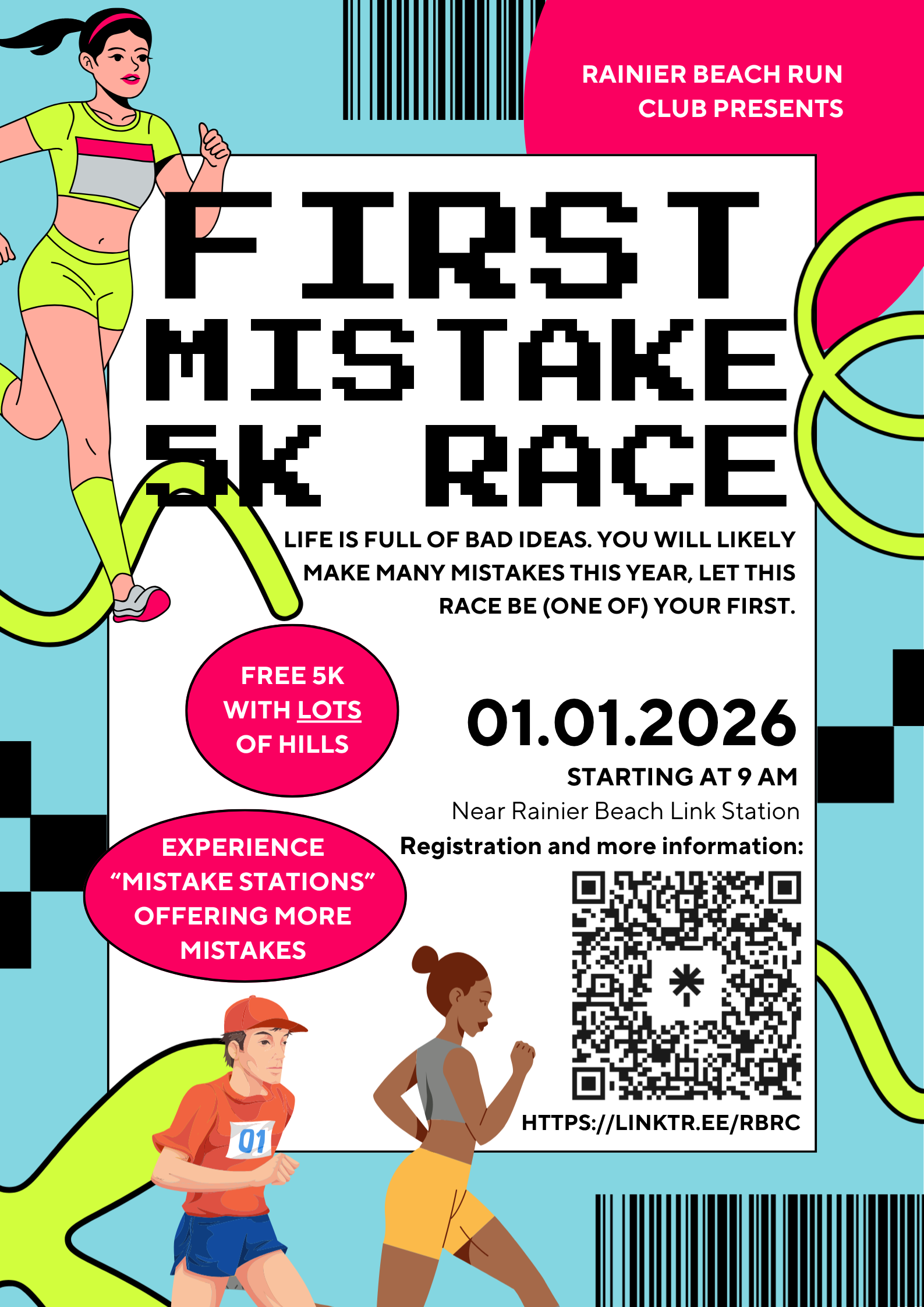
Second Annual First Mistake 5k

Last year we had a lot of fun with the First Mistake 5k. We had 40 runners, lots of hills, and four Mistake Station (including one bottle of Malört, free haircuts, and firefighters hosing us down). I wonder if we can do better this year. Registration details are below. If you’re interested in offering a Mistake Station, contact me to talk details. See you January 1.


Life is full of bad ideas. You will likely make many mistakes next year, let this race be (one of) your first. What could be better than a free race on Jan 1? Let’s check-off as many mistakes as possible now. You know that outfit you haven’t worn since high school? That would be perfect for this race. Maybe eat a big greasy breakfast 30 minutes before the start. Did you party hard on New Years Eve and go home with a stranger? Bring that mistake with you, especially if they aren’t a runner. It’s gonna be “That Kind of Fun”.

  • When: 9am on Jan 1, 2026
  • Where: Chief Sealth Trail at Henderson, just east of Rainier Beach Link Station
  • Route: 5k with 600′ vertical, map. Modified “Default Route” for those who know
  • Cost: Free (see “What to Bring” below)
  • Registration: Use this Fancy Form
  • Prizes: Yes, everyone gets a finisher metal (but no, not a medal… see “What to Bring” below)

What to Bring

Aside from the usual running gear and water, please bring a canned beverage. This can be soda, beer, coffee, wine, NA cocktail, sparkling water, or whatever. As long as it’s in a metal can and you can drink it, it’s perfect. All the cans will go into a cooler. When you cross the finish line, you get to pick out any remaining can as a prize. Congrats on your surviving first (and possibly second or third) mistake of the year.

Aid Stations

No, it’s not that kind of race. If you need water, snacks, or other things while running, you’ll want to bring them with you. There might be “Mistake Stations” along the course where runners are offered the opportunity to make more mistakes. Anyone want a tall glass of warm milk just before the worst hill climb? How about a haircut from a rando with a set of clippers? Chili pepper roulette? We’re still working on these. If you have ideas or want to set up a station, let us know.

Posted in Running | Tagged , , | 1 Comment

Ring and Other Metalwork

I learned to weld in shop class in 8th grade. Two years later, my new shop teacher showed me how to weld well. Working with middle schoolers now, I’m shocked that we ever let any of them near metalworking equipment but also very glad I had the opportunity to try. I’ve continued to weld and tinker around with metal for years.

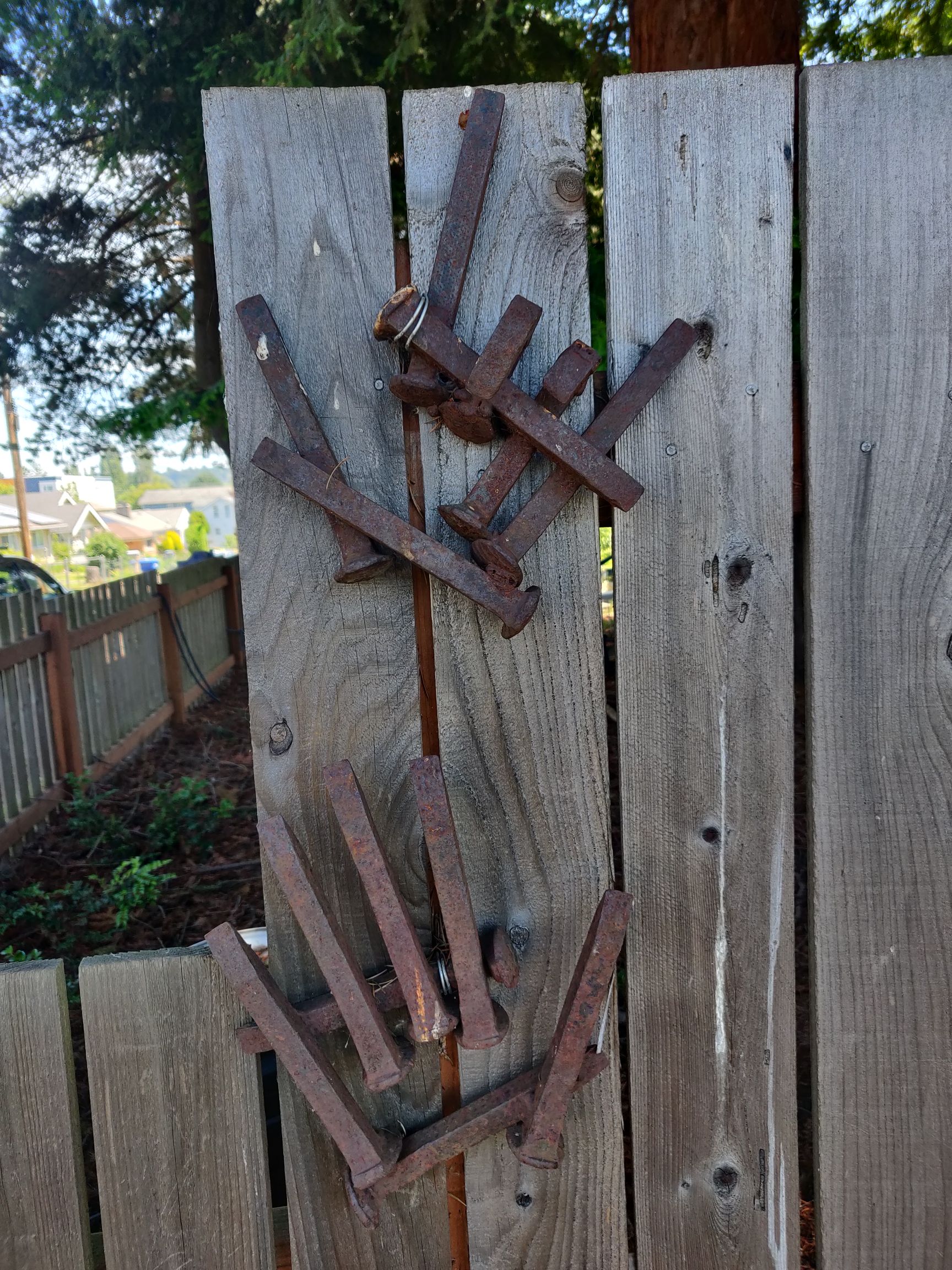
Back in college, several friends were very involved with our school’s art program and encouraged me to submit a piece for the student show. I got some railroad spikes (although thinking about it now, I’m not entirely sure how I got them…) and welded a few into a hand. I then took a few others to the milling machine in the physics lab to cut notches so I could bend them before welding them into an “I love you” hand.

In recent years, I’ve pulled out my oxy acetylene kit to create other interesting pieces to hang on our fence like my dragonfly and ladybug. Not everything requires heat. I also got a small spool of copper wire someone was throwing away and was able to cold work it into a bonsai tree.

When talking with friends about these different projects, I realized I haven’t ever written about my favorite piece which is much more delicate than the rebar pieces and more intricate than the bonsai.

Back in 2008, Dom and I had been together for seven years and I thought it might be time for something new. I talked with a local jeweler about some different designs he could make for an engagement ring. They all sounded amazing, but none felt quiet right. I asked for a week to think it over before making the final decision. When I came back, I was a little nervous about what he would say. I had decided what I most wanted to do was make the ring myself. I wanted to get fine metal wire and tie a Turk’s Head Knot. I was concerned he would be annoyed that I’d wasted his time. Instead he offered to order silver, white gold, and rose gold wire for me at cost, plus let me borrow some of his tools. When I finished it, he happily ran it through his ultrasonic cleaner and even gave me a box to put it it. In fact, he seemed almost as excited about the ring as I was.

Thankfully, Dom said yes and we definitely went back to Mike the Jeweler for our wedding rings which are unique as well, but that’s a different story.

Who are these young kids???

Looking back on a couple of decades of working metal, I’m still uncertain about why anyone would think that 7th and 8th grade students were mature enough to handle glowing hot metal, but given the right situation and proper safety protocols, I can certainly see the benefit. Those classes have clearly impacted my life. Now that I’m in a position to support middle school shop/technology education teachers, I’d be happy to work with any interested teacher to ensure we can safely allow students in the twenty-first century to have the same wonderful learning experience I had. In fact, I’ve already started at home with my daughter banging away on glowing metal from our home forge at the age of three.

Posted in Education, Maker | Tagged , , | Leave a comment

A Closed and Common Orbit

Title: A Closed and Common Orbit

Author: Becky Chambers

Completed: October 2025 (Full list of books)

Overview: After finishing The Long Way to a Small, Angry Planet, the first in the Wayfarers series, I assumed the second book would continue to follow the crew we met already. This was a different direction but very enjoyable. I enjoyed reading this on my phone in the brief moments between other activities.

The discussion about how to treat AI was interesting to think about but also clearly demonstrates just how far we are from achieving real artificial intelligence. Despite what promoters claim, there was no way to mistake ChatGPT for any of the AIs in this book except the frustrating “non-sentient” versions that barely helped the characters buy train tickets.

Looking forward to finding out which characters show up in the next book in the series during the interstitial moments that I no longer use to check social media.

Highlights:

  • Names are important, and if you pick your own, it should be something with meaning to you. That’s how modders go about it, anyway. Chosen names are kind of a big deal for us
  • ‘I’m so sorry to put you through all this trouble.’
    ‘Oh, no, this isn’t trouble. It’s gonna be work, yeah, but it’s not trouble.’
  • personal power generators, empty fuel drums, receivers and transmitters of all kinds. But likewise, there were lovingly tended strips of plantlife basking under sunlamps, and glowing fountains that glittered in the dark. There were sculptures made of scrap, smooth benches utilised by chatting friends and amorous couples, soft lighting fixtures that looked like the pet projects of individuals with disparate senses of style. There was nothing bureaucratic or single-minded about the public decor. This was a place built by many.
  • My pricing is . . . variable. Whatever it says on the package, or whatever I promised. Between you and me, I really don’t care how much things cost. As long as I have food in my belly and can buy dumb stuff to decorate my house with, it doesn’t matter whether people are paying me the same amount every time.
  • Your mind comes from your body. It’s born out of it. And yet, it’s a wholly independent thing. Even though the two are linked, there’s a disconnect. Your body does stuff without asking your mind about it, and your mind wants stuff that your body can’t always do. You know what I mean?’
    ‘Yes.’ Stars, did she ever.
    ‘So, tattooing . . . you’ve got a picture in your mind, then you put it on your body. You make a hazy imagining into a tangible part of you. Or, to flip it around, you want a reminder of something, so you put it on your body, where it’s a real, touchable thing. You see the thing on your body, you remember it in your mind, then you touch it on your body, you remember why you got it, what you were feeling then, and so on, and so on. It’s a re-enforcing circle. You’re reminded that all these separate pieces are part of the whole that comprises you.’ The Aeluon laughed at herself. ‘Or is that too fluffy?’
  • So much scrap. Scrap everywhere. Piles and piles and piles, on and on. How could anyone use this much stuff? And why would they get rid of it, if most of it just needed some fixing to be good?
  • The land on their side was where all the scrap went, and where all the factories were (there was more than just the one!). The land on the other side had cities. The cities were where the scrap came from. The people in the cities didn’t like scrap or think about it much, but they liked stuff, and since they didn’t talk to other Humans or species, they couldn’t get new stuff, or materials to make new stuff (they’d already used up everything they dug out of the ground, Owl said). If they wanted new stuff, they had to make it out of old stuff.
  • I love learning. I love history. But there’s history in everything. Every building, everybody you talk to. It’s not limited to libraries and museums. I think people who spend their lives in school forget that sometimes.
  • We live in a society, Sidra. Societies have rules.’
    ‘You break rules all the time.’
    ‘I break laws. That’s different. Social rules have their place. It’s how we all get along. It’s how we trust each other and work together’
  • How did Blue stay so patient? Sidra had wondered this often. Perhaps it was something in his genes, something his makers had written into his organic code. (Was it less admirable, then, if it was something inbuilt, rather than cultivated by conscious thought and effort?
Posted in Lit Review | Tagged , , , , | Leave a comment

Potholes and Pavements

Title: Potholes and Pavements: A Bumpy Ride on Britain’s National Cycle Network

Author: Laura Laker

Completed: October 2025 (Full list of books)

Overview: This book was harder for me to get through than many of the others about infrastructure and I’m not sure why. As shown by the highlights below, there were many pieces that I loved.

I realized early in the book that much of the work done to set up the National Cycle Network was underway while I lived there yet I knew nothing about it. My hope is that they can overcome many of the challenges Laura outlines and implement the suggested improvements before my next trip to the UK. I look forward to riding several of the routes and allowing my daughter explore with greater independence. I also hope the US can look at what is being done in the UK so we can get beyond the excuse that, “we’re not The Netherlands.”

Highlights:

  • the 2022 National Travel Survey found that in England 71% of all trips we made were less than five miles. You or I could cycle that in less than 30 minutes, saving money, and fitting in a bit of exercise and, dare I say it, joy, into our day.
  • Between half and three quarters of Brits want to cycle more, both for everyday trips and for fun, and polls say we support investment in everyday routes and leisure routes, even if it means taking road space from cars. The main reason we don’t cycle more is an understandable fear of sharing space with motor traffic.
  • In Leicester, one of the many cities to embrace the challenge, a mile per week of new main-road bike lanes were rolled out at their peak, at just over £29,000 per mile – a bargain basement price when you consider a trunk road comes in somewhere at around £1 billion per mile.
  • In the 1950s, cycling was a very normal means of transport in the UK: around a third of distance travelled was by bike, which was more than in the Netherlands at the time.
  • Pedestrians and cyclists were sidelined and, as motor vehicles were increasingly prioritised, traffic volumes grew, and walking and cycling felt less and less safe or appealing. Public transport was on the decline, too, and access to the streets – a public space – increasingly required access to a car.
  • The Green Cross Code was relaunched in 1978 with David Prowse, the actor who played Darth Vader in the original Star Wars films, instructing pedestrians on how not to get run down in the street. This is a trend that continues today in road safety campaigns that hand hi-vis jackets to children walking to school, but fail to tackle the driver behaviour that puts them at risk.
  • Around 75 men and women lay down in Bristol’s Castle Park, forming the spokes of an enormous wheel, with bicycles on kickstands sporting colourful balloons as its rim. Grimshaw later claimed this act was deemed so offensive to a nearby hotel that the council was persuaded to landscape the park to prevent it happening again.
  • ‘It’s easy to motivate people, really. You have to give them a challenge, don’t you?’
  • By the 2005 deadline there were a whopping 10,000 miles of designated routes. If their early work juggling funding, multiple construction projects and a far-flung workforce on a shoestring was impressive, this achievement was truly monumental. When the dust settled, they had raised £200 million for the work, more than quadrupling the original Lottery fund.
  • it links together ancient travelways, including Roman roads, canal towpaths, disused railway lines (including viaducts and tunnels) and drovers’ roads,’ with a handful of brand-new bridges now connecting them. Revived, once again these ancient travelways linked places and landscapes. They connected city, town and village dwellers with green space, artwork, history – and one another.
  • These barriers are mostly installed with the understandable purpose of keeping motorbikes off foot and cycle paths, but in doing so they keep anyone with a non-standard cycle out, including tricycles and cargo cycles that carry children or luggage, and some even require panniers or even less conveniently, a child seat to be removed. Sustrans’ barrier removal is a slow process and often landowners permit cycling and walking on the condition that anti-motorcycle barriers are installed, even though they may not comply with disability legislation.
  • At the entrance are some chunky metal pipes, bent into shapes to prevent motorbike access. Caroline says these were heating pipes discarded during the bulldozing of a local hospital and commandeered in typical John fashion. They went on to form a standard, albeit non-wheelchair-friendly, design across the network.
  • I’d say it’s the kind of morning that makes you glad to be alive, but every morning on the bike does that for me.
  • Following a growth in new cycle routes during the pandemic, the French government claimed there were now 50,000km of cycle routes – more than 18,000 miles more than Britain’s, albeit in a much larger geographical area. In early 2023 France pledged to spend €2 billion on cycle infrastructure and supporting measures over the following four years, with €250 million a year for bike routes alone, to double the cycle network by 2030 to 100,000km. Meanwhile, in Britain, cycling was still fighting for scraps.
  • Attempts to keep those on foot and cycles safe have, perversely, tended to focus on those least able to prevent the carnage: cyclists and pedestrians themselves. Perhaps unsurprisingly, these patchy initiatives encouraging the use of hi-vis, helmets and constant vigilance from anyone on foot or bike from childhood onward have not yielded the hoped-for improvements in road safety.
  • Cycling isn’t fundamentally a dangerous activity; it’s actually more dangerous not getting regular exercise, in terms of our health
  • Leaving university to join the police in 1999, by 2012 Andy had been promoted in record time to superintendent. Then a detective working on violent crime, his chief constable moved him to the role of ‘specialist operations’ in Northamptonshire police. This involved road policing and guns. Andy recalls saying, ‘I’ve never issued a traffic ticket, and I’ve never held a gun, so why on earth would I want to work there?’
  • In trials in Manchester and London, proving Andy’s point, updated collision reports increased the proportion of crashes in which speeding was a factor by three to four times. What was assumed to be the cause of around 250 deaths a year nationwide is now understood to kill somewhere between 750 and 1000 people each year. That’s the equivalent of my entire secondary school dying each year because of people breaking the speed limit. Speeding is, in fact, a factor in around half of all road deaths. There are now plans to roll this change out nationwide.
  • Even in the hardest cycling territory in the UK, 10% of people could commute by bike. In 2017, using census data and cycle journey planning tools, researchers from the universities of Leeds and Westminster developed the Propensity to Cycle Tool. They calculated a Dutch-style network of genuinely quiet roads and traffic-free paths could raise current cycling levels by five times their current 2%. With widespread e-cycle availability, it’s 17% – more than one in six. Across England, with both a network of safe cycle routes and widespread ebike availability, one in four commutes could be done by cycling.
  • the idea of cycling across Cornwall in a dress seems delightfully whimsical.
  • the case for roadbuilding is based on a flawed understanding of what happens when you widen roads. Increasing road capacity, it turns out, generates more car trips, first by making it easier to drive and secondly by squeezing out other options – surrounding roads get busier as more people drive, and cycling and walking feel increasingly dangerous. Add that to declining investment in public transport and you are left with few other options. This long-understood phenomenon is known as induced demand. It’s the same with new cycle routes: more and better increase cycle journeys. Ultimately, you get the users you build routes for.
  • Traffic engineers talk about something called design speed: how fast a road or route allows you to safely travel. These little lanes, which terrify American tourists, come with an optimistic default 60mph speed limit. While people take this as a target, the measured design speed can be far, far lower. Two drivers travelling at 60mph in opposite directions have a combined speed of 120mph, requiring a stopping distance of 400m – which means you need to see each other long before you both slam on the brakes. British lanes rarely allow for that kind of long view. In reality, engineers tell me, some of our most eccentric little lanes come with a design speed of more like 7mph.
  • Residents have told the council they want lower speed limits because they can’t walk to the shops, ride horses or cycle in safety when there’s fast traffic about, and because they want rid of the noise from speeding drivers.
  • Outside Chester station, Chris rides three sides of a long rectangle, the taxi drop-off route, to pull up at the kerb in front of me. When I chuckle, he says in explanation, ‘A single photo of me cycling the wrong way or on the pavement and I’d get Daily Mailed.’ A cycling gotcha is like catnip for some publications.
  • One pressing crisis is the cost of living, and cycling and walking are incredibly cost-effective – if there were safe routes, households could give up one or more vehicle. Each car we own, Chris points out, costs us roughly the same as a family holiday, every year. I know which I’d rather spend my money on.
  • In 2020, during the pandemic, councils up and down the country introduced planters on streets to prevent through-running traffic and enable social-distancing while people got out to exercise. While all addresses in LTNs are still accessible by car, reaching them might require a slightly longer drive. The idea is that by making cycling and walking more direct than driving you reduce short car trips and improve safety – and it seems to have worked. According to Lambeth Council, traffic on streets within the Streatham LTN decreased by 54%, while increasing 13% on boundary roads. It was a net reduction of 5% or 6100 vehicles in the area each day. The measures are now permanent.
  • Wheels for Wellbeing campaigns for disabled cyclists, both those who already cycle, those who would like to and those who don’t even know cycling is an option. As well as producing reports and research with national and international reach, the charity’s inclusive cycling hubs in south London loan out non-standard cycles so people can experience cycling for themselves and learn which cycle works for them. The charity’s national survey, published in 2021, found that for 64% of disabled cyclists cycling is easier than walking – and for 59% their cycle is their mobility aid. Of 245 survey respondents more than half (60%) used standard bicycles, 26% tricycles or recumbents, 16.6% cycles and 8.53% tandems. The challenge is to ensure the environment enables people to cycle, however they do it. ‘Cyclists dismount’ signs, steps, barriers and chicanes all hamper people like Isabelle.
  • The benefits of access to nature and physical exercise extend to everyone, and the mental health benefits are huge: research shows physical activity can cut depression rates by 30%. Cycling can also be a low-stress transport option, in the right circumstances. Isabelle says, ‘For some people in the middle of a mental health issue getting about can be stressful, but I’ve heard from people living with mental health issues who find they do not use public transport because that’s so stressful, but they get on their cycle: they are in control, they are not around other people, they can really get in the zone. That does amazing stuff for your soul.’
  • Subjectively, drivers seemed more aggressive towards cyclists following lockdowns and speeding rates increased dramatically on quieter roads – which disabled cyclists found particularly off-putting.
  • Unable to find the data himself, he wrote to schools across Wales to find out two thirds of primary children lived within a three-mile catchment area – or walking and cycling distance – making the case for better facilities enabling them to travel actively.
  • By 2019 the more than 100 miles of superhighways were carrying 248,500 miles of cycling journeys a day, with a single weekday peak of 29,000 cyclists. Half of users are women and 14% previously used a car. What’s more, cycling trips were surprisingly competitive over longer distances: analysis measured journey times along one seven-mile section of route, representing the average cycle superhighway trip length, and found ebike trips were just five minutes slower than driving and regular cycle trips 12 minutes slower.
  • Holidaymakers said after trying ebikes that they were tempted to buy one when they returned home. However, even though they’re far cheaper than a car, the cost is still daunting and, unlike in Europe, there are no purchase subsidies to help people switch to ebikes. According to a 2019 analysis, an ebike grant in the UK could be more than twice as effective at cutting CO2, per pound spent, as existing electric car grants. In France, ebike grants had a massive impact, increasing how much recipients cycled each year on average by seven times, from 200km to 1400km. People reduced their driving distances by 660km and CO2 output by 200kg each. Almost a third of users said they wouldn’t have bought an ebike without the grant. It also made cycling more equitable: while men make most cycling trips in France, ebike take-up was almost gender-equal (48% of grant beneficiaries were women).
  • The Celtic countries seem to be winning the human-powered transport race as I see it and Glasgow, like Cardiff, is at the pointy end. In 2018 the Scottish government doubled its active travel spending to £80 million. The plan is that by 2024 10% of Scotland’s devolved transport spend will go to cycling and walking, not just in cities but in rural areas. There’s also, rather boldly, the target to cut car journeys by 20% by 2030.
  • a Beithir, a mythological Scottish creature. Described as ‘the largest and most deadly kind of serpent’, it’s a water-dwelling dragon with a sting that could kill you unless you reach a body of water, say a canal, in time.
  • A reminder that Scotland is investing more than any other UK nation in cycling: £58 per person per year, versus £1 a year in England, £28 in Wales and around £7 in Northern Ireland.
  • women are less willing to share with traffic, or to use circuitous backstreet routes that introduce long detours. They need direct, safe routes. Because we don’t have many of those in the UK, for every one woman cycling there are currently three men. The pandemic quite suddenly emptied the roads of traffic and, hey presto, people got on their bikes in droves. One group the quiet roads and new safe cycle routes benefited was women – around the world the proportions of women cycling grew in response to a drop in traffic and billions of pounds’ investment in cycling.
  • When we rediscover it, we wonder why we ever lost it – this gift of freedom, this very pure joy that exists atop a bicycle. It’s one the car industry promises, with its slick and ever-present advertising, beguilingly comfortable cockpits and easy access to power, but, on freedom and joy, cars rarely deliver. The bicycle, humble in essence with, for the most part, few frills and gadgets, does the opposite: it delivers freedom and exhilaration by the armful, even on a gentle potter through the neighbourhood
  • These aren’t necessarily cyclists, per se – people who define themselves using the bicycle – they are people who happen to use bikes to get somewhere, to access the city.
  • For many of these journeys a motor vehicle, with all the expense and inconvenience of parking, isn’t the tool we need, it’s just the only one we happen to have. It wouldn’t take a lot to give ourselves other options; it’s actually very simple, even if it’s not necessarily easy.
  • While most of us are careful behind the wheel, plenty aren’t – with devastating consequences. A good network will design out most of the danger, but not all. Take the worst drivers off the road for good; introduce graded licensing for young drivers and use lifetime bans where appropriate. Speed limiting technology exists – we just need to deploy it and remove the ‘exceptional hardship’ clause that lets so many dangerous drivers off the hook.
Posted in Biking, Lit Review | Tagged , , , , | Leave a comment

Picks and Shovels

Title: Picks and Shovels

Author: Cory Doctorow

Completed: Sept 2025 (Full list of books)

Overview: This is the third book in the Martin Hench series and having read the first two earlier this summer, I moved onto this one. It took a minute to get into the first book, he really put a lot of “geek speak” into it seemingly to show his nerdy credentials, but after that, I really enjoyed it. This one jumps back to Marty’s going to college and getting his first couple of jobs building and working with computers. While telling his story, we learn about the real-world challenges things like non-compete agreements that impact more people today than in the fictional 1980’s when this takes place. Overall, it’s a fun bit of historical fiction that, more than anything else, has made me want to pull out the old Apple ][e, fire up the soldering iron, and see if I can get it working again.

Highlights:

  • It was my first experience with shutting up and listening to women who weren’t afraid to show me they were smarter than me. I am embarrassed that it took me nearly eighteen years to try it, but in my defense, many of my contemporaries never tried it.
  • Art washed, but otherwise, he looked like a homeless person (or a hacker)
  • Looking at someone else’s code was like looking under the rug where they swept their dirty secrets, because every programmer has eventually hit a wall where they can’t be bothered to find an elegant solution so they go for the brute-force treatment. It could certainly feel like the person whose creation you were wrestling with had it in for you, but it was almost always the case that they were just being frail and foolish human beings.
  • “What’s an array transformation?”
    Maria-Eva had been trying to explain this to her parents for weeks, to the point where they’d forbidden the subject at the dinner table, and so great was her relief at having a willing audience for this explanation that she forgot how angry she was at Sister Jean. The words poured out of her. Sister Jean’s curiosity turned briefly to skepticism, as if she was wondering if this was some kind of elaborate child’s fantasy, as though Maria-Eva had invented an imaginary zoo of mythological beasts and was now taking her through their care routines
  • Father Marek had sent a letter quoting Cardinal Ratzinger to all the sales reps, railing against the “Marxist myths” of liberation theology and calling on everyone in the company to be on the alert for “subversive elements” who “seek to destroy the free enterprise system that Fidelity Computing depended on and stood for.” It wasn’t as if Julia Inez, Fatima, and Juana Concepción had kept their politics a secret—how could they, when the minute they went off the clock for Fidelity Computing they went to work with community poverty groups?
  • that’s the interoperator’s advantage! You’ve got this Goliath that’s created an any-color-you-like-so-long-as-it’s-black policy on the whole nation, and that means that you can know exactly what’s out there and how you can plug into it. Every time the Bell System sells a standardized Western Digital phone, that’s another potential customer for a Carterfone
  • “Whereas I only found computer people. Sure. Art’s definitely getting the better end of this deal, I get it. But my point still stands: I love this town.”
    “And my point still stands: it won’t love you back. San Francisco has had gold rush after gold rush, and each one was a disaster. Nearly everyone went broke. The city was mobbed and everything the locals loved about it was destroyed. Sometimes it even burned down. They chopped down all the fucking redwoods. This gold rush won’t be any different, mark my words.”
Posted in Lit Review | Tagged , , , , , | Leave a comment

The Lost Subways of North America

Title: The Lost Subways of North America: A Cartographic Guide to the Past, Present, and What Might Have Been

Author: Jake Berman

Completed: August 2025 (Full list of books)

Overview: I’ve had one or two people tell me recently that I seem to be obsessed with public transit. Not sure I’d phrase it that way, but I do believe that many problem we currently face would be better (not completely solved but certainly better), if we relied more on transit and less on cars. This book describes how it once was in the US and Canada, why it changed, and how it might change again.

Living in Seattle, that chapter resonated most. He quoted the Seattle Weekly in 1983 discussing politics in the city as following “the usual Seattle process of seeking consensus through exhaustion,” which feels just as true today. We’re still using the same technique for projects like safety improvements along Lake Washington Boulevard. Perhaps some day we’ll be able to make a decision just because it’s the right thing to do, without having to wait until everyone is too exhausted to care any more.

Highlights:

  • Pacific Electric stood astride Southern California like a colossus, with over a thousand miles of electric rail service. And transportation wasn’t the only thing the Pacific Electric had its tentacles in—the Pacific Electric was also the largest real estate developer in Southern California. Towns kowtowed before the company to attract a station. One town, Pacific City, had even renamed itself Huntington Beach, after the Pacific Electric’s founder.
  • I had assumed that cars in Los Angeles were just a fact of life, like beaches, palm trees, and tacos. But that wasn’t the case at all. Gridlock was a choice that the people of Los Angeles had made.
  • San Francisco opened a municipal streetcar company to challenge its privately owned streetcar monopoly. The city-owned Municipal Railway ultimately outcompeted the privately owned Market Street Railway and bought it out.
  • Good mass transit should be fast, frequent, and reliable, and it should go where people want to go.
  • Subway, elevated, and metro all describe the same thing: an electric railway system that is fully separated from other traffic, like the New York Subway, the Chicago Elevated, and the Montreal Metro. They are the highest-capacity form of mass transit, but the most expensive to build.
  • Light rail is an electric railway system that has dedicated lanes or trackways. Stations average about every half mile in the urban center and about every mile outside city cores. Light rail systems still have some intersections with cross traffic. This makes light rail slower than subways, but cheaper to build.
  • Streetcars and trolleys are electric railway systems that provide local transportation. They run in normal traffic, stopping every few blocks.
  • A related technology is the electric trolleybus, an electric bus powered by streetcar-style overhead wire. Common in Europe, trolleybuses are rare in North America.
  • Busways, also known as bus rapid transit, are a hybrid between light rail and the humble city bus. A fully built busway system has dedicated lanes, ticket machines, dedicated platforms, and priority at traffic signals. When done well, like the G Line in Los Angeles, busways provide nearly as good service as light rail at a fraction of the cost.
  • Segregationists like Lester Maddox fought an urban rapid transit system tooth and nail, while Georgia threw billions of dollars into new expressways.
  • Between 1950 and 1980, greater Boston’s population growth rate was half the national average. Deindustrialization, the population exodus to the Sun Belt, and the invention of air conditioning all took their toll. The textile, leather, and clothing industries, which had been the backbone of Massachusetts’s economy for over a century, decamped for the South. By March 1976, Massachusetts’s unemployment rate was 38 percent higher than the national average.
  • the national economy was in the middle of a full-scale meltdown. The crash started when rope monopoly National Cordage Company and the giant Philadelphia & Reading Railroad became insolvent in early 1893.3 A chain reaction ensued, and a string of surprise bankruptcies hit every sector of the economy. Across the country, 575 banks failed.4 Unemployment skyrocketed from 4 percent in 1892 to 18 percent in 1894.
  • Yerkes departed Chicago, sold his transit empire, and moved to London. On arrival, he proceeded to play hardball with the English, using the same tactics he learned in Chicago to buy up failing companies that would become part of the London Underground.
  • In the early 2020s, the elevated Loop is still at capacity, as it has been for a century. The L has expanded minimally since the airport extensions reached O’Hare in 1984 and Midway in 1993. Downtown Chicago hasn’t gotten any new L lines since the Blue Line’s downtown subway was finished in 1951. All the same, L ridership increased by 70 percent in the pre-coronavirus decades.
  • Further complicating the situation, Cincinnati’s municipal government had decreed that the local streetcar network be built to nonstandard dimensions. The overwhelming majority of North American railways have a track gauge (i.e., the distance between the rails) set at 4 feet, 8.5 inches. Cincinnati required rails to be placed 5 feet, 2.5 inches apart. This decision was originally made to prevent steam trains from running on city streets, and it created a major dilemma for Cincinnati’s interurban companies.
  • Cincinnati conveniently had a derelict canal running through its downtown that was suitable for subway conversion. (Similar canal-to-subway conversions also occurred in Newark, New Jersey and Rochester, New York.) This reuse of the old canal bed meant that costs were expected to be much lower than in Boston and New York, where more extensive tunneling was needed.
  • Before it was shut down due to coronavirus, Cleveland’s light rail line, the Waterfront Line, carried so few passengers that the press dubbed it “the Ghost Train.”3 In 2016, 20 years after its opening, the Waterfront Line carried only 400 passengers per day, even with trains running every 15 minutes.
  • football-specific stadiums don’t see enough use to permit a surrounding entertainment district to develop. Excluding playoff games, NFL stadiums host only 10 home games a year, and other events are rare. In the first 17 years of its existence, Browns Stadium hosted only 33 ticketed non-football events—fewer than two a year. Few musicians, religious revivals, rodeos, and so on can fill a 70,000-seat stadium, especially in a midsized metropolis like Cleveland.
  • like other baseball-anchored neighborhoods such as Wrigleyville, Chicago, and Fenway, Boston. Visitors are encouraged to take transit and enjoy the neighborhood before games, compared to Cleveland’s culture of driving in and tailgating in a parking lot. In a sense, this creates a self-reinforcing loop. Cleveland favors suburban drivers with its infrastructure, so more people drive. San Francisco favors pedestrians and transit, so more people walk or take the train.
  • it’s not legal to build homes, like it was in the old days.3 The solitary apartment building under construction near Parker Road had to get a special variance from the Plano City Council. This variance took years to wind its way through the bureaucracy. The nearest place where it’s legal to build housing without special dispensation is three-quarters of a mile away on foot. There’s just no convenient way to take the train without driving or transferring from a bus.
  • Metro Detroit’s transit system reflected the toxicity of this relationship. Although 67 percent of city residents work outside the city, and 75 percent of workers in the city live in the suburbs, most suburban buses weren’t allowed to stop in the city as late as the mid-2010s.6
  • In the 1969 election, the law-and-order candidate, former Wayne County sheriff Roman Gribbs, was elected mayor. As mayor, Gribbs promptly brought the hammer down, creating a secret, elite undercover police unit called STRESS (Stop the Robberies, Enjoy Safe Streets) to reduce street crime. STRESS officers wandered around what were considered dangerous areas posing as old ladies, alcoholics, priests, and other easy targets. When an alleged mugger appeared, supporting units pounced. STRESS operations routinely ended in violence. Between 1971 and the unit’s disbandment in 1974, STRESS officers shot and killed 22 civilians, the vast majority black men. STRESS was popular among whites and detested by blacks. Crime rates kept rising.
  • In 1975, when asked by the New York Times about the potential long-term consequences of sprawl, Mayor Fred Hofheinz remarked simply, “Houston is a very growth-oriented city, and there is very little opposition to that proposition.” By 2020, 2.3 million people lived inside the 640-square-mile city limits, making it one-third as dense as Chicago and half as dense as Los Angeles.
  • ample supply of housing also means that Houston’s gentrification is slower than other wealthy cities. With the abundance of housing options, affluent Houstonians tend to move to existing prosperous neighborhoods. In cities like Los Angeles, those same types of families tend to move to more marginal neighborhoods and price out the working classes. The average Los Angeles house costs 3.6 times what it does in Houston.
  • Beverly Hills’ population at the 1970 census was 33,416, and by 1990, it had shrunk to 31,971. Santa Monica shrank from 88,289 to 86,905. These new housing supply restrictions caused home prices to skyrocket. Increased property values meant higher property taxes. In previous eras of development, homeowners who couldn’t afford their taxes would sell to apartment developers and pocket the cash. But 1970s homeowners wanted both high home values and low property taxes. A man named Howard Jarvis tapped into that desire.
  • As of 2020, greater Los Angeles covered an area twice the size of Switzerland.
  • there was only one place in North America where a relatively healthy streetcar system fell victim to a conspiracy. That place was the Twin Cities: Minneapolis and St. Paul (fig. 11.1). The Twin City Rapid Transit Company was a national model for how to run a transit system until a Wall Street financier, a crooked lawyer, and the Minneapolis mob came along and stripped it for parts. High-capacity rail transit wouldn’t return to the Twin Cities until the 21st century.
  • Nine days after the Metro opened, Montrealers went to the polls. Drapeau won reelection with 94 percent of the vote.
  • mix of geographical accident and traditional dominance allowed New Orleans to retain its unique culture and historical continuity. It’s not for nothing that the famed St. Charles streetcar line has been running continuously since Andrew Jackson was president. Even when the rest of the continent was busy tearing out streetcar tracks, the St. Charles streetcar survived without much fuss.
  • All lines were converted to use electric power in the 1890s after abortive experiments with mechanical cables, superheated water, and ammonia-powered locomotives. From the 1920s onward, all streetcars were run by New Orleans Public Service Inc. (NOPSI), the local electric company.
  • Generally speaking, light rail and streetcar lines use similar equipment.15 The differences between the two are in operational procedures. To provide fast, high-capacity service, the best practice is to provide the trains dedicated lanes, run multiple-car trains, sell tickets to passengers before they board, give trains priority at intersections, and build stops every half mile or so when operating in dense areas. This exploits rail’s largest advantage: the ability to move large numbers of people quickly.
  • By 1975, the economy was stagnant, inflation was high, and the city government was in the middle of a fiscal crisis. With the city in danger of defaulting on its debts, Mayor Abe Beame ordered Second Avenue Subway construction to halt in September 1975. The next month, the city had to be saved from insolvency by the city teachers union’s pension fund.
  • Ideally, mass transit should do four things. One, it should be frequent; two, it should be fast; three, it should be reliable; and four, it should go where people want to go. The choice of technology matters somewhat, but only to the extent that one picks an appropriate tool for the job.
  • The average horse pulling a horsecar had a life expectancy of two years.
  • MTA board committed to building the full 10-mile line in 2000. Twenty-two years later, only 1.8 miles of two-track subway is complete. The cost has been $2.5 billion per mile, making it the most expensive piece of subway in the world.17 Per mile, New York paid two and half times what Los Angeles pays, six times what Tokyo pays, and 14 times what Milan pays.18 The challenges of building subways in New York City are not technological compared to these other cities. Los Angeles has earthquakes. Tokyo has earthquakes and is very densely populated. Milan is 2,500 years old, introducing archaeological and geological complexity. Rather, the challenges of building new subways relate to the MTA’s competence as an institution.
  • There’s a German saying in transportation planning that a transit operator’s order of priorities should be Organisation vor Elektronik vor Beton, or organization before electronics before concrete. That is, the most important factor in running effective mass transit is the bread and butter of everyday transit operations, rather than state-of-the-art technology. Building new physical infrastructure should be a last resort. Many public transport agencies and the politicians who oversee them don’t think this way.
  • After the demise of Seattle’s prewar streetcar and cable car system, plans to build a rapid transit network stalled for half a century. In part, these plans fell through because Seattle’s political culture puts a premium on consensus, letting the perfect become the enemy of the good.
  • After this second failure, the federal government pulled its funding commitment. The money earmarked for Seattle would go to Atlanta. Atlanta used the money to build the MARTA subway.
  • But by 1983, endless deliberations and public consultations had become so well established that the Seattle Weekly coined a name for it: “the usual Seattle process of seeking consensus through exhaustion.”
  • On paper, this is a nation-leading expansion of transit, but its sheer slowness is telling. There’s little reason to believe that timelines or budgets will be met, given the Seattle Process and the region’s history of persistent planning delays.
  • Toronto politicians realized that that the coming postwar influx of automobiles would choke the city in car traffic. (Unusually, Toronto kept its streetcar network after World War II, because the TTC decided to buy lightly used streetcars secondhand from cities that were closing their systems.)
  • Since its inception, SkyTrain has expanded steadily over the past three and a half decades, and it is very popular among Vancouverites
  • SkyTrain is practically a unicorn among North American metro systems, because it’s an elevated that nearly everybody likes.
  • it appears likely that these land use reforms, coupled with large simultaneous investments in local rapid transit, will lead to a resurgence of traditional, walkable cities. The more tricky question is how to make this transition go faster. Improving transit and building urban infill is often a painful slog in the early 21st century. Examples are everywhere in this book. New York approved the Second Avenue Subway in 2000. It took 17 years to complete its 1.8 mile first phase. The predecessor to Toronto’s Ontario Line has been a political football since the 1980s, and the line won’t be complete until 2031. Low-cost reforms to improve transit service often fall by the wayside, as with Philadelphia’s Regional Rail. Infill, especially in wealthy cities, commonly faces prolonged timelines and persistent delays, as in Los Angeles and San Francisco. But things don’t have to be like this.
  • Today’s slow, bureaucratic approach to urban growth was not always normal. After all, New York City’s first subway line was approved in 1899, and it opened to the public five years later. The Montreal Metro was approved in 1960, and the initial system was fully operational six years later.
Posted in Lit Review | Tagged , , , , | 1 Comment

The Long Way to a Small, Angry Planet

Title: The Long Way to a Small, Angry Planet

Author: Becky Chambers

Completed: August 2025 (Full list of books)

Overview: A few years ago I came across A Psalm for the Wild Built. I don’t remember how I found it, but I loved Becky’s writing. The second book in that series came out a few months later and I tore through it. Just looking at the titles, her other writing never seemed to interest me. I finally got around to reading the first in her Wayfarers series and loved it.

The story explores aspects of living in a multi-species society without glossing over or minimizing the differences like many popular sci-fi books and movies (thinking specifically of Star Trek, but other also tend to be set in post-xenophobic periods). It feels relevant as we experience xenophobia limited single-species society currently.

Overall, there are fewer highlights from this than I thought as I was going through it. The one about “modders” stuck with me enough that I felt I should go back to find it again and highlight it. When I eventually found it again a few days later, I realized that I had highlighted it the first time.

Highlights:

  • Feels good to be off that pod, doesn’t it?’
    ‘You have no idea.’
    ‘True. But then, you don’t know how good it feels to have your memory banks recalibrated.’
    Rosemary considered this. ‘You’re right, I don’t.’
  • On some level, Ashby could understand how Port Coriol might be a little jarring to someone accustomed to the glossy prefab trade centres you could find throughout the GC, each as sterile and uniform as the other. The markets of the Port were anything but corporate, and the colony’s independent, anything-goes attitude was exactly what made it so beloved – or, to some, rather unsavoury. Ashby conceded that the Port was a little dirty, a little scuffed round the edges. But dangerous? Hardly
    • I feel this often comes up that people equate dirty with unsafe
  • ‘I know, I know,’ Nib said with a shrug. ‘But we still have to go through the process of objectively disproving the claim. That’s our job.’
    ‘Why would people go to all the trouble of trying to prove something like that?’ Kizzy asked.
    ‘Because they’re idiots,’
  • People would choose names for themselves that they only used within a network. Sometimes that name became so much a part of who they were that even their friends out in the real world started using it. For some folks, those names became their whole identity. Their true identity, even. Now, modders, modders don’t care about anything as much as individual freedom. They say that nobody can define you but you. So when Bear gave himself a new arm, he didn’t do it because he didn’t like the body he was born in, but because he felt that new arm fit him better. Tweaking your body, it’s all about trying to make your physical self fit with who you are inside. Not that you have to tweak to get that feeling. Like me, I like to decorate myself, but my body already fits with who I am. But some modders, they’ll keep changing themselves their entire lives. And it doesn’t always work out. Sometimes they seriously mess themselves up. But that’s the risk you take in trying to be more than the little box you’re born into. Change is always dangerous.’ He tapped her arm. ‘You’re Rosemary Harper. You chose that name because the old one didn’t fit any more. So you had to break a few laws to do it. Big fucking deal. Life isn’t fair, and laws usually aren’t, either. You did what you had to do. I get that
    • So many people modify their appearance to look more like how they see themselves even today without electronic modifications. This feels like a reasonable extension from where we are today
  • She smirked. ‘I’ll never understand how the rest of you expect brand new adults to be able to teach kids how to be people.’
  • Still, perhaps it was better that way. If she stopped caring about her hatch family, being away wouldn’t hurt, but cutting those ties was unimaginable. Besides, without leaving, she never would’ve met all the friends she’d made elsewhere. Perhaps the ache of homesickness was a fair price to pay for having so many good people in her life.
  • The Quelin had huge caches of natural resources at their disposal, and had been originally brought into the GC by the Harmagians, who had plenty of money and fancy tech to offer in exchange. Not that the Quelin and the Harmagians actually liked each other. It was funny how the potential for profit always seemed to trump antipathy
Posted in Lit Review | Tagged , , , , | Leave a comment