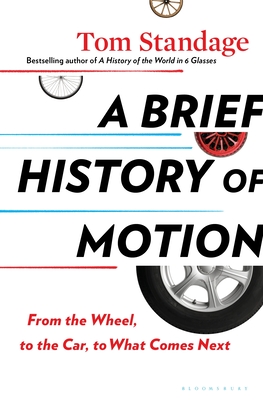
A Brief History of Motion

Title: A Brief History of Motion

Author: Tom Standage

Completed: Dec 2021 (Full list of books)

Overview: Last book of 2021 and first book after transferring my book notes over to my public website. I enjoyed the way this book complimented many of the topics from Strong Towns and showed how close we were on several occasions to having either a car-free society or cars that ran on something other than fossil fuels. Overall it was a good read. I’ve also read “A History of the World in 6 Glasses” by the same author. He does a good job telling stories but sometimes the stories jump from one point to another with seemingly little connection. Still a fun tale.

Highlights:

  • The Horseless Age, a magazine founded in 1895 to champion the new technology, proudly declared that “in cities and in towns the noise and clatter of the streets will be reduced,” because of cars’ rubber tires—yet it is still difficult today to hear yourself think on Broadway. The average speed of cars in central London today is 8 mph, the same as it was for a horse-drawn carriage in the 1890s, belying predictions that cars, taking up less space on the road, would reduce congestion. Road accidents are a major cause of death and injury worldwide. Huge areas of land are devoted to parking, even as cars sit unused, on average, 95 percent of the time—making cities as much dormitories for cars as habitats for people.
  • Their cultural significance is apparent from the appearance of “wagon graves,” which have a wheel buried in each corner, so that the grave itself forms a kind of wagon, carrying its occupant into the afterlife. Such graves first appear on the Black Sea plains around 3300 B.C.E. The distinctive tradition of wagon nomadism in this region persisted for thousands of years; it is mentioned by the Greek historian Herodotus in the fifth century B.C.E., was adopted by the Mongols in the thirteenth century C.E., and survived into the modern era.
  • On the Via di Nola, for example, one of the city’s main thoroughfares, 89 percent of the wear marks are associated with right-side driving. Visual depictions of Roman funeral processions and chariot races, on funerary urns and in mosaics, also indicate a preference for driving on the right. This preference may have been practical in nature. Most people are right-handed, and when driving a cart or wagon being pulled by two or four horses, a right-handed person will prefer to sit on the left-hand side of the vehicle, or on the rearmost, left-hand horse, to be able to reach all the animals with a whip held in the right hand. And when sitting on the left, it is easier to drive on the right because it puts the driver close to the center of the road, providing better visibility of oncoming traffic and of vehicles passing on the other side of the road. For the Romans, right-side driving also had positive religious connotations. They likened life to a forked path where the virtuous choice was always on the right, and when entering temples and other buildings, they tried to ensure that their right foot was the first to cross the threshold.
  • American standard gauge (4 feet 8.5 inches, or 1.43 meters) does closely match the average Roman gauge (derived from wheel ruts) of 1.4 meters. But ever since the first wheeled vehicles emerged, their gauge has been consistent, falling in the range of 1.3 to 1.6 meters, with an average of 1.45 meters.
  • Facing the threat of the expanding Ottoman Empire, Hungarian commanders adopted a new tactic: arranging wagons on the battlefield in a ring and chaining them together to form a wagon fort, a mobile defensive fortification that could resist cavalry charges. The wagons, equipped with gunports, also acted as protected platforms from which men could fire a small cannon or an early form of gun called an arquebus. This cutting-edge combination of wagons and gunpowder weapons made armored knights on horseback look suddenly old-fashioned. And that may explain why men across Europe decided that riding in fancy wagons was not so embarrassing after all—provided they were referred to as coaches, a name borrowed from the country where this new idea had emerged.
  • experiments starting in the 1780s, John McAdam, a Scottish engineer, refined this approach with his proposal that roads be surfaced using small, sharp-edged stones made from crushed rock, rather than rounded pebbles. The straight edges of these small stones caused them to pack together more tightly as vehicles passed over them, rather than being scattered. McAdam’s approach, which became known as a macadam surface, was formally adopted in Britain in the 1820s and spread to other countries. (The treatment of macadam surfaces with tar, patented in 1902, led to the word tarmac.)
  • As its name indicates, the omnibus was open to all. It became a symbol of democracy, with good reason. Though omnibuses were mostly used by middle-class riders, some cities introduced subsidies to extend access to the poorest workers. Those who took advantage of these cut-price or “commuted” fares became known as commuters.
  • Railways had made possible the transport of people and goods at unprecedented speeds. But rather than liberating cities from their dependence on horses, they increased it.
  • unlike trains, which offered high-speed travel subject to a strict timetable and between fixed points, bicycles could go anywhere. Granting riders unprecedented autonomy and freedom, bicycles came to be seen as agents of wider social change. This was not simply because women cyclists challenged the impracticality of Victorian clothing and took to wearing trousers or bloomers instead. Beloved of suffragettes and socialists, bicycles became more broadly associated with personal emancipation and social progress. American civil rights campaigner Susan B. Anthony declared that the bicycle had “done more to emancipate women than anything else in the world. I stand and rejoice every time I see a woman ride by on a wheel. It gives woman a feeling of freedom and self-reliance.”
  • there were concerns that frequent cycling would lead to the development of “bicycle face,” a deformation of the features, or “cyclemania,” an unhealthy obsession with cycling at speed. Scandalized Victorians also worried that cycling made women infertile, loosened their morals, led them to develop overly masculine musculature, and generally threatened the natural order of things.
  • In a speech in 1906, Woodrow Wilson, then president of Princeton University, worried that loutish motorists were fanning the flames of resentment toward the rich: “Nothing has spread socialistic feeling in this country more than the use of automobiles. To the countryman they are a picture of arrogance of wealth with all its independence and carelessness.”
  • In 1908 Octave Mirbeau, a French writer, satirized such complaints from motorists: “How frustrating, how thoroughly disheartening it is that these pigheaded, obstructive villagers, whose hens, dogs and sometimes children I mow down, fail to appreciate that I represent Progress and universal happiness. I intend to bring them these benefits in spite of themselves, even if they don’t live to enjoy them!”
  • from 1914 Ford paid $5 for an eight-hour day, about double the industry’s going rate. Strange as it may seem, paying higher wages was yet another way of cutting costs and improving efficiency. In 1913, the year before the $5 wage was introduced, 71 percent of Ford’s new hires had left within five days. Paying higher wages reduced employee turnover, and hence the amount of time needed for training. Ford claimed that “the payment of five dollars a day for an eight-hour day was one of the finest cost-cutting moves we ever made.”
  • GM became the world’s largest company altogether. At its height it accounted for more than half of America’s automobile market, and more than 10 percent of its national economy—making it far bigger, in comparative terms, than any technology giant today.
  • The first traffic light was installed on Westminster Bridge in London in 1868, to improve the safety of pedestrians. John Peake Knight, a railway engineer, invented a set of semaphore arms, mounted on a tall post on the bridge, that could be raised and lowered manually by a policeman. Raised arms meant vehicles and horses had to stop “to allow the passage of Persons on Foot”; lowered arms meant vehicles and horses should exercise caution and “pass over the Crossing with care, and due regard to the safety of Foot Passengers.” Crucially, the arms were accompanied by colored gaslights for visibility at night: red for “stop,” and green for “caution”—the standard colors that had been adopted for signaling on railways in the 1840s (along with white for “all clear”). This pioneering traffic light did not last long, however. Less than a month after its installation, a gas leak caused it to explode, injuring the policeman operating it, and it was removed soon afterward.
  • In a speech to a medical conference in 1937, a leading German surgeon, Martin Kirschner, argued against the reimposition of speed limits. Even though he admitted such measures would save many lives, he maintained that impeding the progress of the automobile would threaten “our societal relations, our wealth, our industry, our agriculture, the ability to defend ourselves, our international standing, in short, of our whole civilization and culture.” Instead, he argued, he and his colleagues should focus on developing new approaches to trauma surgery as a way to reduce the death toll. This indicates the extent to which the adoption of the car, and the resulting danger posed to life and limb, had already come to be seen as an unfortunate but inevitable fact of life—an attitude that still prevails today.
  • Oslo raised parking charges and tolls to enter the city, established car-free zones around schools, and shifted some city-center deliveries from vans to electric cargo bikes.
  • Officials in Oslo talk of cars being treated as “guests” or “visitors, rather than owning the streets.” Cars are not banned entirely, but drivers crawling through the city center are made to feel like interlopers.
  • Perhaps the most striking example of the shared-space philosophy is in the Dutch town of Noordlaren, where a primary school was adjacent to a road where drivers tended to speed. The wall between the playground and the road was removed, and the playground was extended across the road, forcing cars to drive (carefully) through the middle of it. Amazingly, this eliminated speeding without causing any accidents.
  • This half-hour commuting distance may sound arbitrary, but an analysis of urban layouts by Cesare Marchetti, an Italian physicist, suggests that one hour is, on average, how long people are willing to spend traveling to and from work each day and has been for centuries. (Some people’s commutes are much shorter or longer; this is an average across a whole city’s population.) Marchetti suggested that this time limit defined the size of cities. No ancient walled cities, he found, had a diameter greater than three miles, so assuming a speed of 3 mph, walking to the center from the edge of such a city, or back again, took no more than half an hour. Faster means of transport, starting with horsecars, let cities expand as this half-hour average travel budget allowed people to go farther. Marchetti’s analysis found that the city of Berlin increased in size precisely in accordance with improvements to the speed of transport. Before 1800 its radius was about 1.5 miles, and as faster means of transport were introduced, starting with horsecars and streetcars, its radius expanded in direct proportion to their speed.
  • It is true that a GM-backed company bought some streetcar operators that were later shut down, but it did so only when the decline of streetcars was already a foregone conclusion, with the aim of ensuring the operators would switch to GM-built buses.
  • America’s highway-construction boom came to an end in the 1970s, as opposition mounted and the notion of “induced demand”—the realization that new road capacity attracts more cars—became more widely known and accepted, under the mantra “you can’t build your way out of congestion.”
  • A study published in 2014 analyzed the density, connectivity, and layout of street networks in twenty-four California cities and related them to local health outcomes. It found that more compact and connected street networks, which promote walking and cycling, were associated with lower levels of obesity, diabetes, and heart disease. Other studies have found that Americans who live in “walkable” neighborhoods weigh, on average, six to ten pounds less than those in less walkable neighborhoods.
  • winding suburban streets that are meant to reduce speeds and improve safety, meanwhile, seem to have the opposite effect. Curves encourage faster driving than right-angled turns, and wide streets with houses set far back give drivers a sense of space that also encourages them to accelerate. The most dangerous areas for pedestrians, according to the Centers for Disease Control and Prevention (CDC), are no longer downtown streets but “newer, sprawling, southern and western communities where transportation systems are more focused on the automobile.” In short, suburbs.
  • in his 1925 book, The Revolution of Modern Youth. Advice on dating etiquette abounded in magazine columns; dating many partners was a way to demonstrate one’s popularity, and opting out of this contest by going steady with a single partner was frowned upon.
  • In 1897 the bestselling car in the United States was an electric vehicle: the Pope Manufacturing Company’s Columbia. Electric models were outselling both steam- and gasoline-powered ones.
  • in 1862 a tax on alcohol of $2.08 per gallon was introduced to fund the Civil War. This tax was intended to apply to beverage alcohol, but there was no exemption for alcohol produced for use as fuel. As a result, another hydrocarbon product—kerosene derived from crude oil—became the dominant fuel for lighting almost overnight, and many of the small distilleries that had produced fuel alcohol went out of business. The tax on alcohol was left in place after the Civil War as a temperance measure.
  • American engineers also concluded that alcohol was the most promising substitute for gasoline. “This fuel, far from being controlled by a monopoly, is the product of the tillers of the soil,” noted the Horseless Age with approval. Government agencies agreed: alcohol could potentially create a valuable new market for American farmers, by allowing them, in effect, to produce feed for cars instead of horses. Furthermore, noted Motor magazine in 1904, alcohol “is much cleaner, less odorous, and freer from danger of explosion” than gasoline.
  • in America, all efforts to exempt such “denatured” alcohol, or to repeal the excise altogether, starting in the 1880s, had failed. In part this was because Standard Oil and its allies, keen to protect their own sales, argued that a repeal would cause an increase in drunkenness.
  • One GM researcher concluded that alcohol was the “most direct route … for converting energy from its source, the sun, into a material that is suitable for a fuel.”
  • Cars offering rides in this way came to be known as jitneys, after a slang term for the nickel. Some drivers picked up a few riders while driving to or from their places of work. But an economic slowdown, which had begun in 1913, made operating a jitney an attractive option for those who had lost their job but owned a car and wanted a quick way to make a little money.
  • Technology is neither good nor bad; nor is it neutral. —Melvin Kranzberg, American Historian
  • In America the proportion of the population with a driving license declined between 2011 and 2014, across all age groups. Young people are either qualifying to drive at a later age or not doing so at all. Since the 1980s, the proportion of Americans with a license has fallen from 46 percent to 25 percent among sixteen-year-olds, 80 percent to 60 percent among eighteen-year-olds, and 92 percent to 77 percent among those aged twenty to twenty-four, according to researchers at the University of Michigan. Young people are also qualifying to drive later than they used to in Britain, Canada, France, Norway, South Korea, and Sweden. Even in car-loving Germany, the share of young households without cars increased from 20 percent to 28 percent between 1998 and 2008.
Posted in Lit Review | Tagged | Leave a comment

First month of fermenting

Well, we’re now a little over a month into my Year of Fermenting and so far, it’s been going great. We’re starting to sample some of what we’ve made, we’re coming up with plenty of ideas to keep trying throughout the year, and (so far) only one cupboard in the kitchen stinks… and as long as we don’t open the cupboard door, you can’t really notice. So at this point, I wanted to take a minute to reflect on what we’ve attempted and how it’s gone.

First up was a Brown Ale brewed on New Years Eve with the yeast pitched just after midnight (I wanted to start the year in correct mindset). I brewed a brown ale and someone suggested adding hazelnuts to make a Rogue Hazelnut Brown Nectar clone. I sounded good so I looked around to see what others had tried and found that most people throw in a small amount of “hazelnut flavoring” when they keg it. The next time I was at the store, I wandered down the coffee isle and noticed hazelnut flavored syrup which it turns out is not what they meant by hazelnut flavoring. Oh well. I added a little to the keg before realizing what I’d done wrong then decided to just add a little syrup to each glass when filling pints. Turns out, I like the brown ale, but I’m not a huge fan of the hazelnut so I’ll call this ferment a success with a lucky accident.

Next up, I tried rice beer made with some qu balls we got a year ago at a local Asian market. I steamed some sticky rice, waited for it to cool and added a crushed qu ball. There didn’t seem to be enough liquid so I added a bit of water and eventually the rice started to break down and ferment. One site I saw recommended blending the rice and liquid once fermentation finished so I tried it… Not an approach I’ll try again. Still a pretty good drink but the small amount of rice-free beverage that floats to the top is definitely the best part.

After making a tasty ginger beer, I decided I needed to try something that wasn’t a beverage. We got some serrano peppers and decided to make hot sauce. I used the same technique I’ve used for kimchi (add the peppers and garlic to a jar with salt equal to 2% of their weight and mash it until enough liquid comes out to cover the peppers). It smelled so good while it was fermenting. I kept getting a hint of the peppers and wanting to eat them all. After about two weeks, I blended it all. It was a little too thick to pour so I added some cider vinegar. I’ve been putting it on everything recently and really love the flavor. Next time I’ll skip the vinegar and serve it with a spoon. The vinegar just dilutes the flavor a bit.

We’ve never been big fans of cauliflower in this house. It’s ok, but the only time we usually get it is in the fall to make cauliflower/garlic mash (like mashed potatoes). Well, a few weeks ago our veg box arrived with cauliflower which then sat in the fridge for a week or two. Finally I decided we weren’t going to use it for anything else so I might as well try lacto-fermenting it. I made one large jar with cauliflower, garlic, peppercorns and 3% brine, plus one smaller jar that also had some scotch bonnet powder and Korean chili flakes. They both fermented for a little over a week. We’ve been eating them for less that a week and both jars are almost empty. Cauliflower is on our list for the next veg box.

Finally, I wanted to try something with a longer ferment. I found several different techniques for fermented tofu. Some significantly stinkier than others. I went with a less smelly version and have had it going for about three weeks. From what I understand, after about four weeks, it will have the flavor and consistency of a soft cheese. I can’t wait to try it.

I’ve got many ideas for other fermentation experiments but I’m open to other ideas. Any suggestions for what to ferment next month?

Posted in Cooking | Tagged , , , | Leave a comment

Ferments of 2021

For several years now, I have challenged myself to do something all year. I’ve done a year of running (twice), one of biking/not driving, and one year of getting into open water once a week. This year, I’m trying something different. I recently got more into fermentation so I want to make a new ferment every week of 2021. It might be beer or kimchi or vinegar or ??? The only rules (so far) are that I can’t count the same recipe twice and it must ferment for at least 48 hours. Below is a list of what I’ve fermented so far and I will continue to update it so I have a central location to track my progress.

  • Week 1 – Dec 28 to Jan 3: Hazelnut Brown Ale – Brewed Dec 31 and pitched just in time for the start of the new year. It was racked on 12-Jan and should be ready by the end of the month.
  • Week 2 – Jan 4 to Jan 10: Sweet Rice Qu – Steamed sweet rice with a Chinese yeast ball or qu thrown in. After a few days, it was still too dry so I added more water. A week into the fermentation, the rice started to breakdown, release water, and start bubbling.
  • Week 3 – Jan 11 to Jan 17: Ginger Beer – Grated 8oz ginger into one gallon of water and boiled for 15 minutes. After flame-out, I added one more gallon of cold water and strained it onto three cups of turbinado sugar. Once cool, I pitched 4oz of ginger beer we made with ginger bug.
  • Week 4 – Jan 18 to Jan 24: Lacto Tofu – Put cubed tofu into 1 qt jar. Added Korean pepper flakes, sesame oil and salt. Filled jar with water and a splash of juice from previous kimchi batch
  • Week 5 – Jan 25 to Jan 31: Serrano/Garlic Hot Sauce – Sliced serranos and garlic into a mason jar with 2% salt (by weight). Crushed the mixture with a muddler until enough juice comes out to cover the mixture. Also, I’m using a Fermentation Spring & Lid. These make it so easy to keep everything submerged.
  • Week 6 – Feb 1 to Feb 7: Lacto Cauliflower – Mix cauliflower with whole garlic and whole peppercorns. Ferment for a week in 3% salt brine. Also made a smaller batch with scotch bonnet powder and Korean chili flakes (kimchi-style?).
  • Week 7 – Feb 8 to Feb 14: Kimchi – Purple cabbage, carrots, onion, rainbow radish
  • Week 8 – Feb 15 to Feb 21: ESB – Time for another beer. This one will be the first I try to put some into cask-style containers for true British beer
  • Week 9 – Feb 22 to Feb 28: Habanero hot sauce – Got a pound of habaneros decided to make two sauces. About 3/8 lb plus 1 apple and 1 lemon. The other was 5/8 lb habaneros plus ~12 cloves garlic. Both at ~3% salt brine. (Also made more lacto cauliflower… so good)
  • Week 10 – Mar 1 to Mar 7: Plum vinegar
  • Week 11 – Mar 8 to Mar 14: Over night sourdough
  • Week 12 – Mar 15 to Mar 21: Sauerkraut
  • Week 13 – Mar 22 to Mar 28:
  • Week 14 – Mar 29 to Apr 4: Kimchi variation
  • Week 15 – Apr 5 to Apr 11: Celery Root kraut
  • Week 16 – Apr 12 to Apr 18: new version of lacto-cauliflower
  • Week 17 – Apr 19 to Apr 25:
  • Week 18 – Apr 26 to May 2:
  • Week 19 – May 3 to May 9:
  • Week 20 – May 10 to May 16:
  • Week 21 – May 17 to May 23:
  • Week 22 – May 24 to May 30:

Update: I’m continuing to ferment a lot more food that I had previously, but not doing a new ferment every week. Most of my ferments are slight variations on earlier ones. There is a lot of slow sourdough, hot sauce, lacto-cauliflower, and sauerkraut/kimchi. They are too tasty to not make. I’m also making hard cider with apples we picked in our neighborhood. I will continue to update this when I do new, unique ferments.

Posted in Cooking | Tagged | 2 Comments

Sourdough Starter Care

I was recently asked about how to care for a sourdough starter and thought I’d write down what I’ve learned over the years. The very short version is, “If it doesn’t look active, I should feed it.” The longer version is below. I hope it’s helpful.

Sourdough starter is a concentrated collection of wild yeast and bacteria that produce water, ethanol, CO2, acetic acid, and lactic acid along with countless other compounds bakers are less interested in. Simply by providing food for them, these microbes will reproduce in enough quantity to be useful baking bread or other products.

When I look at my starter, I generally think of it in one of three states: active, sleepy, or dead. Active starter will bubble and grow in size within a few hours (1-4ish) of feeding. Sleepy starter happens for a number of reasons we’ll explore below but is generally characterized by slowly bubbling and only showing sign of an increase in volume after 8 or more hours. Finally is dead starter. This shows no signs of activity after a day or more. But, here’s the good news, with all the wild yeast and bacteria in your kitchen, if you keep feeding a starter (even a dead starter), it will be active within a week.

Feeding and care of your starter is something a lot of people fret over. So first thing, relax and don’t overthink it. Remember, the worst thing that could happen is you kill your starter in which case, you feed it for a week and you’re back to an active starter. Next, there are a lot of methods for feeding and care. I’ll explain what works for me, but if it doesn’t work for you, think about the important points listed below and try any method that covers those points and works for your schedule. I typically bake a sourdough loaf every 3 days so I keep my starter active and on the counter. I pull off 100g to start my levain, leaving about 30g in the jar. I add another 50g room temperature tap water and 50g flour (usually bread flour, sometime whole wheat) to the jar with the remaining starter, mix well, cover and ignore until I need it again in three days.

Important points for feeding:

  • Discard: If you’re not using your starter, it’s very tempting to just keep feeding it rather than discarding the majority of the starter. Don’t do this. I did it; it’s doesn’t work. Over time, your starter builds up too much ethanol and acid and all the microbes stop working. If you really don’t want to waste 100g of starter, save it in the fridge or freezer and throw it in your next bake to add a little funkiness, but don’t expect it to contribute much to the rise. At least once a week (if it’s on the counter) or once a month (if stored in the fridge), discard most of the starter and feed it at least double the mass you are keeping (as above, keep 30g and feed it at least 60g, I do 100g)
  • Counter vs Fridge: If you plan to use your starter again within a week, I would keep it on the counter. If it is going to be longer than a week, put it in the fridge after feeding to slow down their eating and conserve food/flour. If you put it in the fridge, your starter will be “sleepy” when you pull it out so know that it will take a day or two before it is active again. I wouldn’t recommend putting it in the freezer.
  • Feeding ratio: I like to use equal weights of flour and water. If you use more water, the starter will be active faster and go through the food faster. If you’re baking daily, maybe go with more water. If you’re baking once a week or less, maybe go with less water. I’ve never worried too much about this and equal weights is simple for me to remember.

What could possibly go wrong??? If you feed your starter and it isn’t active within 8 hours, what should you do? Feed it again. There are a lot of problems that can happen with starter and most of them are solved by more feedings/discardings. As I mentioned above, if you keep feeding your starter without using or discarding any, the ethanol produced by the yeast as well as the lactic and acetic acids will build up to the point that even the microbes we want are having a hard time surviving. By discarding some and feeding, you bring the pH closer to neutral and remove ethanol. Another problem is that the starter went through all of the food, so you’ll want to feed it.

Temperature can also greatly impact your starter. The microbes in the starter are most active around 90°F. If you go much hotter than this, they will start to die off. We generally want to keep the starter cooler than this because the starter produces better flavor closer to room temperature. If we just think about three main products from starter fermentation (ethanol, lactic acid, and acetic acid), we get more ethanol and lactic acid at higher temperatures with more acetic acid at lower temperatures. Generally we want more balance in the bread with some of all of these flavors. If your starter smells like vinegar (acetic acid), you might want to store it in a warmer place or add slightly warmer water when feeding. If it smells boozy (ethanol) or slightly of yogurt (lactic acid), you might want to try to keep it a bit cooler. My starter sits on the counter which means I get slightly different flavor breads in the summer versus the winter due to changes in “room temperature”.

Once you’ve got the starter going strong and keep feeding it, everything should take care of itself, but sometime you need to leave it for an extended period and a few things can happen. The obvious thing is that your starter will be very sleepy so you’ll want to feed it. If the starter has been left in the fridge for a couple weeks, you might find a dark liquid floating on top. Don’t worry about it, it’s mostly ethanol. You can stir it back in, but I would just dump the liquid and feed the remaining starter as usual. Finally, if it gets fuzzy, this is unwanted and potentially dangerous mold. The best thing to do is get rid of the starter and begin a new one.

There’s plenty more to learn about starter, if you’re interested, but for most home bakers, any additional knowledge is to satisfy your curiosity. Know much beyond, “If it doesn’t look active, I should feed it” isn’t really needed to bake great bread. That said, this article gets pretty geeky pretty fast. Also, the above graphic provides some interesting information. Remember to relax because the starter will naturally survive with very little input from you… but also know, sometime a starter dies. It’s not a big deal, just leave some flour and water on the counter, feed it daily, and within a week you’ll have starter again. Finally, don’t cherish your starter too much. Even if the starter has “been in the family for 400 years”, after a month in your kitchen, the microbes in the starter are no different from a wild starter you caught in your kitchen. The local microbes will out compete the others so a starter that’s two weeks old is just as good as one that you’ve had for decades.

Have fun with it and happy baking

Update Aug 2024: I’ve found another resource that has lots of additional information about sourdough. Check out the Sourdough Framework by theBread.Code(); which has more details than you need to bake but is interesting to learn about bread.

Posted in Cooking | Tagged , , , | Leave a comment

Running through 2020

A little over four years ago, I started running every day. I had done that before but never with much success. This time things were different and I managed to run every day for a year. The following year, I biked everywhere. After that, we moved from Boise to Seattle and I decided to jump into open water and swim at least once a week for a year. Then, I had no idea what challenge to do next.

During 2019, I decided to run my first 50 mile race. When I finished, I wasn’t motivated to run much (apparently that happens after a lot of long runs). To get back into running, I decided 2020 would be another run streak year. Well, about 10 days in, I had pain that made it difficult to walk (not a running injury), three months in all my running clubs went on hiatus (along with much of life), nine months in we had air quality so terrible anything that wasn’t closed for covid was shut down, but this afternoon we went to the track to finish out the year with speed.

Leah invited us to run the Flying Lion Run Club Virtual Final Mile 2020. We found a local high school track that wasn’t locked and our two households met for a timed mile. I hadn’t run a timed mile in a couple of years. Leah had never run one. Avery opted to run it was well. The track only had three lanes (typically six is the minimum while eight is usually required for official events). To ensure that we kept a safe distance apart, Avery, Dom, and I started first. I did two warm-up laps with them before getting ready for my mile. Dom accompanied and cheered on Avery for the final two laps. She crossed the finish line at about 14:30 which is pretty good for a four year old. I went next and hoped to run a 5:30 or a bit faster. While chasing a high school kid in a race a couple months ago, I managed a 5:50 pace for four miles so I thought 5:30 was doable. I completed my first lap in 71 seconds or at a 4:44 pace. Clearly I started a bit too fast. I kept going as well as I could and finished at 5:13 which seems like a great way to finish my year of running. After I picked myself up off the ground, Leah started her mile. She too started a bit fast but put in a great mile as well. She wanted to run a sub-7 minute mile and hoped to hit 6:45. She crossed the line at 6:54 and now knows what a track mile feels like. I’m excited to see how we all do next year.

As for 2021, I was again thinking about what my annual challenge could be. I came up with a lot of different ideas, but none felt quite right. Then, as I was researching a present for Dom, I started discovering all the different ways to ferment and thought it might be fun to do a new ferment each week. I’ve brewed beer, baked sourdough bread, and even got pretty good at making kimchi, but hopefully this will push me to try new ferments. My only rules are: I can only count one recipe once, no matter how many times I make it, and it has to ferment for at least two days (yeast breads with commercial yeast won’t usually count since they are done in hours).

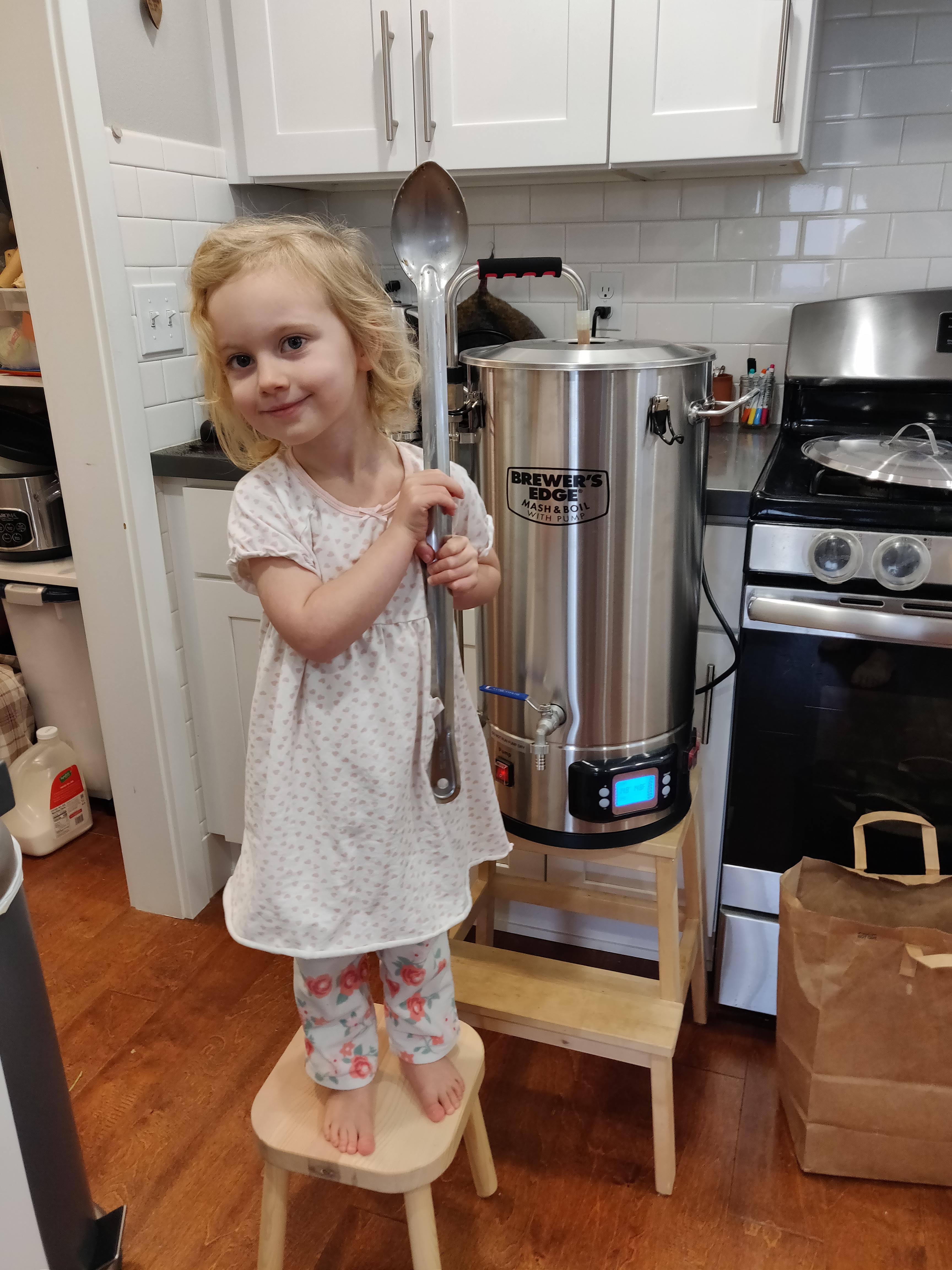
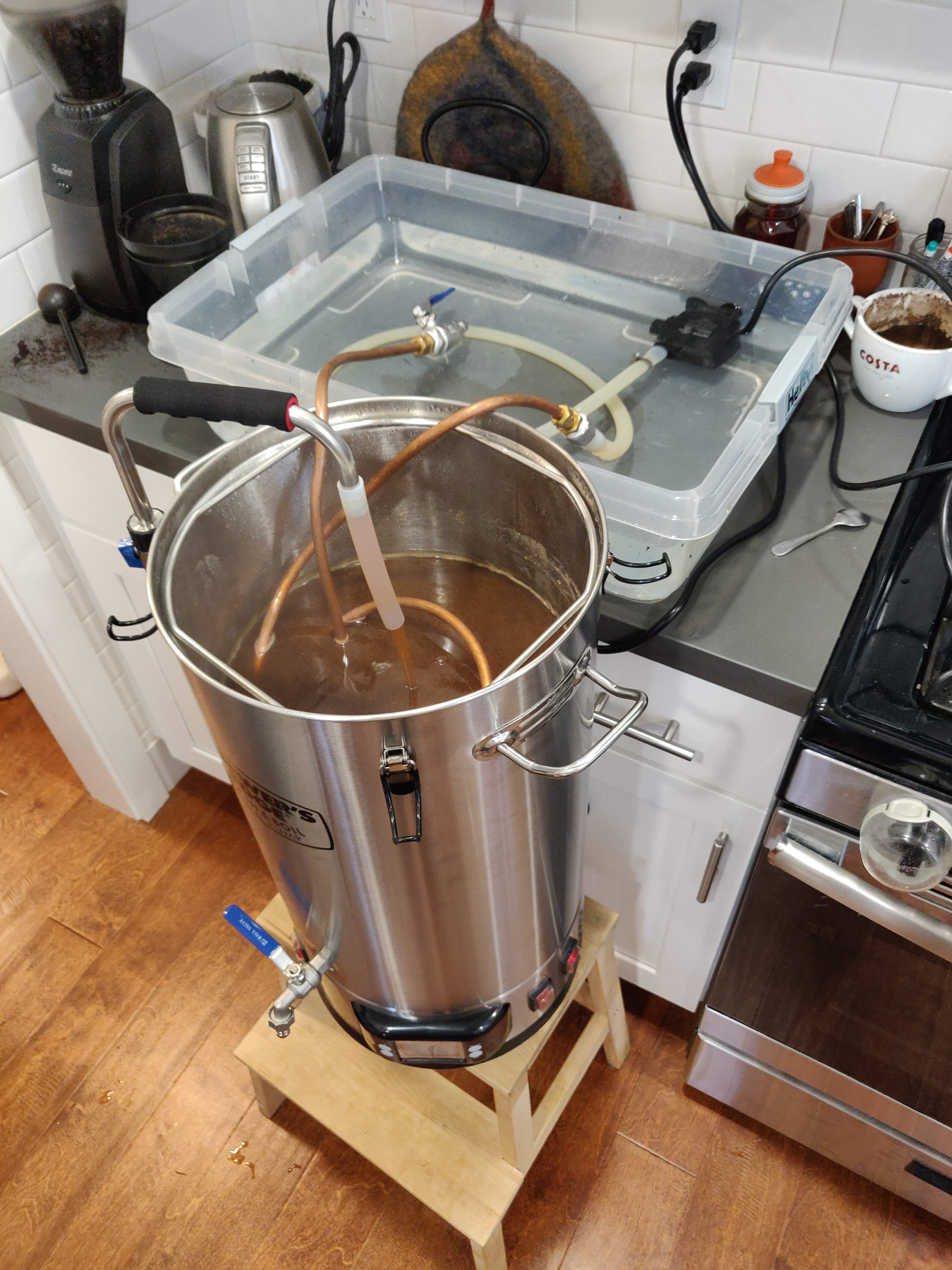
To get the year started well, I brewed a Hazelnut Brown Ale today and once it cools, at 12:01 on Jan 1, 2021, I will pitch the yeast to get that one going. I got to use my electric brewer for the second time and I’m still excited about how easy it makes brewing. Avery even grabbed the brew spoon to help stir the grain. Next year is going to look new and different, hopefully there will be more changes than just switching from running to fermenting.
Posted in Cooking, Running | Tagged , | 2 Comments

Croissants

After going vegan, there are obvious things you miss like good cheese (they are getting better, but still have room to improve) and there are less obvious foods like croissants. Maybe it’s obvious to everyone else, but having never made croissants, I hadn’t thought about all the layers of butter required to make them so flaky.

We finally decided we wanted to try them and Dom found a recipe on theRoseAndBean.com. We tried them. They were amazing! Just what we’d been missing. Then a few weeks later, she went to make them again and the recipe (and the entire site) was gone. I was able to find a copy of it and reached out through several platforms to ask permission to repost it here. After weeks, I’ve heard nothing back but felt the recipe needed to be shared so below is our experiment with vegan croissants. We used the Miyokos butter and it’s amazing. We haven’t tried their vegan butter recipe, but included it in case you can’t get Miyokos where you are. The photo is of one of the croissants Dom made, the rest of the content is theirs.

Ingredients

  • 260ml water
  • 14g fast-action yeast (2 sachets)
  • 500g plain flour
  • 10g salt
  • 40g caster sugar
  • 360g vegan butter (we used Miyokos or see below)
  • Splash of non-dairy milk

Directions

  • Step 1 In a large bowl, put your water, sugar and yeast and stir together
  • Step 2 Add your flour, salt and 100g of vegan butter and knead until it all comes together (mix it in the bowl first before tipping out and kneading). If you have an electric whisk with a dough hook, you can use this
  • Step 3 Cover the dough with cling film, place in the fridge, and leave for 8 hours or overnight
  • Step 4 Once you’ve placed your dough in the fridge, take the remaining 260g of vegan butter and place between two pieces of parchment paper or into a sandwich bag
  • Step 5 With a rolling pin, flatten the butter until it becomes a square shape that is roughly 7×7 inch (ideally, measure it with a tape measure to be sure). Wrap in cling film and place back in the fridge and leave until your dough is ready (you need to be working with the butter cold but not rock solid, so ensure it stays in the fridge until needed, and then work quickly)
  • Step 6 Once your dough has been left for at least 8 hours, remove from the fridge and place on a lightly floured worktop
  • Step 7 With a rolling pin, roll into a rectangle that is 14×7 inches in size
  • Step 8 Take your slab of butter and place it in the middle of your dough
  • Step 9 Fold the two ends of the dough to meet in the middle over the butter slab, and make sure the butter is sealed by pushing the dough together all around the edges
  • Step 10 Turn the dough so that the join is now straight in front of you, not lengthways. Starting from the middle, roll your pastry out into a long rectangle, till it’s roughly 22×7 inches in size (do not roll back on yourself, always come back to the middle and roll out towards the edges)
  • Step 11 Now it’s time for your first fold. Take one end of your dough and fold about two thirds of the way down, then take the other end, and fold it on top, so that you’ve folded the dough into thirds and you’re left with a rough square shape
  • Step 12 Wrap your dough into cling film (make sure it’s well wrapped as this stops it from drying out) and put in the fridge for 30 minutes to 1 hour
  • Step 13 Remove from the fridge and place it so that the folded end of your dough (the part like the binding of a book) is on your left
  • Step 14 Roll your dough again until it’s 22×7 inches (step 10), then repeat step 11 (the fold), wrap in cling film and place in the fridge for 30 minutes. Repeat this again (make sure fold is on left, roll and fold), wrap in cling film, but this time place in the fridge for 60 minutes
  • Step 15 After your dough has been in the fridge for its third and final time, remove from the fridge and on a lightly floured surface, roll out to about 24×8 inches
  • Step 16 Next, create yourself a template. Cut a piece of card or paper into a triangle shape. The base should be 4 inches wide and it should be 8 inches high
  • Step 17 Place your template onto your dough and cut around it (use something sharp like a pizza cutter) to create 9 triangle shapes
  • Step 18 Take a piece of dough and make a small slit in the middle of the base of your triangle with a knife
  • Step 19 Roll your dough from the base to the end using your finger and thumb, turning by the corners so as to not crush the layers
  • Step 20 Repeat for all pieces of dough
  • Step 21 Place on a baking sheet with the pointed end at the bottom, then brush each croissant lightly with some non-dairy milk
  • Step 22 Cover lightly with parchment paper and leave to rise for 1 hour. Pre-heat your oven to 180 degrees fan. Once heated, place in the oven for 20 minutes. If they look like they’re browning too quickly, cover with tin foil
  • Step 23 Remove from the oven and allow to cool
  • Step 24 Serve!

Vegan Butter Ingredients

  • 200ml water
  • 160g cashews, soaked overnight
  • 250ml refined coconut oil, melted (it is important to use refined and not unrefined to avoid a strong coconut flavour)
  • 20ml sunflower oil
  • 1tbsp apple cider vinegar
  • 2tsp soy lecithin granules
  • 1tsp salt (don’t add if using the butter for vegan croissants)

Directions

  • Step 1 Place all ingredients in a high-speed blender
  • Step 2 Blend until smooth
  • Step 3 Pour into silicon mould (or old butter tub) and leave to harden in the fridge
  • Step 4 Serve!
Posted in Cooking | Tagged | Leave a comment

Sourdough

I’ve been baking for a while and keeping my sourdough starter going for about two years. During the first 23.5 months, one person asked for some. Since beginning “Stay Home, Stay Safe,” aka COVID lockdown, four nine (as of April 20) different people have asked for some. Since several of them haven’t cared for starter recently and because I want to track what I do to see how it changes over time, this will walk through the entire process from getting starter to making bread. I will probably be vague in places because I know what I mean, but if you see something that isn’t explained as well as it should be, please let me know and I’ll add details.

  1. IMG_20200408_095832

    Step 1: Just mixed, note the volume

    In a medium bowl, mix 100g starter with 75g bread flour and 75g warm water. Stir, cover, and set aside.

  2. Add 25g bread flour and 25g water to the starter. Stir, cover, and set aside. If you are likely to bake in the next 4 days, you can leave it on the counter. If it’s going to be at least a week, put it in the fridge.
  3. Check the bowl every few hours. When bubbles start to pop on the surface, it’s ready to use. This usually takes 8-24 hours depending on the temperature and how active the yeast were when mixed. If in doubt, wait.

    IMG_20200408_150524

    Step 3: Very bubbly and much larger

  4. Empty the bowl into your stand mixer* and add 500g total flour (I like to use about 30g Rye and 30-90g Whole Wheat with the rest being bread flour, but all bread flour or other similar combinations work). Also add 325g warm water, 13g salt, and 1/4 tsp commercial yeast (optional, helps keep the timing consistent).
  5. Start to mix with the bread hook on a slow setting until all the flour is wet. It will still be lumpy. Turn off mixer and let it rest for 10 minutes.

    IMG_20200408_151437

    Step 5: Mixed and still lumpy

  6. Mix on medium-high speed until the dough is smooth and pulls the dough completely away from the side of the mixer. If in doubt, let it mix longer. More mixing won’t harm the dough. When ready, it should look like this:
  7. Let the dough rise in the mixer bowl or another bowl on the counter until it doubles in size. This usually take 2-3 hours if you used the optional commercial yeast and 2-24 hours without it.
  8. Dump the dough onto a floured counter. Stretch the dough until it just starts to create small tears then fold the stretched part back. Rotate 90° and repeat until you’ve done it four times. Each stretch will get a little harder to do and tear a little sooner. (See start of video in next step)
  9. Form the dough into a ball and stretch the surface by pushing the sides underneath the ball. This video shows steps 8, 9, and 11:
  10. Line a medium-large bowl with a tightly woven kitchen towel and sprinkle liberally with flour.
  11. Flip the ball of dough into the bowl so the seam that was on the bottom is now on top.
  12. Let it rest for 1 hour.
  13. Preheat the oven to 475° F with the rack on the bottom. Put a large pot (big enough for the dough ball to fit inside with plenty of room) in the oven and allow it to heat.
  14. Sprinkle a little flour on the seam of the dough ball then flip it over onto a baking sheet. Slice a line, square or X on the top of the bread with a very sharp knife. This helps it expand in the oven.
  15. Pull the pot out of the oven, flip it over to cover the bread and put it all back into the oven for 30 minutes
  16. Pull the pot off the bread, lower the temp to 425° F, and bake for another 20 minutes
  17. Pull the bread out and let it cool completely on a wire rack before cutting it. This helps the center finish cooking
  18. IMG_20200408_152538

    Step 18: Feed your yeast

    Before baking next time, you need to feed your yeast another 25g flour and 25g water 24 hours before doing Step 1. If the yeast was in the fridge, it might want up to a day of extra time to warm up and get going again before moving on the Step 1 again.

Good luck and please let me know how it goes.

IMG_20200409_141221

Enjoy the bread

* I like to use a stand mixer but you don’t need to. Without one, mix until the dough is lumpy but there is no dry flour and let it rest for 10 minutes. Then knead it for 1-2 minutes and let it rest for 10. Then knead it once more and you should be good. There are a lot of different techniques for kneading. Note, the dough will start off very sticky and seem like a mess. Given enough time and kneading, it will come together. I recently found this kneading technique and like it, but do what works best for you. YouTube is full of different kneading videos.

Posted in Cooking, Maker | Tagged , , , | Leave a comment

Making Vegan Challah (First Try)

IMG_20190402_193543I’ve been baking breads for several years now, but still remember the confusion of getting started. So many recipes said things like “Add water 1 TBSP at a time until reaching the right consistency” or “Let rise until the dough rebounds when you push on it” or “Knead the dough until you can read through it during a window pane test”. After so many loaves, some of those phrases have started to make sense. To be fair, that last one still hasn’t ever worked for me like I think it’s supposed to.

I’ve occasionally brought bread into work to share. This week a friend announced she was taking a new job and would host the final lunch talk about equity in education. These have been wonderful discussions for two reasons. First, these are conversations we need to be having for our students and our staff. Second, she always brings great snacks to share. After her announcement, she let me know she had some special berry jam from home that she was planning to bring and wondered if I could make challah to go with it. Having never made it and knowing only that it uses a lot of eggs, I said I would happy make a vegan version for the lunch.

Looking around online, I found several recipes, but none were quiet what I was looking for, so I decided to combine a few. As I started making it, the dough seemed extremely dry. I now know that I misread the instructions and only included about 30% of the liquid it called for. As the dough continued to mix, I decided to give up on the recipe completely and just go with what seemed right. I started adding liquid in small amounts, then just dumped in water, soy milk, and oil. It was finally looking close, but at that point, I felt I’d added too much, so more flour went in. Eventually I felt it had reached “the right consistency” and let the dough rise.

IMG_20190402_180715It rose much faster than I was used to, so I worked quickly to cut it into strands and braid it. After baking, I had trouble waiting for it to cool before tearing into it. It came out great, good color and flavor. It’s times like that when I feel I’m not just messing around with bread in the kitchen, but maybe just maybe, I’m an actual baker.

So here’s approximately what I think I put in:

Dry Ingredients:

  • 600g AP Flour
  • 10g Dry Yeast
  • 10g Salt

Wet Ingredients:

  • 80g Soy Milk (plus additional for wash)
  • 75g Canola Oil (plus additional for wash)
  • 60g Honey* or Agave
  • 260g 315g Water (Updated after another test)
* I use honey from bees we keep. I recognize this isn’t technically vegan, but it works for me. You can use any similar liquid sweetener.

Steps:

  1. Combine all dry ingredients
  2. Combine wet ingredients and mix well
  3. Stir wet ingredients into dry and mix for 2 minutes at slow speed
  4. Let the dough rest for 5 minutes
  5. Mix/kneed with dough hook for 5 minutes at moderate speed (4-6)
  6. Repeat steps 4 and 5 once more
  7. Let rise for about 90 minutes
  8. Cut dough in half. Cut each half into four pieces and form them into strands
  9. Braid the strands into a loaf and place each loaf on parchment paper
  10. Preheat oven to 350° F
  11. Let rise for about 60 minutes
  12. Paint tops of loaves generously with wash made of equal parts oil and soy milk
  13. Bake for 40 minutes
  14. Let cool and enjoy
  15. Wish your friend well in her new job.

IMG_20190402_191158


Posted in Cooking | Tagged , , | Leave a comment

BLE BirdLight

Avery has never been a great sleeper. In fact, by the time she turned two and a half, the number of nights she slept all the way through could still be counted on one hand. We’ve tried multiple approaches including co-sleeping, crib sleeping, sleeping in her own bed, singing her to sleep, rocking her, or letting her “cry it out” in her crib. The last resulted in her climbing up the side of her crib, over the top, and falling to the floor. Decidedly less than ideal.

Several of our friends with kids about her age have started using Wake Up Clocks. The idea is that the clock changes color to let the young ones when when they should be in bed and when it’s ok to get up. Mostly they were using it because their kids would come in at 4:30 in the morning to ask if the day was starting yet. For most of the families, these clocks worked wonders with one child staying in his room an extra 30 minutes beyond the end of his nap because the parents forgot to switch the color of the light. (We also have one family where the child comes into the parents’ bedroom at all hours to tell mom that it’s still time to be in bed, in case mom was wondering, so it doesn’t work well in all cases). We decided to try it and see if having another cue would help with the nighttime routine.

I was wondering if it was the sort of thing I could build, but assumed Dom would rather just buy one. When she asked Avery if it would be fun to have me convert an old battery-powered night light into a multi-colored wake up clock, I was on board (and luckily, so was Avery).

IMG_20190218_093557

Avery helping take apart the night light

I started by taking apart the light we had and seeing what was inside. I got help with this step. Turns out, it’s a small space. I wanted to put in a micro-controller, but the smallest one I’ve worked with recently, Arduino Nano, is too big to fit. I had some Arduino Micro Pros sitting around that I wanted to play with and this was the perfect opportunity. One of those would just fit inside and could run off the same power regulator that was already there.

I wanted to control the bird light with an app on my phone which meant it had to have wireless connectivity of some kind. I went with Bluetooth Low Energy (BLE) because it was cheap, small, and I had one of those chips sitting around as well. The prototype was roughly the size of a piece of toast. Way too big, but at least it worked. Then came the challenge of shrinking it down. This took longer than I expected, but I now feel much more confident about soldering really small components.

52882774_2035399316753448_4441114710991533546_n

Once it was all put back together, I was able to pick one of over 16 million colors for the light. All it took was five clicks and entering a hex value for the color I wanted (i.e. yellow is #ffff00). Turns out that the other people who want to control the light didn’t think that was intuitive. Fair enough.

BirdLight

Time to create an app. Most of the phones people will use to control the light run Android, so I decided to create the controller in App Inventor. It was quick and easy. If you’ve never written an app for your phone, but think it sounds interesting, this is the way to go. With no coding experience, you can create something simple in less than an hour. Anyhow, I was testing the app and found it mostly worked. Unfortunately, I had the color wrong and the bird went bright blue while Dom was putting Avery down one night. Oops.

We now have a Bluetooth-controlled multi-color Wake Up Clock. We’ve only been using it for a few days and already Avery is learning what it means. She knows when it’s yellow, we need to start calming down and go brush teeth. Pink (and barely on) means it’s time for bed and Bright Blue means it’s time to get us (she picked the colors). The yellow and pink have been helpful for getting us to bed without too much protesting. Blue is very exciting because we can then run around. So far it hasn’t helped with sleeping through the night or staying in bed, but it’s still early in the process. Hopefully over time, she’ll learn to trust the light a little more. In the mean time, it’s one more part of the bed time routine which helps us calm down and get ready for sleep. Plus, when compared to letting her “cry it out,” this hasn’t caused her to fall out of her crib, so I guess that’s a win.

IMG_20190308_175354


Posted in Maker, Other Writing | Tagged , , , , | Leave a comment

Can’t you check the wiring?!?

A group of four students in the Nelsen Middle School Robotics Club stared from their robot to the diagram on the screen and back again.
wiring
“Wait, does the yellow wire go there?”

“No, I think it goes in the next line down.”

They were spending significantly longer determining where all the parts went this time than last. Because of the limit focus they had the first time, wires had been cross and they burned out an Arduino microprocessor. I had another one and told them they could have it as soon as all the team members agreed that the robot was correctly wired this time.

“I think we’ve got it. Can we get the new chip?”

“She doesn’t seem convinced. You all need to agree, then you get the chip and I don’t want you burning another chip.”

“Can’t you check the wiring?!?”

“Why would I do that? You have the diagram for how it needs to be wired and you’ve shown me that you can read it. Take your time and do it right this time.”

“… uh… ok… uh… we’re not ready yet…”

The chips are only $4 each, but I didn’t have an unlimited supply of them with me. I wanted to see how they would do if I put all responsibility for this on them. It was their robot, after all.

The one who was always quick to dive in and change things started explaining why each wire was where it was. Another student who spent the first 20 minutes of the meeting reading a book about Arduinos put it down and leaned in to get a better view. All four of them asked questions, moved wires and pointed to the diagram on the screen. After 15 minutes, one of them came to me and said, full of confidence, “We’ve got it!”

“Are you sure?”

Looking back at the others and now speaking with slightly less confidence, “Yes!… ?”

“Ok, here’s the new chip. Install it on the breadboard and have everyone double check that it’s in the correct place before you turn it on.”

Three minutes later, and only about 45 seconds before the end of the meeting, they agreed that it was correct. They turned it on and the robot started to drive, exactly how they’d programmed it. They were elated.

It’s fun to see what students can do when we empower them enough to make the decisions. The consequence of failure here would have been destroying a $4 chip, but because I wasn’t going to check their work, they wanted to ensure that it was done right. They took pride in their work and the results were exactly what they hoped for. If I could get students to do that everyday at the cost of a few Arduinos, I’d take that deal for every student in the district.


Posted in Education | Tagged , , | 1 Comment