Overview: If you like XKCD you’re going to enjoy this book, but if you like XKCD, you probably already knew that. Randall answers some truly ridiculous questions with the scientific rigor usually reserved for graduate studies. Many of the questions were one he originally answered on the What If website, but it was wonderful to look back at those and fun to see the new questions readers sent in. I’ve used similar questions in class to get students thinking about problems in a different way. It is wonderful to see how they solve problems that aren’t abstractions in a book but also don’t have a specific “right” answer.
Highlights:
This “cold sky” effect can cool things down to below the ambient air temperature. If you leave out a tray of water under a clear sky, it can turn to ice overnight even if the air temperature stays well above freezing.
What the physicists found, after half a century of research, was that children know exactly what they’re doing. Rhythmically kicking and leaning with their hands on the chains seems to be just about the optimal strategy for powering a swing using the rider’s body.
Really big objects can get extremely hot from even a tiny amount of heat production per unit of volume. Even the core of the Sun, where nuclear fusion happens, would be pretty cold if you could somehow isolate a piece of it. A cup of solar core material produces about 60 milliwatts of thermal energy. By volume, that’s about the same heat production rate as the body of a lizard, and less than that of a human. In a sense, you’re hotter than the Sun—there’s just not as much of you.
It might seem confusing that someone navigating toward Earth’s north pole would be attracted to the MRI’s south pole, but that’s because the Earth’s pole names are backward. The “north” end of a magnet is the one that points toward the Earth’s north pole, which means the Earth’s north magnetic pole is technically a south magnetic pole, and vice versa. This is deeply annoying to me, but there’s nothing we can do about it, so we might as well move on.
When you crush sugar in the dark, it emits flashes of light. This phenomenon is called triboluminescence. The light can be pretty faint, but the old Wint-O-Green flavor of Life Savers candies are famous for producing an especially bright flash, which is thanks to an additive used for flavoring. Most of the light emitted by sugar through triboluminescence is ultraviolet, but certain Life Savers contain methyl salicylate, which is fluorescent. It absorbs the invisible ultraviolet and emits it as blue visible light.
If you’re not familiar with it, I recommend doing a quick image search for “glass beaches of Vladivostok” —you won’t regret it!
piece of trivia is that the point on the Earth’s surface farthest from its center is the summit of Mount Chimborazo in Ecuador, due to the fact that the planet bulges out at the equator. Even more obscure is the question of which point on the Earth’s surface moves the fastest as the Earth spins, which is the same as asking which point is farthest from the Earth’s axis. The answer isn’t Chimborazo or Everest. The fastest point turns out to be the peak of Mount Cayambe,‡ a volcano north of Chimborazo.
Overview: Learning helps the brain stay young and despite the difficulties, is something the brain yearns to do. That’s the simplified version of the book. The author then goes through and tell about his experiences learning new skills in his 40s-50s. There are certainly skills that I’ve dabbled in that I keep thinking I should actually dedicate some time to learning and this book has encouraged me to go back and try them again. We’ll see if any of them are stickier this time.
Highlights:
At chess tournaments, I saw a dynamic that was all too familiar from the world of children’s activities: kids doing the activity, adults like me staring into their smartphones.
A man…progresses in all things by making a fool of himself. —GEORGE BERNARD SHAW
I am brimming with declarative knowledge, or what is called “knowing that.” I have a lot of “knowing that”; hell, I was on Jeopardy! (I lost, to someone who knew more of “that.”) But what about procedural knowledge, or “knowing how”? I was a quick study when it came to facts, but what had I actually learned to do lately?
In one fascinating experiment, researchers demonstrated, to different infant subjects, the act of retrieving a toy from a container. One adult model struggled with the process, while another adult did it quickly. The infants who saw the adult struggle tried harder when it was their turn to try to retrieve the toy. The ones who saw the adult do it more easily didn’t want to try as much.
one example, Claude Shannon, the brilliant MIT polymath who helped invent the digital world in which we live today, plunged into all kinds of pursuits, from juggling to poetry to designing the first wearable computer. “Time and time again,” notes his biographer, “he pursued projects that might have caused others embarrassment, engaged questions that seemed trivial or minor, then managed to wring breakthroughs out of them.”
Learning new skills also changes the way you think, or the way you see the world. Learning to sing changes the way you listen to music, while learning to draw is a striking tutorial on the human visual system. Learning to weld is a crash course in physics and metallurgy. You learn to surf and suddenly you find yourself interested in tide tables and storm systems and the hydrodynamics of waves. Your world got bigger because you did.
The subjects who took the classes had larger improvements in a variety of cognitive areas, ranging from episodic memory to processing speed. It’s not that learning by yourself is bad, or that simply socializing is mind-numbing, but learning with people just seems to hit some sweet spot in the human brain. It helped, Park said, that in the activities chosen, “everyone could proceed at their own rate, and it wasn’t obvious if you were doing it badly.” Learners were motivated by the presence of other learners and challenged by the instructors.
The long-standing hypothesis was that infants were always walking to something: a friendly caregiver, an alluring toy. And sometimes they are. But as research at the Action Lab has shown, the majority of walking instances don’t really seem pointed toward an obvious destination. Infants walk in place, stop in the middle of nowhere, and often seem to stumble into interesting objects or destinations by happenstance. Eye-tracking software reveals that they’re rarely looking toward some goal as they begin to walk.
Infants live what might be called the beginner’s creed: If you don’t learn to fail, you’ll fail to learn.
When we practice a variety of skills, rather than long, monotonous drills in the same skill, we often do worse during the practice session but better in the long run. Because we have to work harder to remember the different exercises, and the ways we solved them, we perform them better.
you may be wondering about your own singing ability. I would urge you to take the online test that Steven Demorest helped create.6 It’s based on pitch accuracy, the easiest-to-measure, most fundamental variable in singing quality. No matter your score, remember one thing: It can be improved.
The widespread use of the phrase “tone deafness” obscures the real problem, as Sean Hutchins, director of research at Canada’s Royal Conservatory, told me. We’re incredibly sensitive listeners when it comes to pitch. The problem is not perceiving correct notes,*7 Hutchins says, but producing them.
According to a theory from the sports psychologist Gabriele Wulf, we do worse at an activity when we focus on ourselves, instead of some “external” target. This idea shows up in almost every sport there is. Darts players do better if they focus on the board and not their own arms; golfers do better if they focus on the hole and not their elbows. Even musicians, it’s been shown, seem to do better if they focus on overall sound rather than on their fingers strumming the instrument. Wulf, who says the findings have been replicated across 180 studies, thinks a focus on the self can prompt “micro-choking,” getting in the way of automatic movement—which is what we’re talking about when we’re talking about skilled behavior.
“Don’t beat yourself up in the sessions that went badly, and don’t pat yourself on the back too hard when you have a really good one.” It seemed like a good mantra. You just did the best you could. It might work out, it might not, but the rest was out of your hands.
The legendary pro surfer Phil Edwards once said, “The best surfer is the one who’s having the most fun.”
“Almost everyone can ride a bicycle,” observed the physicist David Jones, “but almost no one knows how they do it.” Ask the average rider how to turn a bicycle, and they’ll probably answer, “Turn the handlebars in the direction you want to go.” But this isn’t technically true. As bike geeks from Wilbur Wright onward have noted, to go left, you first have to steer to the right.
The more things you have to pay attention to, the faster time seems to move. But as you get better, you learn what to pay attention to. You have a better sense of what to expect.
we shouldn’t try to endlessly perfect that one technique that seems to work, under the same set of conditions. That’s too rigid; if one little variable changes, the technique might not work so well. Instead, we should try to solve the problem every time, which means we might even use a different technique. He called it “repetition without repetition.”
Our brain has a host of regions, termed the “action-observation network,” that’s sparked when we watch others do something in our “motor repertoire” (watching a dog bark, for instance, not typically being a human trait, doesn’t activate the region). We’re simulating doing the task ourselves, warming up the same neurons that will be used when we actually give it a go. The action observation network isn’t a substitute for action—only doing something will fully engage one’s motor cortex—but rather a dress rehearsal.
The more we want to learn, the more we prime the brain. The more curious you are to know the answer to a question, the better chance you’ll remember it. People who believe they will need to teach something that they learn seem to learn motor skills better than those simply learning them. Curiously, we seem to learn better when we watch the error-filled efforts of novices. When we watch the flawless performance of experts, after all, we’re watching someone who isn’t learning. Seeing learning happening actually helps us learn.
While we tend to think of feedback as a diagnostic tool for fixing mistakes, a growing body of research shows that people not only prefer to be given feedback on their successful attempts at a skill; they seem to learn better this way.
a whole body of research has shown that sleep, or even just a short rest, is one of our best learning tools. The resting brain “consolidates” the memories of what you were just trying to do; a big part of any skill, after all, is remembering how to do it.
The more learning older adults take on, the faster they seem to learn—the more they become like younger adults. Learning to learn, it seems, is a lifetime sport.
The artist Frederick Franck quotes the ninth-century Zen master Daie: “Meditation in a state of activity is a thousand times more profound than in a state of quietude.” Nowadays we call it flow.
They were soon dropped into water for a bout of swimming. Analyzing the subsequent changes to the mice’s brains (specifically proteins in the hippocampus), the researchers concluded that it looked as if the mice had swum their depression away.
the philosopher Seneca, writing about “feeble old men” terrified by mortality when an illness appears. “They exclaim that they were fools because they have not really lived, and that if only they can recover from this illness they will live in leisure.”
There’s an argument, made by Kelly Lambert, who runs a neuroscience lab at the University of Richmond, that doing physical labor with your hands is a powerful, mood-enhancing way of activating what she terms “effort-driven rewards.” We’re “programmed,” Lambert suggests, to “derive a deep sense of satisfaction and pleasure when our physical effort produces something tangible.”
I wanted effort. I wanted struggle. I wanted to be able to feel the little advances, the setbacks. This was a journey by foot, not airplane. To be a traveler, the writer Daniel Boorstin once observed, you need some travail—that’s French for “painful or laborious effort.” Otherwise you’re just a tourist; someone else has done the legwork for you. You’re watching the how-to video without getting your own hands dirty.
“In science,” he wrote, “if you know what you are doing you should not be doing it.” Meaning: Science was about probing beyond the edge of what we know. It was about experimentation and failure. There was no need to dabble in proven hypotheses. In engineering, however, wrote Hamming, “if you do not know what you are doing you should not be doing it.” Engineers are tasked with making sure things do not fail, with ensuring certain quantifiable levels of performance. No one wants to drive across an experimental bridge.
Overview: Borders and immigration are topics that get a lot of attention within political discussions but most of the attention is based on reactions and feelings. This book looked at the impacts immigration has on a country; what happens when you let in anyone who wants to live and work in your country. There is clearly plenty of fear about this in the US (and many countries around the world) currently. This book shows the benefits of free immigration and open borders. They look into many of the arguments against letting people into the country and provide data to show that from an economic perspective, more immigrants benefit the receiving country.
This was a very quick read and if you’re interested in getting beyond the political talking points, this book is a good start.
Overview: If there is nothing in this book that makes you want to go out for a bike ride, nothing will. It has a many stories about bikes and biking I’d heard before but so many that I hadn’t. Who knew that bikes were so popular during the Klondike Gold Rush? Some of the later chapters rambled on a little but overall, this was such an enjoyable look at (arguably) the best form of land transportation ever.
Highlights:
During the last years of the century there were countless efforts to merge the bicycle and the airship. Newspapers and scientific quarterlies announced the inventions of “the Aerial-Cycle,” “the Luftvelociped,” “the Pegasipede.” There were designs for bikes with whirling rotors, with whipping fan blades, with kite-shaped sails; there were proposals for dirigibles powered by squadrons of cyclists.
“Bicycling…has done more to emancipate women than anything else in the world,” said Susan B. Anthony in 1896. “It would not be at all strange,” wrote a Detroit Tribune editorialist that same year, “if history came to the conclusion that the perfection of the bicycle was the greatest incident in the nineteenth century.”
There are approximately one billion cars in the world today. There are twice as many bikes. The number of bicycles manufactured this year in China alone will exceed the total worldwide production of automobiles. The cities and towns we inhabit, our economies, our laws are designed for cars; we hop between continents on airplanes. Yet we live on a bicycle planet.
“Get a bicycle,” wrote Mark Twain in 1886. “You will not regret it, if you live.”
Among the first major cycling organizations were socialist bicycle clubs in 1890s Britain, which hailed the bicycle as an egalitarian “people’s nag.” Through the decades, the bicycle has retained its countercultural potency.
Governments have long recognized the bicycle as a means of resistance. One of Adolf Hitler’s first acts upon assuming power, in 1933, was to smash Germany’s cycling union, the Bund Deutscher Radfahrer, which was associated with anti-Nazi political parties and was capable of assembling tens of thousands of cyclists in the streets.
Increasingly, public opinion is tilting toward a belief long held by cycling advocates: cars are killing us. Researchers say that motor vehicles are the largest net contributor to climate change. The problem will not be solved by electric or hybrid automobiles, since tire wear and other non-tailpipe pollutants account for a large percentage of vehicle emissions.
In earlier stages of wheel development, spokes were threaded from hub to rim radially, but designers figured out that a tangential pattern—in which the spokes stretch out from the hub at angles in an overlapping configuration—made the wheel more resistant to warping. Also, tangential spoking is an eye-catcher.
A key figure is Jules-Pierre Suriray, the Parisian bicycle builder who patented the ball bearing, that “atom of the Machine Age,” essential to the operation of not just bikes and cars but everything from fishing reels to air conditioners to computer hard drives to the Hubble telescope and the Mars rover.
Charles Sheldon, the American Congregationalist minister whose 1896 novel In His Steps popularized the phrase “What would Jesus do?,” took the position that the bicycle was the ethical choice: “I think Jesus might ride a wheel if He were in our place, in order to save His own strength and the beast of burden.”
Whenever a healthful amusement becomes a mania, it ceases to be healthful. The doctors have invented the word bicychloris to designate a condition in which the blood is impoverished and the vitality of the system lowered from excessive wheeling.
Philip Carr-Gomm has written that people who protest in the nude “convey a complex message: they challenge the status quo by acting provocatively, and they empower themselves and their cause by showing that they are fearless and have nothing to hide. But at the same time they reveal the vulnerability and frailty of the human being.” The WNBR embraces the direct-action tactics of Critical Mass; its rhetoric links nudity and sexuality to environmentalism, safe streets, and anti-automobilism. “By cycling naked we declare our confidence in the beauty and individuality of our bodies,” reads the WNBR mission statement. “We face automobile traffic with our naked bodies as the best way of defending our dignity and exposing the vulnerability faced by cyclists and pedestrians on our streets as well as the negative consequences we all face due to dependence on oil, and other forms of non-renewable energy.”
the only people getting wealthy in the Klondike were the early stakeholders and entrepreneurs who had established businesses catering to the gold rush hordes. One of these was Frederick Trump, Donald Trump’s grandfather, an immigrant who had dodged the draft in Germany, fled to the United States, and made a small fortune opening hotels in the Yukon riverbank towns of Bennett and Whitehorse.
Klondike cyclists claimed another advantage over horses and dog teams: speed. If the weather cooperated, bicycle riders could travel faster than anyone, up to one hundred miles per day on flat stretches of trail, about twice the distance covered by prospectors with dog teams.
there is a responsibility to create the conditions for happiness.” Dorji said: “When we say ‘happiness,’ we have to be very clear that it’s not fun, pleasure, thrills, excitement, all the temporary fleeting senses. It is permanent contentment. That lies within the self. Because the bigger house, the faster car, the nicer clothes—they don’t give you that contentment. GNH means good governance. GNH means preservation of traditional culture. And it means sustainable socioeconomic development. Remember that GNH is a pun on GDP, gross domestic product. We are making a distinction.”
Bhutan’s success in combating the Covid-19 pandemic—only three Covid deaths, through the end of 2021—has been ascribed to geography and topography: the Himalayas are great social distancers. But the efficiency with which the government vaccinated nearly the entire adult population underscores another kind of Bhutanese exceptionalism, the bureaucratic competency and social cohesion that shield a small developing nation from the pathogens, and the pathologies, plaguing the theoretically more sophisticated wider world.
Tshering Tobgay, for one, doesn’t see Bhutan’s topography as an impediment. “In fact, our terrain in Bhutan is bicycle-friendly,” Tobgay said. “If it’s all flat, it’s no fun.”
For three straight years—1972, 1973, and 1974—bicycles outsold cars in the United States.
In 1992, Gallagher estimated that there were seven million passenger trips taken by rickshaw in Dhaka each day, covering a distance of eleven million miles. These totals, Gallagher noted, “nearly double the output of London’s underground railway.” In the decades since, Dhaka’s population has more than tripled, and the statistics have surely spiked accordingly.
To teach a novice how to keep a bike stable and moving forward, Karl von Drais’s invention turns out to be far preferable to a bicycle rigged with training wheels. History’s original bike has returned as a starter bike.
Eventually, the bicycle would become something close to compulsory: along with a watch and sewing machine and radio, it was one of the proverbial “three rounds and a sound,” the must-have possessions for all Chinese adults who wished to get married and start a family.
a woman could be heard screaming at the police, asking why bikes were being taken and how protesters were supposed to travel home. Another piece of viral footage showed three policemen clubbing a cyclist with batons on a Manhattan street. It was unclear whether the man was arrested or what became of his bicycle. In the days that followed, the NYPD’s anti-bicycle actions continued. The Daily News reporter Catherina Gioino tweeted that the police had been ordered to “focus on the bicyclists.”
NYPD has a long history of hostility to cyclists, especially cyclists who are also protesters. For years, the police used aggressive, sometimes violent tactics to sweep up participants in Critical Mass rallies. In 2008, an NYPD officer body-slammed a Critical Mass rider; the cop later received a felony conviction for this action and for filing a false criminal complaint in an attempt to frame the cyclist. In 2010, the city agreed to pay a settlement of nearly $1 million to eighty-three Critical Mass riders who had been wrongly detained or arrested between 2004 and 2006.
The manual offers examples illustrating the difference between “peaceful” crowds (“Parades or details such as New Year’s Eve”) and “violent” crowds (“Occupy Wall Street, BLM movement, Anti-Trump Demonstrations”), and provides instruction in a number of “aggressive” cycling maneuvers (the “Power Slide,” the “Dynamic Dismount”) that bike officers use to control and subdue.
Overview: This book was quoted in a podcast I listen to called “Dim Lights & Stiff Drinks” about dive bars in Seattle. They were reviewing bars around Pioneer Square and quoted HB’s description of the area: “Perhaps never in all history, certainly not in America, has there ever existed such a massive collection of the demimonde grouped in a restricted area.” With such a colorful look at early Seattle, I had to know more. It took longer to find a copy of this book than it took to read it. It was published in 1959 and has first and second hand accounts of events happening back to the 1880s. Some of the stories I had read before and others were new, but overall it was enjoyable to think back to what my city was like 100+ years ago. Worth reading and while you’re at it, add Dim Lights & Stiff Drinks to your podcast queue. It’s not the most polished and professionally produced podcast but it sure makes me want to get and explore all the old bars of Seattle.
Overview: This book came up in several reading lists I’d seen recently. The first chapter or two had a very different voice than I’m used to with books. His use of seemed to focus on shock value more than actual content. After that, it read much more like a stoic self-help book. It was not a bad book and I’m glad I read it, but not one of my favorites.
Highlights:
A confident man doesn’t feel a need to prove that he’s confident. A rich woman doesn’t feel a need to convince anybody that she’s rich. Either you are or you are not. And if you’re dreaming of something all the time, then you’re reinforcing the same unconscious reality over and over: that you are not that.
You are constantly bombarded with messages to give a fuck about everything, all the time. Give a fuck about a new TV. Give a fuck about having a better vacation than your coworkers. Give a fuck about buying that new lawn ornament. Give a fuck about having the right kind of selfie stick. Why? My guess: because giving a fuck about more stuff is good for business.
Wanting positive experience is a negative experience; accepting negative experience is a positive experience. It’s what the philosopher Alan Watts used to refer to as “the backwards law”—the idea that the more you pursue feeling better all the time, the less satisfied you become, as pursuing something only reinforces the fact that you lack it in the first place. The more you desperately want to be rich, the more poor and unworthy you feel, regardless of how much money you actually make.
As the existential philosopher Albert Camus said (and I’m pretty sure he wasn’t on LSD at the time): “You will never be happy if you continue to search for what happiness consists of. You will never live if you are looking for the meaning of life.” Or put more simply: Don’t try.
I once heard an artist say that when a person has no problems, the mind automatically finds a way to invent some. I think what most people—especially educated, pampered middle-class white people—consider “life problems” are really just side effects of not having anything more important to worry about.
this is what’s so dangerous about a society that coddles itself more and more from the inevitable discomforts of life: we lose the benefits of experiencing healthy doses of pain, a loss that disconnects us from the reality of the world around us.
Happiness comes from solving problems. The keyword here is “solving.” If you’re avoiding your problems or feel like you don’t have any problems, then you’re going to make yourself miserable. If you feel like you have problems that you can’t solve, you will likewise make yourself miserable. The secret sauce is in the solving of the problems, not in not having problems in the first place.
What determines your success isn’t, “What do you want to enjoy?” The relevant question is, “What pain do you want to sustain?” The path to happiness is a path full of shitheaps and shame. You have to choose something. You can’t have a pain-free life.
our struggles determine our successes. Our problems birth our happiness, along with slightly better, slightly upgraded problems. See: it’s a never-ending upward spiral. And if you think at any point you’re allowed to stop climbing, I’m afraid you’re missing the point. Because the joy is in the climb itself.
If suffering is inevitable, if our problems in life are unavoidable, then the question we should be asking is not “How do I stop suffering?” but “Why am I suffering—for what purpose?”
Self-awareness is like an onion. There are multiple layers to it, and the more you peel them back, the more likely you’re going to start crying at inappropriate times.
the first layer of the self-awareness onion is a simple understanding of one’s emotions.
The second layer of the self-awareness onion is an ability to ask why we feel certain emotions.
The third level is our personal values: Why do I consider this to be success/failure? How am I choosing to measure myself? By what standard am I judging myself and everyone around me? This level, which takes constant questioning and effort, is incredibly difficult to reach. But it’s the most important, because our values determine the nature of our problems, and the nature of our problems determines the quality of our lives.
We don’t always control what happens to us. But we always control how we interpret what happens to us, as well as how we respond. Whether we consciously recognize it or not, we are always responsible for our experiences. It’s impossible not to be. Choosing to not consciously interpret events in our lives is still an interpretation of the events of our lives. Choosing to not respond to the events in our lives is still a response to the events in our lives. Even if you get run over by a clown car and pissed on by a busload of schoolchildren, it’s still your responsibility to interpret the meaning of the event and choose a response.
“With great responsibility comes great power.” The more we choose to accept responsibility in our lives, the more power we will exercise over our lives. Accepting responsibility for our problems is thus the first step to solving them.
But there are also problems that we aren’t at fault for, yet we are still responsible for them. For example, if you woke up one day and there was a newborn baby on your doorstep, it would not be your fault that the baby had been put there, but the baby would now be your responsibility. You would have to choose what to do. And whatever you ended up choosing (keeping it, getting rid of it, ignoring it, feeding it to a pit bull), there would be problems associated with your choice—and you would be responsible for those as well.
Here’s one way to think about the distinction between the two concepts. Fault is past tense. Responsibility is present tense. Fault results from choices that have already been made. Responsibility results from the choices you’re currently making, every second of every day.
Growth is an endlessly iterative process. When we learn something new, we don’t go from “wrong” to “right.” Rather, we go from wrong to slightly less wrong.
My recommendation: don’t be special; don’t be unique. Redefine your metrics in mundane and broad ways. Choose to measure yourself not as a rising star or an undiscovered genius. Choose to measure yourself not as some horrible victim or dismal failure. Instead, measure yourself by more mundane identities: a student, a partner, a friend, a creator. The narrower and rarer the identity you choose for yourself, the more everything will seem to threaten you. For that reason, define yourself in the simplest and most ordinary ways possible.
Question #3: Would being wrong create a better or a worse problem than my current problem, for both myself and others?
If your metric for the value “success by worldly standards” is “Buy a house and a nice car,” and you spend twenty years working your ass off to achieve it, once it’s achieved the metric has nothing left to give you. Then say hello to your midlife crisis, because the problem that drove you your entire adult life was just taken away from you. There are no other opportunities to keep growing and improving, and yet it’s growth that generates happiness, not a long list of arbitrary achievements.
When I was in high school, my math teacher Mr. Packwood used to say, “If you’re stuck on a problem, don’t sit there and think about it; just start working on it. Even if you don’t know what you’re doing, the simple act of working on it will eventually cause the right ideas to show up in your head.”
If we follow the “do something” principle, failure feels unimportant. When the standard of success becomes merely acting—when any result is regarded as progress and important, when inspiration is seen as a reward rather than a prerequisite—we propel ourselves ahead. We feel free to fail, and that failure moves us forward.
Without conflict, there can be no trust. Conflict exists to show us who is there for us unconditionally and who is just there for the benefits. No one trusts a yes-man.
A few months ago, friends mentioned that they were going to ToorCamp and thought it was the sort of event I’d enjoy. As I looked into “The American Hacker Camp: for hackers, makers, breaks & shakers” I started getting very excited about going and mentioned it to someone at work. He and I help teachers cover computer security, networking, and robotics in their classes. This was a perfect connection and he thought work should pay my registration which sounded great to me. My boss had two requests: first, bring back lots of knowledge to share with our students, and second, pass out some promotional pens in the hopes we could encourage someone there to apply for a tech teaching position. I admit, I wasn’t super excited about passing out these pens, they felt a little cheesy to me, but it’s a small price to pay.
Since ToorCamp is held on Orcas island, the primary way to get there is a ferry from Anacortes. But I’ve been doing a lot morekayaking this year so the 11 mile crossing sounded much more interesting. That meant everything I planned to have for the five day event had to fit inside my kayak. After finding out that I could easily get food there, I decided to pack fun stuff rather than food. This included ~15kg of pewter, an electric melt furnace, and everything to make stomp rockets. Clearly these are more important than food anyways.
The first lesson I learned was not to trust the person who told me to launch my kayak from the ferry terminal. This meant carrying my boat, paddle, all my gear, too much pewter, and those silly pens about 3/8 mile across the ferry loading lanes to get to a small bay. Instead, go to the Washington Park Boat Launch less than a mile away. With the difficulty launching, I got on the water late which meant the tides were not what I expected. On the paddle over, I got on the wrong side of an island and struggled to correct that. At one point, I’d been paddling for about ten minutes and didn’t feel like I was getting anywhere. As soon as I stopped to look around and verify I was going the right direction, my GPS announced, “Activity resumed.” I was only moving when I stopped paddling? That wasn’t good. I eventually made it around the southern tip of the island and started paddling with the tide which made everything much easier.
I eventually got to camp and set up my tent in a corner of a field labelled “Misfit Toys village.” It sounded like the perfect spot for me. After registration/check-in, I wandered around to get a feel for the camp which was divided into two main areas. Lower camp was where a lot of the activities and socialization took place. The upper camp was mostly tent and villages with the prime dome for main stage presentations in the upper corner of the upper camp. This meant a lot of back and forth over the next few days, but also gave me an excuse to see what others brought to camp to share.
My Shadybucks card just after I embossed my card number
As the official program and all the unofficial activities that groups brought began the next day, I quickly met a bunch of people who I would continue to connect with throughout camp. I also got my official Shadybucks credit card which I had to emboss myself. This monetary system was just for camp and even had instructions warning you not to hack the system… although it mentioned that such hack would probably be beneficial to you. By the end of camp one of my friends had realized that the “bank” had a rounding error in its program. If he transferred 0.005 Shadybucks to himself, it rounded up to the closest penny. With each transaction, he made half a penny so he quickly wrote a script to transfer two cents a second.
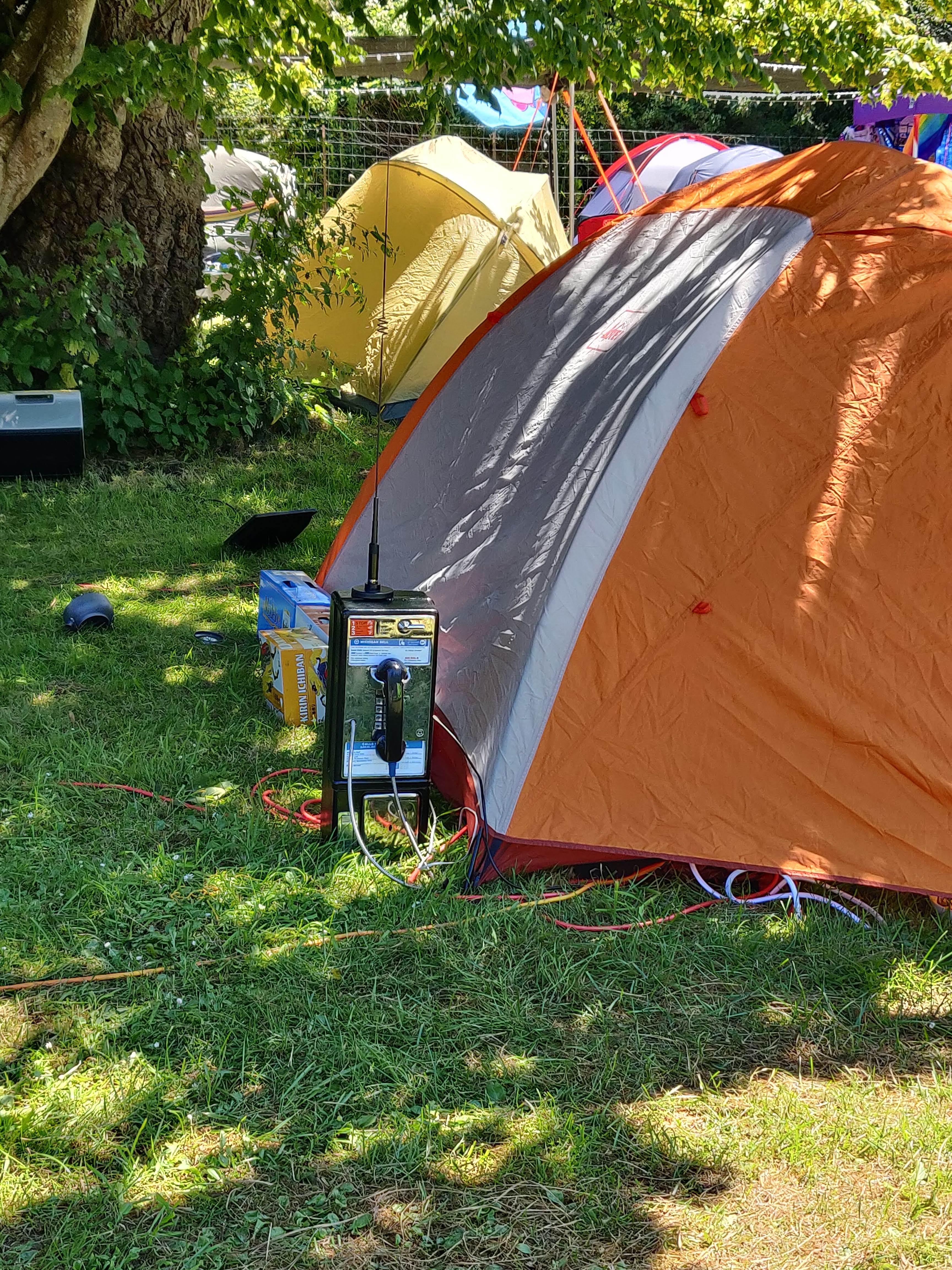
ShadyTel, the extremely local phone company, was also busy running phone lines to any tent that had the correct paperwork filed. I wasn’t sure why I needed a phone line to my tent but I was sure I did. Although it took some time, our village finally got phone service which not only allowed us to place important calls (more on that in a moment) but we could also get dial up internet service set up in the field. Through this we could access the hacker version of capture the flag on a bulletin board service. I didn’t spend enough time trying to hack the BBS, but it was fun to see how far others were able to get.
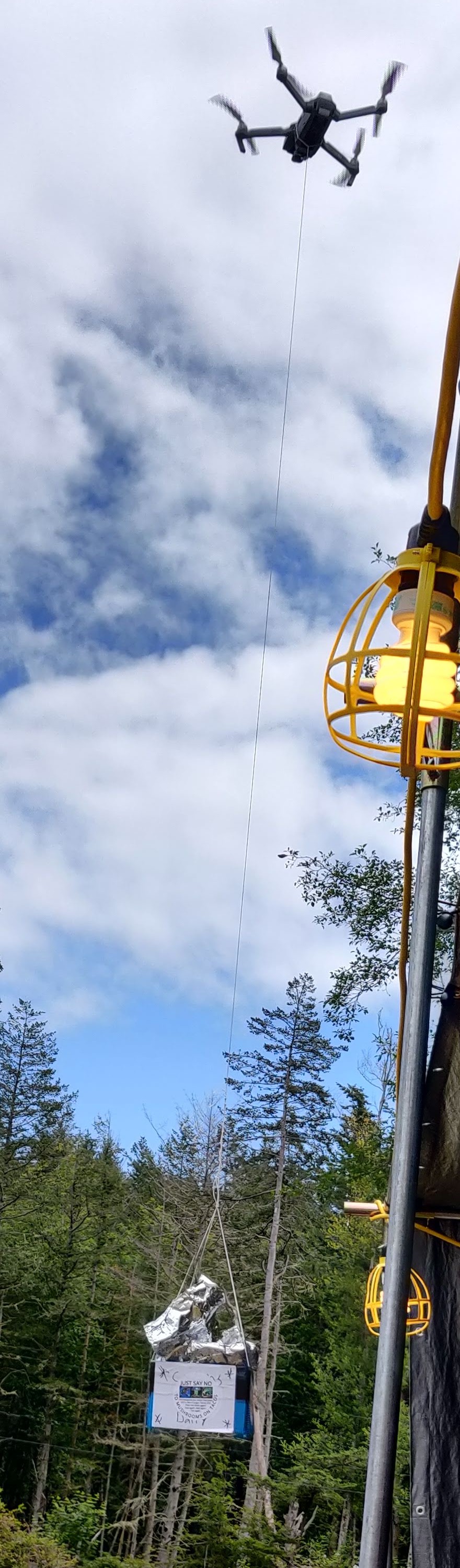
There were plenty of important places to call at camp. You could call to request a song on the pirate radio station or check on your Beerocracy paperwork or call the phone booth and just see who picks up. But, the most popular number to call was 4-NFT because as everyone knows, NFT stands for Nifty Flying Tacos and this is how you would place an order. Let them know how many tacos you wanted and where you were at camp, within minutes, a quad-copter with a basket underneath was zipping towards you carrying tacos. Just wait for them to hover close enough to grab the tacos and they’d zip back for the next order.
Even though this was my first time going, I knew I couldn’t just arrive and receive content without offering something of mine to the group. It is a maker gathering so I brought stuff to make. On the second day, I pulled out my mini electric melt furnace, several kilos of pewter, and some floral foam. I offered an impromptu pewter casting workshop for anyone who wanted to participate. They came in, grabbed a piece of foam, and pressed or carved their design into it. Some even used the CTE pens to design and carve the foam. Once they were happy with the look of it, we carved a pour hole and two vent holes then let the pewter flow. Different designs had varying degrees of success, but overall, I think they had some fun. We had several heart designs cast; we cloned one Shadybucks credit card; and even cast the world’s first two Shadycoins. The virtual currency was now physical. We didn’t get though as pewter as I’d hoped but about 15-18 people made castings.
The next day, I took my other activity over to the kids camp area. I had met a couple of the kids already and encouraged them to make stomp rockets out of a piece of paper, masking tape, and a paperclip. When they launched them, the rockets went about 15 feet. As they went back to improve their designs, I encouraged other kids to participate. Two hours later, I was exhausted and we’d built over 100 rockets. The best ones were flying about 130′ and most of the kids at ToorCamp had built at least one rocket. We even convinced a few of the parents to build them as well.
So many of the workshops I attended were great. I got to build a Blue Box which was used in the ’70s and ’80s to trick the phone systems into allowing you to make free long distance phone calls. We explored desktop milling machines for creating custom circuit boards. I heard from a team developing autonomous sailboats they plan to use for moving cargo throughout the inside passage and around rural Alaskan islands. We got a crash course in a block-based programming language for machine learning. All of these are topics that have come up in student interest surveys back at work (ok, maybe not the Blue Boxes, but they’re still cool). I also got to practice my lock picking and sample some good whisky. Through it all, I was able to pass out or trade away a lot of the CTE pens I’d brought. They turned out to be pretty popular with the crowd at ToorCamp.
The paddle back to Anacortes was much less eventful and significantly less fear-inducing than the paddle over. On the drive home, I started planning projects I could bring to the next ToorCamp in 2024. Whatever I do, I’ll have to leave room to pack more CTE pens.
Overview: This book had been on my To-Read list for a couple of years but took a while to get to the top. It was a fun look at table-top/board games and how we can develop skills through gaming to help in other areas of our lives. It was also (maybe even more so) a quick introduction to a large variety of games. One of the authors helps people find games to play at a game cafe. Parts of this felt like the conversation she would have with you, if you weren’t able to provide her with any feedback about your interests. The book explores different games and different types of games. As far as a book about the benefits of gaming, I think Reality is Broken does a better job, but this book got me excited about going out and playing more games which seems like exactly what it was intended to do.
Highlights:
I believe this truth applies to nearly every game. If you are an absolute perfectionist, there is no room for fun. Likewise, if you are too bored or lazy to even bother trying, it spoils the game for the whole table. To enjoy play, to be playful, the freedom to fail is as essential as the will to succeed.
almost every Eurogame is designed so that final scoring comes only at the end of the game, after some defined milestone or turn limit so that every player can enjoy the experience of being a (nominal) contender until the final moments. If this sounds somewhat Euro-socialistic, that is because it is
pre-twentieth-century, track-based games tended to share one thing in common: your goal would be to lead a virtuous life. This, too, was abandoned by game designers in the postwar period in favor of material wealth.
Whenever you sit down to play a game, whether you realize it or not, you are entering into an unspoken agreement with your fellow players. There is no universally agreed-upon text for the play contract. But if there were, it might include these basic precepts, which flow from our discussion of the magic circle in the book’s first chapter: 1. I agree to abide by the rules of the game as I understand them; no cheating. 2. I agree to take the game seriously enough to make a sincere effort to win; no throwing the game. 3. I agree to not take the game so seriously that it will affect my real-life relationships with my fellow players; no behaving like a jackass. The problem is that the second and third points sometimes come into conflict.
One of the main reasons some bosses micromanage is that they do not have a lot of work on their own desks. Give a boss something to do, and she will tend to give more autonomy to her minions. Likewise, minions who are tired of being told how to tie their shoelaces may rebel against corporate higher-ups by hoarding data within their fiefdoms and throttling the flow of information. The boss cannot micromanage a department she cannot fully survey or understand.
playing games really can provide important lessons for people running companies. In particular, cooperative games such as Pandemic teach us that group dynamics can get more complicated, not less when people are trying to co-operate rather than compete. This is important because most businesses, NGOs, government agencies, social clubs and even families can be thought of in some way as cooperative projects, even if real life tends to lack the well-defined rules and victory conditions you would find in a cooperative board game.
Critics of capitalism often decry the “greed” that animates successful entrepreneurs. The real problem, however, is not the amount of money made by people at the top; it is the systematic suppression of people at the bottom. The real-life equivalent of the Monopoly player who has to mortgage all his money-making assets to pay his debts is the hand-to-mouth day laborer who, unable to pay his car insurance, loses his car and, unable to drive to his job, is unable to pay his rent.
To experience the board game version of this kind of misery vortex in Monopoly is to appreciate the advantages of the welfare state, which, when it is functioning properly, does not just take money from rich people and give it to poor people. It also softens the iterative feedback dynamics within the system so as to ensure that minor nudges—a lost job, a criminal conviction, a divorce, a medical setback—do not create feedback effects that ultimately produce a full-blown personal catastrophe.
While we all know that medieval Europeans had metal pots and swords, few first-time Greenland players will know that Indigenous hunters used a remarkable device called a seal scratcher to simulate the sound of a ringed seal clawing its way through an ice sheet, thereby signaling to other seals that the coast was clear. Greenland is full of marvelous little discoveries like this.
the only way to get really good at Scattergories is to become a horrifyingly inhuman engine of misery and suffering. In other words, the most effective way to play Scattergories is to harm your opponents in real life. The game encourages, indeed, demands that its players violate the magic circle. For this reason, Scattergories is not merely a bad game and unhealthy for your relationships. From my point of view, as someone who considers the play space sacred, it is sacrilegious.
As a Jew whose ancestors were slaughtered by the Nazis, I know something about the crimes against humanity perpetrated by Hitler and his minions. I will admit that it has felt strange to take the German side in a war game but even that sense of unease has its educational side. Notwithstanding the monstrous nature of the Nazi regime, the young men who took up arms for the regime were flesh-and-blood human beings whose manner of warfare shaped the history of Europe. They, and their ways, deserve study for their own sake.
Overview: I typically read one fiction book each year. I have no real reason for this other than I noticed a few years ago that it seemed to be a pattern so I decided to make it an informal rule for myself. After reading the Three Body Problem trilogy over the last several years, I didn’t have any fiction books jumping out at me. Not sure where I found this but really enjoyed it. It’s a fast read and had a similar futuristic-environmentalist feel of Ecotopia. I also don’t usually take notes in fiction books, but I felt this one had a few really good lines. The second book in this series comes out next month and I think it will be my first read of 2023.
Highlights:
Sometimes, a person reaches a point in their life when it becomes absolutely essential to get the fuck out of the city.
all of it could be boiled down to listen to people, give tea.
The whole reason they never went into those fields before is because they were afraid. They lived under constant fear of a wild dog jumping out and eating them or their young at any moment. That is an awful way to live. It must have been such a relief to be free of predators and eat whatever the hell you wanted. But that was the exact opposite of what the ecosystem needed. The ecosystem required the elk to be afraid in order to stay in balance. But elk don’t want to be afraid. Fear is miserable, as is pain. As is hunger. Every animal is hardwired to do absolutely anything to stop those feelings as fast as possible. We’re all just trying to be comfortable, and well fed, and unafraid. It wasn’t the elk’s fault. The elk just wanted to relax.”
“So, the paradox is that the ecosystem as a whole needs its participants to act with restraint in order to avoid collapse, but the participants themselves have no inbuilt mechanism to encourage such behavior.” “Other than fear.” “Other than fear, which is a feeling you want to avoid or stop at all costs.”
It is difficult for anyone born and raised in human infrastructure to truly internalize the fact that your view of the world is backward. Even if you fully know that you live in a natural world that existed before you and will continue long after, even if you know that the wilderness is the default state of things, and that nature is not something that only happens in carefully curated enclaves between towns, something that pops up in empty spaces if you ignore them for a while, even if you spend your whole life believing yourself to be deeply in touch with the ebb and flow, the cycle, the ecosystem as it actually is, you will still have trouble picturing an untouched world. You will still struggle to understand that human constructs are carved out and overlaid, that these are the places that are the in-between, not the other way around.
“‘Without constructs, you will unravel few mysteries. Without knowledge of the mysteries, your constructs will fail. These pursuits are what make us, but without comfort, you will lack the strength to sustain either.’”
the Child Gods aren’t actively involved in our lives. They’re … not like that. They can’t break the Parent Gods’ laws. They provide inspiration, not intervention. If we want change, or good fortune, or solace, we have to create it for ourselves.
Overview: There aren’t a lot of authors I return to for new books. Many seem to cover similar topics in a slightly different light and present it as something completely new. Ijeoma does not. She presents a similar message is in each that I’ve read, “The systemic racism in America is hurting everyone and we all need to work to rectify it.” But each book presents that message in a unique way and she includes new examples each time. Depressing as it is that she has so many examples to select from, she again weaves them into a compelling story in this book and I’m sure I’ll be reading another one of her books soon.
Highlights:
I am not arguing that every white man is mediocre. I do not believe that any race or gender is predisposed to mediocrity. What I’m saying is that white male mediocrity is a baseline, the dominant narrative, and that everything in our society is centered around preserving white male power regardless of white male skill or talent.
How can white men be our born leaders and at the same time so fragile that they cannot handle social progress?
White male identity is not inborn—it is built. This identity is not designed to be its most intelligent, most productive, most innovative self. The aspirational image of white maleness is meant to be far less than that. Elite white men don’t need actual competition from rising and striving average white men. Instead, this status becomes a birthright detached from actual achievement. It is an identity that clings to mediocrity.
help solve the “Indian Problem” once and for all. Sheridan reached out to William Tecumseh Sherman, who had distinguished himself with his scorched-earth battle tactics during the Civil War, for advice. Sherman observed that wherever buffalo existed, there would be Native people, and they would continue to fight for land wherever the buffalo roamed. Sherman’s advice to Sheridan was simple: remove the buffalo in order to remove the Indian. “I think it would be wise to invite all the sportsmen of England and America there this fall for a Grand Buffalo hunt, and make one grand sweep of them all,” Sherman wrote to Sheridan.
In the mid-nineteenth century, white men in England and the United States began to worry about their young men. These young men had it too easy; their wealth and comfort had made them soft. In the United States, a country still fighting to retain the land it had stolen from Native people, this softness could threaten the expansion of America across the continent. The call for white men of America to maintain physical power was not just political; it was a spiritual calling. The rise in popularity of Muscular Christianity in the United States and Europe during this time gave white male elites a religious mandate to conquer both rugby fields and battlefields. According to practitioners of Muscular Christianity, physical softness in men had undermined traditional masculinity and had led to intellectual and moral softness.
“Masculine” theater, dime novels, and adult male fiction steeped in grit and violence known as “red-blooded realism” became increasingly popular, in large part due to the threat of the widespread success of women writers like Harriet Beecher Stowe and Susan Warner (whom author Nathaniel Hawthorne dismissed as a “damn’d mob of scribbling women”),13 and of plays geared toward women audiences.
“This continent had to be won,” Cody wrote. “We need not waste our time in dealing with any sentimentalist who believes that, on account of any abstract principle, it would have been right to leave this continent to the domain, the hunting ground of squalid savages. It had to be taken by the white race.”18 Manly men were quick to sing the praises of a stage show that opened with the scalping of an Indian and then moved through gunfights, horseback riding, cattle roping, and more fantastic feats of masculinity.
After three days, Ryan’s mother relented and began making lunches from home again. Nothing says “American” like a boy making a woman struggle so that he can seem independent.
The land was promised to the Paiute people by the federal government in 1872. But the government had no interest in keeping white colonizers from settling there. The Paiute people took their grievances to the US government, and they were rebuffed. White settlers were incredulous that the Paiutes thought they had any right to the land. An editorial in the Idaho Statesman summed up the popular opinion toward Native claims on land: “The idea that the Indians have any right to the soil is ridiculous.… They have no more right to the soil of the Territories of the United States than wolves or coyotes.”
Max Eastman was a founder of the New York Men’s League for Woman Suffrage, which sounds pretty cool, right? However, one of the first things Eastman did was make a promise to the men who signed up that “no member would be called upon to do anything. The main function of the league would be to exist.”8 In the battle for women’s suffrage, in which women literally fought and died, men become heroes by simply existing.
When Biden, a young, liberal Northern senator whose star was on the rise, came out strongly against busing, it gave other liberal senators permission to do the same. Instead of a stance taken only by the likes of George Wallace in order to preserve white supremacy, antibusing as framed by Biden became an issue that white liberals could stand behind without questioning their racist motives. The majority of Black voters at the time still supported busing to desegregate schools, but their concerns were drowned out by the wants of the white majority.
Fewer students overall were entering colleges to join the clergy, but the vast majority of students were still white men from elite families. Universities were seen more as finishing schools for wealthy white men on their path to inheriting leadership than places for practical education. In fact, early degrees were often awarded in graduation ceremonies that recognized the students not by order of achievement or even field of study but by family rank.
Lowell claimed that he was not antisemitic or racist; he just believed that the increasing number of Jewish students would drive away students who were antisemitic.
Brigham’s test was quickly rolled out to high schools and by 1926 was used by many colleges and universities across the country to help them select students most likely to find academic success in their halls. But by 1930, Brigham had rejected his own eugenics-based tests. He’d found some fundamental flaws in his methodology. In particular, he had come to realize that what his tests showed, instead of intelligence, was the test-taker’s ability to speak English, attend good primary schools, and demonstrate a strong familiarity with white culture. He wrote a refutation of his earlier army research in a paper titled “Intelligence Tests of Immigrant Groups” and later denounced the SAT tests that he had based on that research, but by then it was too late.
When the Great Recession hit, higher-education budgets were among the first items to be cut as state budgets plummeted; overall, states collectively reduced their annual education funding by $9 billion in the years 2008–2017. Colleges responded by passing a sizeable amount of their expense burden on to students. Even though the recession is years behind us, most states have not increased their education funding to even prerecession levels. Adjusting for inflation, states still paid on average 10 percent less on education per student in 2017 than they did in 2007.
Southern whites tried multiple tactics to get Blacks to stay. They cut the wages of Black workers so they couldn’t afford transportation north. They refused to cash paychecks for Black workers if they had a suspicion that the money would be used to finance travel north. Lawmakers made the recruitment of Black workers to the North illegal and started jailing recruiters who showed up in Southern cities. They printed horror stories of Black Northern life in local papers. They refused to sell bus and train tickets to Black travelers.
In 2017, when researchers from Harvard Business School looked at the socioeconomic histories of various regions of the United States to determine which factors supported economic growth and innovation, they found a lot of interesting patterns. They found that places that were more economically and socially open to diversity were more conducive to innovation in business and technology. They also found that having once been a slaveholding state was a good predictor of stagnant economic growth, based on past growth patterns.
When Wallace first ran for governor of Alabama in 1958, he conducted a relatively progressive campaign. He was outspoken against the KKK and was even endorsed by the NAACP. And he got his ass handed to him in the primary by an openly racist candidate, John Malcolm Patterson. In defeat, Wallace learned that his path to electoral victory did not lie in peace and love. After the election, Wallace was quoted as saying to his friend Seymore Trammell, “I was outniggered by John Patterson. And I’ll tell you here and now, I will never be outniggered again.”
The percentage of women workers increased because as men were losing jobs and income, more women needed to enter the workforce to help provide for their households. If a husband or father lost his job or was forced to take a large pay cut, then the additional income from a wife’s or daughter’s job might just help a family scrape by. (That said, the wages of women were not nearly enough to replace the incomes of men—especially when incomes were reduced by businesses that took advantage of a desperate job market to slash the wages of male workers.) Ironically, employment that was considered “women’s work” or “colored work” (primarily service and domestic work) was far less impacted by the Great Depression.
“The Negro was born in depression. It didn’t mean too much to him, the Great American Depression, as you call it. There was no such thing,” recounted Clifford Burke in Hard Times: An Oral History of the Great Depression. “The best he could be is a janitor or a porter or shoeshine boy. It only became official when it hit the white man. If you can tell me the difference between the depression today and the Depression of 1932 for a Black man, I’d like to know it.”
possible ways to deal with women workers after the war, including those who wanted to keep working. Possible solutions include treating housework and child-rearing more like “a profession” and establishing training programs on household management. Another is to pay women not to work. The prospect of women staying in the workplace so long as men helped them with household chores in order to lighten their burden is briefly floated but immediately dismissed as too upsetting to the “traditional scheme of things.”
When Pao resigned she was replaced by Reddit cofounder Steve Huffman. He didn’t roll back the changes that Pao had implemented—the ones that apparently had caused so much outrage with Redditors—and yet, for some mysterious reason, the outrage ended. The protests stopped; the popular subreddits were taken out of their private settings.
“The very foundation of football in this country comes out of fears of ruling-class mediocrity and [fears of] the mediocrity of their own children.”
This manipulation is unsurprising when we remember that many NFL teams started as company teams as a way to pacify and control workers. Teams like the Decatur Staleys (which became the Chicago Bears) were developed to keep workers busy and happy, and to foster company loyalty during times of union upheaval.