WA-ACTE Summer Conference Presentations on Robotics and Lock Picking

(Updated: Additional links requested in the session at bottom)

I’m presenting to middle and high school CTE teachers at this year’s WA-ACTE Summer Conference on two topics: Robotics and Lock Picking. The “Lockpicking and other mischievous way to learn engineering” looks at using lock picking as a way to get students excited about learning how locks work and how to use tools to make lock picks. My other talk is “DIY Robotics – Affordable Robotics for Every Classroom and Beyond“. In this one, I cover common issues with robotics in the classroom (cost of the robotics kits being the biggest one) and how we can use open source robotics systems like Arduinos to overcome many of these problems. Below are resources for anyone interested in getting started with robotics in the classroom. If you want to try using Arduinos in your classroom, feel free to contact me with questions. Unlike the prepackaged kits, there isn’t a company to reach out to with questions so the community has to help each other.

What do you need to get started?

  • Arduino – You certainly need one of these but Arduino isn’t just one thing, there are many types of Arduinos that have different characteristics so which one to pick. In Renton Schools, we opted for Arduino Nanos originally and are now switching to the Leonardo. Both are great, especially for mobile robots. If you’re just getting started with Arduino, get the Uno. Note that Arduino is open source so anyone can manufacture Arduino-compatible boards that usually cost less than official Arduinos. This is intentional. Also, you can find Arduino (both official and third-party) on many other websites that will give different levels of support/price. For lots of support look at places like AdaFruit (their Uno equivalent is called “METRO”) and for no support but lower prices, check AliExpress.
  • USB Cable – Often your Arduino will come with one, but not always. Just note which type it requires (mini, micro, USB-C, etc) and if it didn’t come with one, you likely have an old cable in a drawer that will work.
  • Programming Environment – This is where you write the code before loading it onto your Arduino. I’ll outline several options for this below. For now just know that you need a computer with some software installed to program your robot.

That’s all you need to get started. After the basics, you’ll want to start getting sensor, motors, lights, speakers, and all the other items to make your robot do everything you want. For now, we’ll just look at programming the built-in LED to keep things as simple as possible

Programming Environments

There are different ways to program your Arduino. Most online tutorials will assume you’re writing code but there are block-based coding languages as well. These are helpful for younger students and people just getting started with coding.

  • Arduino IDE – This is the default programming environment. You can download it for free and install it on Windows, Mac, or Linux machines. There isn’t a version for Chromebooks. They do offer an online editor that can work with ChromeOS, but I haven’t had good luck running it on Chromebooks at our schools.
  • Makeblock or mBlock – This is an online editor that works with Chromebooks. It also defaults to block-based coding and will translate your blocks into Arduino code that you can see on the right side. You have to install a plug-in to allow it access to your USB port for uploading code. You also need to tell it you’re using at Arduino when starting. Do this by clicking “Add” on the Devices tab on the right edge of the screen and selecting the Arduino you’re using.
  • CodeBender – This is another online editor, but only allows for text based coding. I’m not a huge fan but I know many teachers have experience using CodeBender for other projects so if you’re already comfortable with it, give it a try

Blinking LED

The first project to try when starting is blinking the built-in LED. Below is the code in both the Arduino IDE and mBlocks. In both examples, we blink the built-in LED on pin 13 on for one second and off for one second.

Using Arduino IDE, you always need to have two sections of code “void setup()” and “void loop()”. The setup runs once when the Arduino turns on, then goes to the loop code with continues to run over and over until you unplug it. In the setup part of this code, we only tell the Arduino that we’re using pin 13 as output. In the loop section, we turn on pin 13 (set it to high), wait a second, turn pin 13 off, and wait another second before repeating it.

After the code is written, click Tools >> Board and select the type of Arduino you’re using (Nano, Leonardo, Uno, etc). Then click Tools >> Port and select which port on your computer it’s connected to. Now click the arrow at the top (next to the check mark) to load your code onto your Arduino and watch the LED blink. Now try changing the code to make it blink in a different pattern like on for two seconds and off for 1/4 second.

With mBlock, once you’ve added your Arduino on the Device tab, you can start coding with the “when Arduino starts up” block in the Events section. Next add the other blocks shown above to turn pin 13 on (set output to high), wait 1 second, turn pin 13 off, wait another second, and repeat forever.

Make sure your Arduino is plugged in and click Connect. It will ask what port you want to use and usually only gives you one option. Once connected, you can click Upload Code to see it work. You can also click the “Arduinoc” tab to see the text-based code. Now change the code (either the blocks or the text) and see if you can get the Arduino to blink in a different pattern.

Project Ideas

Now it’s time to start building more advance projects but what to build? You could build a mobile temperature sensor or temperature logger, create a digital egg for an egg drop challenge using an accelerometer, or start building a $20 mobile robot. If none of those are exciting enough, there are plenty of project ideas online:

  • Arduino Project Hub – The Arduino website hosts a repository of different projects from simple to very advanced. There will certainly be a project there for anyone.
  • Instructables – There are over 200 Arduino project on there. Some are very well written and other leave a lot for you to figure out along the way. If you’re just looking for ideas, this is another great place
  • Student imagination – Your students will be able to come up with too many project ideas. Many will be much more complex than they are able to create, but if they break the large project ideas down into smaller and smaller pieces, they will find the intersection of their dreams and the edge of their skills. Have them start there then learn, build, and expand the project until it can do much more.

You now have the basic. Create some cool projects, reach out if you have questions, and please send me photos of what you create.

Update with additional resources requested during the session

  • Renton Custom Leonardo Projects – Several of you asked for resources related to the custom Renton CTE Arduino Leonardo. This site shows a few basic projects and how individual components can be combined into larger projects
  • Class projects and guide – We discussed the list of projects I have the students go through during their first Tri to understand the basic of Arduinos. This page list those projects and walks you through many of them. The formatting was corrupted a bit when Google switched from Classic Sites to the new version but hopefully the content is still good. This is based on the Arduino Nano which is easy to get on any of the sites listed above
  • Robotics Parts List – The most common question was where to buy supplies. This page was badly corrupted so the formatting is terrible (working on it). The most common links people wanted were for:
    • Chassis – The chassis are from Feetek (the spelling changes sometimes so don’t worry if it’s a bit off). I found it here before and ordered the FT-MC-005 which doesn’t seem to be available currently. I’ve emailed with them before and they’ve been super helpful getting the FT-MC-005 even when it wasn’t shown. If not, the other option to get the same thing is to “Start Order Request” on this page and explain that you want the 2WD Chassis with servos (the other option is for geared motors. Servos have 3 wires and are what all my examples use. Geared motors only have two wires and require an additional piece of hardware.)
    • Storage Boxes – These are small, inexpensive storage boxes that will hold the robots and are easily stackable
    • Arduinos – You can get these on  Amazon or AliExpress for a little less
Posted in Education, Maker | Tagged | 1 Comment

When Driving Is Not an Option

Title: When Driving Is Not an Option: Steering Away from Car Dependency

Author: Anna Zivarts

Completed: July 2024 (Full list of books)

Overview: I met Anna a couple of years ago when our kids did gymnastics together. Out of the 100+ families at the gym in a very walkable part of Seattle, Anna was the only other parent I saw who arrived without a car. After parking our bikes next to each other several weeks in a row, we started talking (first about the lack of a bike rack).

Although our kids have both stopped doing gymnastics, our families have remained friends and I was very excited to read this book when it came out. Some parts seemed obvious to me as a bike commuter while others points were news to me. My biggest surprise was the percentage of people in the US who can’t or don’t drive. I’m now thinking of all the families in Renton Schools where I work who don’t drive and how invisible they are at school drop-off. Perhaps we should get the District Admin to take the Week Without Driving challenge.

Highlights:

  • In Seattle, the route 7 bus that I took to and from work was always packed. I’d have to negotiate room for my toddler and his stroller to squeeze in with the other moms, many of them immigrants from East Africa, with seniors pushing grocery carts returning from shopping trips in the International District, with young men getting off at Lowe’s to look for work as day laborers, with blind and deafblind workers on the way home from their shifts at the Lighthouse, with groups of high school students in the afternoons. Sitting on the 7, I started to think about what it would take to build a coalition with everyone on that bus, where we could fight for more reliable transit, for smoother sidewalks and nicer bus stops, for affordable housing close to where we needed to go.
  • ONE-THIRD OF PEOPLE LIVING IN THE UNITED STATES don’t have a driver’s license.1 This includes people like me who cannot drive because of a disability. It also includes young people, immigrants, people with suspended licenses, and people who have aged out of driving. Additionally, there are many people with licenses who can’t afford to own a car or pay for insurance, parking, or gas. But because of who the majority of nondrivers are—disabled and poor people, unhoused or recently incarcerated individuals, undocumented immigrants, kids, young people, seniors aging out of driving—we are largely invisible,
  • Seven percent of American households do not own a car, and an additional 17 percent of households have a “vehicle deficit,” meaning they have more adults than vehicles.
  • If you ask someone from the United States what image comes to mind when they think about disability, it’s probably a disabled parking spot sign. These signs with a stick figure in a wheelchair are probably the most, if not the only, visible manifestation of disability in many public spaces. But the reality is that many disabled people can’t drive or can’t afford cars. People with disabilities are four times less likely to drive than nondisabled people, and two to three times more likely to live in a zero-vehicle household.
  • Many people who are disabled must remain in poverty in order to qualify for needed health care or home care support, support services that wouldn’t be covered even with “good” health care coverage from an employer. Tamara Jackson, a policy analyst for the Wisconsin Board for People with Developmental Disabilities and co-chair of the Wisconsin Non-Driver Advisory Committee, explains: “The reality is that you have a system where pre-poverty is a prerequisite.” A 2020 report on employment and disability from the National Council on Disability describes this “poverty trap,” explaining that many disabled people “agonize over the choice between maintaining the health care that they need to live and work, or a job that they are qualified for and desire, given the asset limitations imposed by means-tested programs that are attached to health care.”
  • When our communities are designed to work best for, and only for, car-based mobility, the cost of not driving is unemployment and foregoing basic needs. So, people will choose to buy and maintain a vehicle, despite it being a significant financial burden and stressor.
  • I also depend more on my block community than perhaps many of my neighbors who can drive. I don’t have the ability to jump in a car and go visit a friend across town in an easy fifteen minutes or head out of town to the woods or the mountains on the weekend. My block is really the heart of my social and recreational world and where I spend most of my time, and I believe that’s something to aspire to.
  • WHAT NONDRIVERS NEED—what we all need—is a transformation of the way we organize mobility, housing, and public space so that we have options for getting around that do not rely on driving a car. We need safe, connected places to walk, roll, and ride; transit that is as reliable as driving; and land use and remote access opportunities that reduce how much we have to travel.
  • For many years, transit riders who lack the resources or ability to drive were referred to as “captive” riders (now we use the slightly better, though still condescending, term “transit dependent.”) As outlined in Nicholas Bloom’s 2023 book, The Great American Transit Disaster,22 decades of racialized underinvestment and neglect have resulted in a second-class system that is, in most American cities, viewed as a social service for those unfortunate enough to lack access to a car. The view that transit is for those who don’t have other choices, and therefore those of us who ride transit will take whatever we can get, still lurks deep within many conversations around transit funding and service. It’s time to call out the racist, ableist, and classist undertones of this assumption and invest in transit so that it becomes the reliable, comfortable choice to get us where we need to go.
  • As employers began to rehire after the initial pandemic layoffs, in many cases making telework an option for the first time, disabled workers had new job opportunities. In research published in late 2022, Ari Ne’eman, a doctoral student in public health at Harvard, found that from the last quarter of 2021 through the second half of 2022, employment gains by disabled people outpaced employment gains for nondisabled people by 14 percent.
  • From his experience in Bellingham, Comeau believes much of the most difficult work is in convincing the public that reducing congestion shouldn’t be the overarching priority of local government. He insists we need leaders who are willing to be straightforward with how our communities must change:   We’re gonna densify. There’s going to be more people living here in the future, and we need you all to get ready. That includes more traffic in certain places, and you’re going to have to get used to it. We’re not going to widen our streets just because it’s not as easy to drive anymore. We want it to be easy to walk. We want it to be easy to bike or get on a bus or cross the street to a bus stop. Nobody enjoys traffic congestion, myself included. But that’s literally the trade-off for focusing on density and people-oriented infrastructure. You cannot continue to make it easy to drive or park a car if you’re trying to plan for people.
  • Imagine a highway department staffed entirely of people who do not drive. Maybe they ride as passengers in cars sometimes, or drive when out of town on vacation, in other countries where more people drive, where driving is easier, more comfortable, and more convenient. Our perspective of what a transportation system should look like would be heavily influenced by what people walking, rolling, and taking transit need. Would we be able to know what would work best for drivers at a highway interchange? Probably not, and yet the inverse of this is the reality for most of the people in charge of our transportation system, to the point where it’s still revolutionary to suggest that engineers or planners get out of their cars and try walking or biking a road project to experience how it works for people outside of cars.
  • An easy step for employers is to stop requiring driver’s licenses for jobs where driving isn’t an essential function. This one seems pretty simple, but I find driver’s license requirements all the time on new transportation planning, admin, and engineering postings. Someone explained once that a driver’s license requirement was a default setting on their internal HR system for job posts, and so until those HR settings are turned off, it will be the default on every new posting.
  • Remember the school drop-off paradox. When you choose to drive, you make it more dangerous and less comfortable for other kids to access school or activities without a car. Consider how parents and caregivers who can’t drive get to the activities you take your child to. Is there a nearby transit stop? Is there a well-lit sidewalk? Is there bike parking?
Posted in Biking, Lit Review | Tagged , , , , | Leave a comment

LilyTiny

It’s time for ToorCamp again and this year I’m helping people learn to program LilyTiny microcontrollers. You can use these at the Fairie Yurt to control the EL wire (prototyping this currently) or over at the Maker Stage to create wearables with LEDs or sensors. I plan to update this with photos as projects are completed but want to offer the basics for programming here so anyone at Toor can start modifying them.

Also, if you’re at Toor and want to play with one of these, I am giving away plenty. Stop by OlyMEGA and ask.

To program these the first thing you need is to install the Arduino IDE. Next you’ll need the ATTiny85 driver. The Windows Driver is here. Linux didn’t need this but required another step later (see below). I’ll add that and the Mac directions on an update.

Then we need to add this in the Arduino IDE to File >> Preferences >> “Additional Board Managers URLs”: https://home.drownedchipmunk.com/lilypad//package_digistump_index.json Now close the preference window and open Tools >> Board >> Board Manager, search for Digispark, and install the first one. You’re now ready to program. This seems like a lot but if you’re at Toor, I can walk you through it quickly and you can get to the fun part.

Finally, here’s some basic code for the LilyTiny to control LEDs or EL to blink/fade depending on which pin you connect to. Good luck and please share your projects

/* Default program for wearables and sew-ables using the LilyTiny (Lilypad with ATTiny85
 *  Slow and Fast set how long the cycles are
 *  Pin 0: Fast Fade
 *  Pin 1: Slow Fade
 *  Pin 2: Fast Blink
 *  Pin 3: Slow Blink
 *  Pin 4: Random (Not yet implemented)
 */
const int Slow = 2000;
const int Fast = 250;
int Bright;
// the setup function runs once when you press reset or power the board
void setup() {
  // initialize digital pin LED_BUILTIN as an output.
  pinMode(0, OUTPUT);
  pinMode(1, OUTPUT);
  pinMode(2, OUTPUT);
  pinMode(3, OUTPUT);
 // pinMode(4, OUTPUT);
 // pinMode(5, OUTPUT);
}
// the loop function runs over and over again forever
void loop() {
 //Fast Fade on Pin 0 
  if((millis()%(Fast*2))>Fast) Bright = map((millis()%Fast), 0, (Fast-1), 0, 255);
  else Bright = map((millis()%Fast), 0, (Fast-1), 255, 0);
  analogWrite(0, Bright);
 //Slow Fade on Pin 1 
  if((millis()%(Slow*2))>Slow) Bright = map((millis()%Slow), 0, (Slow-1), 0, 255);
  else Bright = map((millis()%Slow), 0, (Slow-1), 255, 0);
  analogWrite(1, Bright);
 //Fast Blink on Pin 2
  if((millis()%(Fast*2))==0)digitalWrite(2, HIGH);  
  if((millis()%(Fast*2))==(Fast))digitalWrite(2, LOW);    
 //Slow Blink on Pin 3
  if((millis()%(Slow*2))==0)digitalWrite(3, HIGH);  
  if((millis()%(Slow*2))==(Slow))digitalWrite(3, LOW);   
}

Linux Installation

In addition to installing the Arduino IDE, adding the json file, and installing the ATTiny85 boards in the Board Manager, you need to do two other thing pointed out on this page. You need to add your username to the dialout group with the following command. (If you already program Arduinos, this step is already done).

sudo adduser $USER dialout

You also need to create the file /etc/udev/rules.d/49-micronucleus.rules and adding the following code to it.

# UDEV Rules for Micronucleus boards including the Digispark.
# This file must be placed at:
#
# /etc/udev/rules.d/49-micronucleus.rules    (preferred location)
#   or
# /lib/udev/rules.d/49-micronucleus.rules    (req'd on some broken systems)
#
# After this file is copied, physically unplug and reconnect the board.
#
SUBSYSTEMS=="usb", ATTRS{idVendor}=="16d0", ATTRS{idProduct}=="0753", MODE:="0666"
KERNEL=="ttyACM*", ATTRS{idVendor}=="16d0", ATTRS{idProduct}=="0753", MODE:="0666", ENV{ID_MM_DEVICE_IGNORE}="1"
#
# If you share your linux system with other users, or just don't like the
# idea of write permission for everybody, you can replace MODE:="0666" with
# OWNER:="yourusername" to create the device owned by you, or with
# GROUP:="somegroupname" and mange access using standard unix groups.

If you need additional details, the linked page above provides more insight.

Posted in Education, Maker | Tagged , , , | Leave a comment

Rebar Ladybug

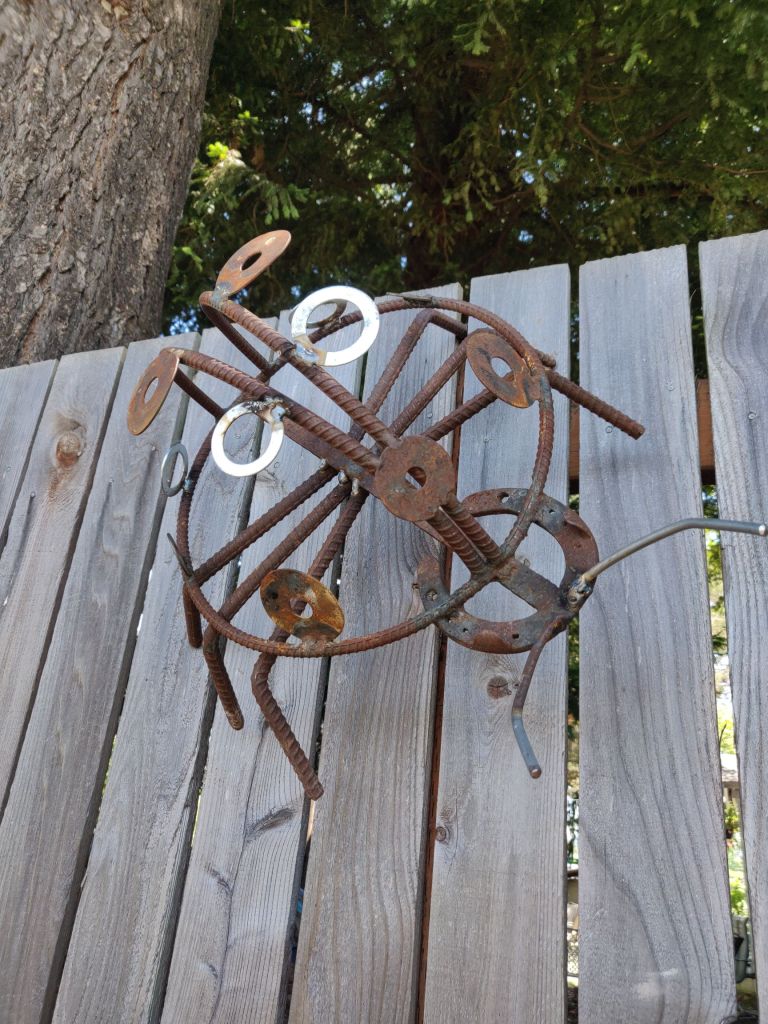
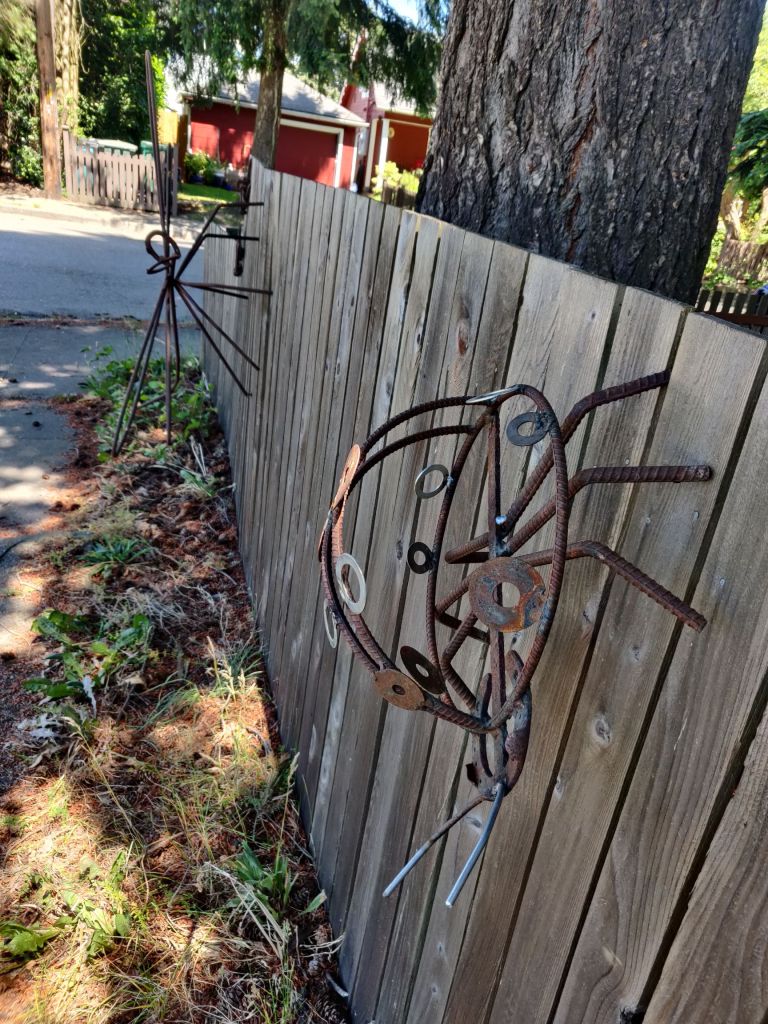
A few years back, I made a rebar dragonfly. Shortly after I started work on a ladybug to join the dragonfly on the fence, but ran out of welding gas before finishing. For over a year it sat there, slowly losing pieces. I still haven’t refilled my gas canister but I took it into work and used the welder there. It’s now hanging on the fence with the other welded art I’ve done. Next up… maybe a bee or an ant? Comment any suggestions below.

Posted in Maker | Tagged , , | 2 Comments

Get the Picture

Title: Get the Picture: A Mind-Bending Journey among the Inspired Artists and Obsessive Art Fiends Who Taught Me How to See

Author: Bianca Bosker

Completed: June 2024 (Full list of books)

Overview: About a year ago, I was asked to support high school art teachers at work. A few months ago, middle school art teachers were added as well. The trouble is my background in art is very limited. I enjoy welding pieces, but my art history knowledge and skill with a paintbrush are both severely lacking. While this book did not improve my painting or provide me with all the history of “The Art World,” it did show me there are many “art worlds” and that I’m not as far removed from some of them as it feels. Bianca also offers insight into how to better connect with art, find art that speaks to you, and incorporate art into our lives. After reading this, I feel better prepared to help all the art teachers in our district… until next year when I’m expected to support the Ag Science teachers, but that will require a different book.

Highlights:

  • modernists were pushing white as the new neutral. But it was the Nazis who helped perfect what we now think of as the white cube. The Nazis’ first foray into architecture-as-propaganda was building none other than an art museum, which opened in 1937 with tall ceilings, spotless white walls, gleaming floors, sparsely hung art, and bright overhead lighting—a design ethos that failed artist Adolf Hitler praised as a brick-and-mortar manifestation of his quest for “cultural purification.” From then on, the look became so popular that, historian Charlotte Klonk observes, “one is almost tempted to speak of the white cube as a Nazi invention.”
  • Jack had mentioned that he used to love the meticulous black-and-white photographs made by the artist Hiroshi Sugimoto. Now, however, Jack considered them—kiss of death—“decorative.” His key criticism of the work: “It’s just very technically skilled.”
  • In 1917, Duchamp blew minds when he took a porcelain urinal, turned it on its side, and declared it a sculpture. (He dubbed art made from existing things “readymades.”) Besides Fountain (the sculpture of the urinal), Duchamp made pieces such as Bottlerack (literally, a bottle rack) and In Advance of the Broken Arm (just a snow shovel, albeit one with a sense of humor). Duchamp believed art needed to evolve beyond the so-called “retinal art” he saw his peers making—paintings of reclining nudes and impressionistic water lilies that, Duchamp sniffed dismissively, were “pleasing” and “attractive” objects that tickled the eye without stimulating the mind. “I was interested in ideas—not merely in visual products,” Duchamp wrote.
  • You can stick a stroller in a garage and get a few mechanics to claim it’s a car, but that does not mean the stroller can do sixty miles an hour on the freeway. But put a urinal in a gallery and get critics to extol its artistic essence, and the urinal becomes a sculpture. There are many schools of thought on looking at art, including isolationists who will wave away context and tell you that anything beyond the artifact itself is irrelevant. But I didn’t know any isolationists. The mood in the room was that fine art was what influential insiders said it was, hence the importance of attaching the right names (the right context) to whatever you were doing.
  • Barbara Guggenheim—whose last name is chiseled on museums around the world—in her book Art World. “Gallerists and collectors are quick to snap up quality artists, leaving few good ones, if any, languishing in obscurity.” So it’s pure coincidence, then, that the artists languishing in obscurity tend to be overwhelmingly women and people of color, while the “quality artists” in major American museums are 85 percent white and 87 percent male.
  • Fumbling for words early on, I had occasionally—and very regrettably, I now saw—praised artists’ work as “beautiful.” Since then, I’d had it drilled into me that beautiful meant “decorative” and decorative meant “dumb,” and the only graver insult was “accessible,” which beautiful art was assumed to be.
  • “Just walk up to a piece and try to think of five things that it brings up,” she suggested. Not five things that the art is about. The observations don’t need to be grandiose, like this probes masculinity in the postinternet age. Just, what are five things you notice, either in the work or in how it makes you feel. “Like, that red is very cool or very warm . . . That shape really dominates the canvas . . . I love how that paint is gushy and then it thins out,” Gina said, ticking through formal features. “All those things are important, and they’re intentional.” I thought of Julie wrestling with her blue sky. Painting is constant decision-making.
  • beauty appears to be hardwired in our brains. “Beauty is one of the ways life perpetuates itself, and love of beauty is deeply rooted in our biology,” writes psychologist Nancy Etcoff in her book Survival of the Prettiest. Like the innate preference for sweetness that makes newborns smile when they drink sugar water, scientists like Etcoff hypothesize that humans have evolved to find certain forms more attractive than others (a theory that undermines the idea, espoused by some, that what we find beautiful has been imposed on us by a corrupt cabal of Don Draper types). Exactly which visual features constitute the “aesthetic primitives” that humans innately consider beautiful is still being researched, but there are a few promising candidates. People across diverse cultures and age groups prefer curved shapes to angular ones—a preference that holds constant across things, rooms, patterns, and abstract shapes, as well as one we share with rats, chimps, and gorillas. Humans—like squirrels, crows, and capuchin monkeys—also prefer symmetrical designs to asymmetrical ones, and, perhaps unsurprisingly, we prefer colors (like blue) that we strongly associate with pleasant things (like clean water), while we dislike colors (like brown) that we strongly associate with things we avoid (like feces).
  • Today we hail Picasso’s Les Demoiselles d’Avignon as art and dismiss a needlepoint pillow that says “NAP QUEEN” as lowly “craft”—certainly not the sort of thing we should stare at in museums, waiting to feel transformed. Yet the notion that fine art exists in a special category unto itself and moves us more deeply than mere stuff is actually a recent invention, one that’s newer and more European than the cuckoo clock.
  • ancient Greece and Rome. “Art” meant any activity requiring human ingenuity and skill. Training horses, painting vases, passing laws, writing poems, singing songs, sewing clothes, blowing glass: art, art, and more art. While in ancient Egypt the “chief sculptors” who worked on royal tombs enjoyed a privileged status, among the ancient Greeks and Romans, painters and sculptors got lumped in with farmers, cobblers, and other manual workers who did physical labor for a fee—“suppliers of a commodity on par with shoemakers,” writes one archaeologist, describing Greek artists circa the fifth century BCE.
  • One survival-of-the-most-artistic hypothesis contends that art is our version of peacock feathers: An extravagant, frivolous display by which paleolithic humans showed potential mates that they were fit enough to hunt and gather and have time leftover to paint warty pigs. Another theory is that our art-inclined ancestors survived, thrived, and reproduced because making art offered a dress rehearsal for grappling with hostile conditions.
  • The scholar Ellen Dissanayake, who’s dabbled in anthropology, archaeology, psychology, and art history, argues that art is a social glue that bonds communities together and thus increases its members’ odds of survival. Also, she thinks the concept of “fine art” is a travesty that’s made us forget that “engaging with the arts is as universal, normal, and obvious in human behavior as sex or parenting.”
  • [Ellen Dissanayake] is for banning the word art altogether on the grounds it’s uselessly vague, and argues we shouldn’t treat art as a thing but as a behavior. Art, she claims, occurs anytime we take ordinary things and transform them into extraordinary experiences through a process she calls “making special.” Making special happens when words turn into poetry, flesh gets painted for a shaman’s ceremony, a B-flat meets a middle G to form the tune in a Peking opera.
  • what if taste was simply an idea to be interrogated? I liked the idea that “good” taste could just mean having tastes that were unpredictable and flexible
  • And here’s the thing: According to the latest theories, our brains are not faithful translators of those impoverished light signals hitting our retinas. The incoming visual data passes through what Rebecca calls a “filter of expectation” in which our brains preemptively dismiss, ignore, sort, classify, and prioritize the raw data even before we get the full picture.
  • Our perception of the world is only a prediction—a hallucination, you might say, shaped by our filters of expectation. And art, Wagemans contends, deliberately messes with those predictions. Artists create images that introduce incongruities, such as a plate of sushi made with eyes instead of fish. Artists defy our expectations, such as by sticking a pearl-clad woman in wrestling helmet inside a padded room. Artists introduce “unfamiliar experiences in an otherwise completely familiar setting,”
  • The glitch that art introduces our brains to is a gift, one that may nudge us to adjust our filters of expectation
  • Our brains evolved into engines for compressing reality and turning it into a trickle. We had to conserve our mental energy so we could spot the predator jumping out of the bushes to eat us. But what happens when we evolve beyond being prey? I’d come to think our brains needed help transforming from trash compactors into microscopes, and that’s where art comes in: a way to fight our instincts to truncate and elide, and, in so doing, to notice more, appreciate more, empathize more. Which is all to say, to experience more. If our lives are the set of experiences that we collect, then art can enable us to literally live more in the same amount of time by uncompressing those experiences. Art is practice for appreciating life,
  • Studies by Braverman and others found that after going through this art-based visual literacy course, medical students who then examined a patient observed more, offered more sophisticated descriptions of what they saw, were better at reading human facial expressions, and tended to make fewer mistakes than did control groups who, say, went to an anatomy lecture or sat through a tutorial on physically examining a patient. NYPD detectives, FBI agents, and Navy SEALs have all since made their own treks to museums to relearn looking by spending time with paintings.
  • Putting art on your walls wasn’t the same as decorating. Buying art also meant helping artists thrive and enlivening your hours on this planet by surrounding yourself with objects that could tweak your humanity.
  • The big galleries supported a winner-take-all model and the fantasy that talent was in short supply. But you could buy a print for $150 at Denny Dimin or spend $10 and get a small sculpture of candy from Spring/Break, where the work jarred loose my filter of expectation more than did anything I saw at the week’s more prestigious fairs. You could take chances for prices like that. You could back a different way of seeing the world—and potentially change your own while you’re at it. Or you could spend nothing: My conversations with artists and gallerists left me with the sense that you could support art just by seeing it and letting it work its magic on you.
  • Beauty, I’d come to think, doesn’t have to have a physical form, and it certainly doesn’t have to be something we agree on. Beauty is that moment your mind jumps the curb. Beauty is the instant you sit up and start paying attention. Whatever makes that happen for you can be beautiful. Math equations. Gymnastics. Planes landing. But you have to be open to seeing it. Beauty doesn’t find you. You create beauty by looking for it, and the moment you do find it, stop and pay attention. Beauty is infinite, if you decide it can be, but you may never see it the same way twice.
Posted in Lit Review | Tagged , , , , | Leave a comment

Shielded

Title: Shielded: How the Police Became Untouchable

Author: Joanna Schwartz

Completed: May 2024 (Full list of books)

Overview: This was a somewhat depressing read. I think most people understand that police violate people’s civil rights often and the reasons for that can be debated. Having read news articles about civil rights cases being won, I assumed it was common for some kind of amends to be made (not always, but certainly often). This book shows how untrue that narrative is and all the steps one must go through before the police department ever has consequences, even when everyone agrees rights were violated. It clarifies many aspects of our legal system that have always been murky to me and is worth reading by anyone interested in better understanding how we got to the point where police in this country are untouchable.

Many of these topics also came up in a recent 5-4 Podcast.

Highlights:

  • we must foreground the realities of civil rights litigation when we do. Myths about the dangers of making it too easy to sue police have made a mess of our system. A shared understanding of how officers are shielded from the consequences of their actions, and how those shields leave many victims without a meaningful remedy, must fuel a reimagining of what it means to hold government accountable and what it means to protect and serve.
  • In the summer of 1919, after a seventeen-year-old Black boy’s raft veered into the “whites only” part of Lake Michigan, a white beachgoer pelted him with rocks until he fell off his raft and drowned. Chicago erupted into violence, with Black people suffering the lion’s share of injuries and death. When the Chicago Commission on Race Relations investigated the Chicago riot, they found Black people’s distrust of the police was widespread and well earned; as Maclay Hoyne, Cook County state’s attorney, testified before the commission, police had “shut their eyes to offenses committed by white men while they were very vigorous in getting all the colored men they could get.”
  • the Wickersham Commission, to examine the impact of Prohibition on police tactics. Two years later, the commission issued a report called Lawlessness in Law Enforcement that concluded, based on evidence from more than a dozen cities across the country, that “the third degree—that is, the use of physical brutality, or other forms of cruelty, to obtain involuntary confessions or admissions—is widespread.”
  • The Court has justified limitations on Mapp and Miranda in the same way it has justified limitations on Monroe—with concerns that police cannot effectively do their jobs and keep people safe if they must meticulously respect people’s rights.
  • Congress imagined that through the fee-shifting provision in Section 1988, attorneys would be encouraged to bring Section 1983 cases on behalf of plaintiffs acting as “private attorneys general” to vindicate constitutional rights. But, as a result of the Supreme Court’s decisions interpreting Section 1988, attorneys who represent successful plaintiffs are often paid for only a fraction of their time. And if they lose—which happens more often in civil rights cases than in other types of cases—they will be paid nothing at all.
  • As Justice Kennedy explained, “Litigation, though necessary to ensure that officials comply with the law, exacts heavy costs in terms of efficiency and expenditure of valuable time and resources that might otherwise be directed to the proper execution of the work of the Government.” In other words, it was more important to protect Ashcroft and Mueller’s time than it was to investigate Iqbal’s allegations that they had violated the Constitution.
  • There are other civil rights cases that challenge local governments’ conduct—claims, for example, that a police department does not properly train or supervise its officers. A plaintiff will not likely have any evidence about officials’ intentions or local governments’ inner workings until they get to discovery. The heightened pleading requirement puts these civil rights plaintiffs in a bind: they are only allowed discovery if their complaints include evidence supporting their claims, but they need the tools of discovery to access that evidence.
  • Deputy Sylvester pounded on the door so loudly that the neighbor in apartment 115 came out to ask what the commotion was all about. When another deputy explained that they were looking for the owner of the motorcycle, the neighbor said the owner lived in a different building in the apartment complex. A few seconds later, Deputy Sylvester saw the door of apartment 114 opening, glimpsed a gun, and started shooting.
  • After the Supreme Court’s 1985 decision in Garner, departments adopted its rule prohibiting deadly force against a person fleeing arrest who was not a threat, and studies found a 16 percent reduction nationwide in fatal police shootings. More recently, Seattle and San Francisco have adopted standards less flexible than Graham and have reported a significant reduction in the number of force incidents without a decrease in officer or community safety.
  • “You shoot me, paralyze me, put me in a nursing home, ruin everything, and I can’t get no type of compensation?” Leaning back in bed, David Collie said, “This ain’t justice.”
  • Pierson v. Ray, got to the Supreme Court in 1967, Chief Justice Earl Warren, writing for the Court, held that the officers had good-faith immunity under Mississippi law because they thought the arrests were proper, and that that immunity should apply to the Section 1983 claim as well. Chief Justice Warren explained that this qualified immunity from suit was necessary because, otherwise, officers could be held liable when they mistakenly believed the law authorized an arrest.
  • In Baxter v. Bracey, an appeals court granted qualified immunity to officers who released their police dog on a burglary suspect who had surrendered and was sitting down with his hands up. Although a prior court decision had held that it was unconstitutional to release a police dog on a suspect who had surrendered and was lying down, the court in Alexander Baxter’s case granted qualified immunity to the officers because, it held, the prior decision did not clearly establish the unconstitutionality of the officers’ decision to release a police dog on a person who was seated with his hands in the air.
  • Defenders of qualified immunity have not been able to summon a reason why officers who violate the Constitution should be protected from liability simply because a court has not previously ruled nearly identical conduct to be unconstitutional. Instead, the strongest defenses of qualified immunity have been various predictions that the world would be worse off without it. But claims about the need for qualified immunity are unsupported by the facts on the ground.
  • I studied police misconduct settlements and judgments in eighty-one jurisdictions across the country, over a six-year period, and found that officers paid just 0.02 percent of the more than $735 million that plaintiffs received. Officers in only two of the jurisdictions were required to contribute anything to settlements and judgments entered against them; their average payment was $4,194, their median payment was $2,250, and no officer paid more than $25,000. Officers do not need qualified immunity to protect them from bankruptcy when they are sued; local governments almost always pick up the tab.
  • Some believe that those structural forces are part and parcel of having a law enforcement system that grew out of slave patrols, and that it is impossible to have a police apparatus that is disentangled from that racist and violent history. Others view police misconduct less through a historical lens than through an institutional one, bred in the bureaucratic crevices of individual agencies. Either way, it is common wisdom that individual acts of police misconduct can’t be wholly separated from the culture of a department or from leaders who encourage that misconduct or look the other way when it occurs. There may be bad apples, but they often come from rotten trees.
  • Analysis of thousands of qualified immunity decisions revealed that judges appointed by Republican presidents are more likely to grant qualified immunity than judges appointed by Democratic presidents, and judges located in more Republican-leaning regions of the country are more likely to grant qualified immunity. Studies have also found that judges’ personal characteristics may influence their decisions: white judges grant summary judgment to defendants in employment discrimination cases more often than judges of color, and court of appeals judges with daughters are more sympathetic to female plaintiffs in employment discrimination cases than are those without.
  • not all people trust the police, and the demographics of differences of opinion on this point are noteworthy. Gallup’s 2020 poll found that 82 percent of Republicans had confidence in the police, as compared with 28 percent of Democrats. Fifty-six percent of white adults expressed confidence in the police, but only 19 percent of Black adults did.
  • As Supreme Court Justice Thurgood Marshall wrote in 1972, When any large and identifiable segment of the community is excluded from jury service, the effect is to remove from the jury room qualities of human nature and varieties of human experience, the range of which is unknown and perhaps unknowable. It is not necessary to assume that the excluded group will consistently vote as a class in order to conclude . . . that its exclusion deprives the jury of a perspective on human events that may have unsuspected importance in any case that may be presented.
  • In the forty-four large jurisdictions, over a six-year period, plaintiffs had received more than $735 million to resolve the police misconduct cases they’d brought. Officers were made to contribute just 0.02 percent of that $735 million. The remaining 99.98 percent of the awards came from the pockets of taxpayers, not police officers. And in the thirty-seven smaller agencies in my study, no officer contributed to any settlement or judgment in a police misconduct case—not one dime. In just two of the forty-four large agencies in my study—Cleveland and New York—could I confirm that officers had personally contributed to a settlement or judgment during the six-year study period: 34 cases (out of 6,887) in New York, and 2 (out of 35) in Cleveland. But, even in these two cities, the likelihood that an officer would be required to make a financial contribution to a settlement or judgment entered against them was remote.
  • officers were more likely to be struck by lightning than pay anything from their pockets in a police misconduct case.
  • In fact, the effect of ballooning police budgets on local governments’ financial stability is a far more pressing budgetary concern than are payouts in Section 1983 cases. In many cities—including Atlanta, Baltimore, Chicago, Detroit, Houston, and Los Angeles—annual police spending amounts to between one-quarter and one-third of general fund expenditures. In these same cities, settlements and judgments in police misconduct suits account for between 0.06 percent and 0.64 percent of general fund expenditures.
  • During the three years of my study, the Chicago Police Department was allocated, on average, about $16.5 million per year for lawsuit payouts. During those three years, plaintiffs in police misconduct suits received more than $52 million per year. When the police department’s litigation fund ran dry—as it did in the first quarter of one of those fiscal years—the police department was not called upon to reduce spending in other areas. Instead, the city council took money from other parts of the city’s budget to make up for the shortfall, often from parts of the budget that were earmarked for the most vulnerable members of the city.
  • Alan Hevesi, wrote to the police commissioner echoing Holtzman’s recommendations. Even when cases are settled, Hevesi wrote, “there is enough evidence collected to convince the City that the plaintiff has a serious case. The police department should analyze these settled claims, and take steps to review the officers’ performance and propensity to commit acts of excessive force.” NYPD officials did not take Holtzman and Hevesi up on their suggestions.
  • The Supreme Court could revisit its decisions in Rizzo and Lyons, and make it easier for individuals to seek injunctive relief that would change police department policies and practices. But, given the near impossibility of that happening anytime soon, local governments should take advantage of the leverage they have to make police departments more attentive to the lawsuits brought against them. A local government can, for example, tie the money to pay settlements and judgments—as well as the defense of these cases—to their law enforcement agency’s budget.
  • research showing that police misconduct lawsuits account for less than 1 percent of local governments’ budgets, while police departments eat up one-quarter to one-third of those budgets.
Posted in Lit Review | Tagged , , , , | Leave a comment

Running Around the World (Now with Arduino)

About a decade ago, while running with the Boise Area Runners, I challenged the club to (collectively) run around the world in a year. I set up a Google form where people could input their mileage then gave monthly updates about how far we’d gone. We made it back to Boise in November.

Last summer the idea of running around the world came up again when talking about the Southeast Seattle Schools Fundraising Alliance (SESSFA) Move-a-Thon. This time, another parent was voluntold to create the tracking website which gave me time to plan another event. For the final day of the Move-a-Thon we decided to hosted a jog-a-thon at Dunlap Elementary.

The event was held immediately after school so all students could attend. To connect it to the SESSFA Run Around the World Challenge, we wanted to keep track of how far we collectively ran but obviously couldn’t do that with a website. Luckily, a co-worker had a large red button on his desk that used to make funny noises when you pressed it and I had an Arduino.

We measured the course the kids would run, figured out how many laps it would take to get to different cities in and around Washington, then programmed that into the Arduino to track their progress each time someone pressed the button. Not sure how many students would attend or how far they would be willing to run, there were cities included from 12 laps (2.4 miles) to 2000 laps (400 miles).

After each lap, they would slap the big red button, pause to catch their breath, and start the next lap. We had about 35 runners participate. Some ran only one or two laps while others continued running (with only brief snack breaks) for the entire hour and managed to cover four miles. Collectively, we ran 346 laps for a total of 69.2 miles putting us well past Mt. Rainier and only 5.5 miles shy of the Canadian border and by the end of Move-a-Thon, SESSFA kids had run a total of 32,000 miles, 29% over the goal of getting around the world!

As we started cleaning up after the event, several of the longer distance runners came up to me and asked, “Can we do this again next year?” As someone who likes to run and encourage others to do the same, that may have been the highlight of my week. We can most definitely do it again next year!

Congratulations to all the Dunlap and Rainier View Elementary students who came out and ran. You did amazing!


For anyone interested in doing something similar, but unsure about Arduinos, hopefully this next section will help. If you’re never going to build one, the rest of this will probably be pretty boring.

For this project, I used an Arduino Nano. I wired the LCD screen to it just like we show here. The button was connected between digital pin 8 and a GND pin. You can modify the two arrays at the top of the code with the correct number of laps for the cities you pick. Once you upload it, every button click gets you closer to the next city. Good luck with the project and feel free to comment below, if you have questions.

/*
  Dunlap Running Lap Counter 
  Button connected to Pin 8 and GND.
  Output to 16x2 LCD
*/

#include <LiquidCrystal_I2C.h>      // LCD Library
LiquidCrystal_I2C lcd(0x27, 16, 2);     // LCD Declaration, tell the arduino we're using an LCD at I2C address 0x27, 16 column and 2 rows

const int buttonPin = 8;         // input pin for pushbutton
int previousButtonState = LOW;  // for checking the state of a pushButton
int counter = 0;                 // button push counter

// Next three variables are used for debouncing the push button
unsigned long lastDebounceTime = 0;
unsigned long delayTime = 50;
int counted = 0;

int lapsRequired[] = {12, 23, 36, 58, 102, 168, 229, 250, 375, 440, 504, 525, 620, 667, 759, 912, 1050, 1130, 1215, 1525, 1905, 2000};
char *cities[] = {"Columbia City", "Renton", "Bellevue", "Issaquah", "Tacoma", "JBLM", "Olympia", "Mt Rainier", "Canada", "Ellensburg", "Oregon", "Yakima", "Vancouver", "Portland", "Mt Hood", "Salem", "Corv/Pendleton", "Spokane", "Eugen/Pulman", "Roseburg", "California", "Boise"};

void setup() {
  // make the pushButton pin an input:
  pinMode(buttonPin, INPUT_PULLUP);

  lcd.init();               // initialize the lcd
  lcd.backlight();
  lcd.setCursor(0, 0);      // move cursor to   (0, 0)
  lcd.print("Laps: ");
  lcd.setCursor(0, 1);
  lcd.print("City: ");
}

void loop() {
  // read the pushbutton:
  int buttonState = digitalRead(buttonPin);
  // if the button state has changed,
  if (buttonState != previousButtonState) {
    lastDebounceTime = millis();
  }

  if (((millis() - lastDebounceTime) > delayTime)
      // and it's currently pressed:
      && (buttonState == LOW) && (counted == 0)) {
    // increment the button counter
    counter++;
    counted = 1;     //Flag used to only count a button push once
    for (int i = 0; i <= 21; i++) {
      if (counter == lapsRequired[i]) {
        lcd.clear();
        lcd.setCursor(0, 1);
        lcd.print("City: ");
        lcd.print(cities[i]);
      }
    }
    lcd.setCursor(0, 0);      // move cursor to   (0, 0)
    lcd.print("Laps: ");        
    lcd.print(counter);
  }

  if (((millis() - lastDebounceTime) > delayTime)
      // and it's currently pressed:
      && (buttonState == HIGH) && (counted == 1)) {
        counted = 0;
      }
  // save the current button state for comparison next time:
  previousButtonState = buttonState;
}
Posted in Education, Running | Tagged , , , , | Leave a comment

Mayan Center Village and Dangriga

Just before Avery was born, we had been traveling more with recent trips to the Bahamas and Africa. She went on her first international trip (to Canada) the day after the 2016 Presidential election, when she was about 2 months old. She visited three more countries before all travel stopped in 2020. This year we decided it was time to restart the tradition with a trip to Belize.

Cacao pod split open so the fruit is exposed. Several seeds have been removed
Cacao fruit still in the husk

Our first non-travel day was at the Mayan Center Village on the edge of Cockscomb Basin Wildlife Sanctuary. The two big attractions for us were the wild cats and chocolate so we started the day touring a farm that grows cacao and, it turns out, so many other fruits. The cacao fruit was so good, I was a little surprised it isn’t imported in that form for people to eat. Next we tried cinnamon, star fruit, sugar cane, and a handful of other fruits and spices. The plants were each grown in their own area but not exclusively and not in neat rows. If we were hiking through without a guide, I doubt I would have realized it was a farm and the birds certainly didn’t realize this bounty wasn’t meant for them. We saw hummingbirds and hawks, lots of songbirds, evidence of many woodpeckers, but the highlight was the toucan that decided to natter at us for a few minutes.

Now that we’d seen how cacao was grown, it was time to visit the Mayan chocolate factory to see how it’s processed. Here, the tour starts with… a trip to another local cacao farm to see how it’s grown. I guess we could have researched that a little better but by the end of our second farm tour, we were very familiar with how cacao is grown. Back at the processing center, we heard about fermenting the seeds to improve flavor and got to taste one seed at this stage. I liked it but it was bitter and didn’t really taste of chocolate yet. Next, the seeds were roasted to creates cocoa nibs. These definitely taste like chocolate but felt nothing like it. Then they pulled out the grinding stone and Avery got to work. I thought I’d read somewhere that it takes hours of grinding to get it smooth enough for chocolate bars. We had it ready in about 5 minutes. Then we added a little sugar that was locally grown and some more cocoa butter before scooping it into molds and setting it in the fridge. Five minutes later, we had some amazing mini chocolate bars. It was such an easy process, we’re going to try it again at home. Maybe we’ll start Drowned Chipmunk Chocolates.

Child using a grinding stone to make chocolate
Avery grinding cocoa nibs

For lunch, we found a roadside cafe that catered to locals. Our beers arrived just in for kickoff of the Man City vs Real Madrid game. The owner found out we had lived in England and informed us that we were clearly cheering for Man City… while he was cheering for Madrid. About a dozen of us watched. Four cheered when Man City scored an early goal. The other eight or so cheered more when Madrid scored two in the next 15 minutes. Avery got bored so we decided to leave at half time. We found out later the game ended in a 3-3 draw.

Across from the Mayan chocolate center is a butterfly garden. For a few dollars, you can go inside a large net enclosure with hundreds of butterflies. The owner has been raising butterflies for over 20 years and appears to have 10+ species. Occasionally, when we stopped moving for long enough, one would land on us. Avery loved the idea of a butterfly landing on her… until one was about to, then it instantly turned into a scary bug and she jumped back. No matter how much we reassured her, she kept jumping.

Hand coming in from the left side with a yellow and black butterfly resting in the fingertips
Obviously a scary insect

It had been a busy morning so we went back to our room to rest for a bit before the night walk in Cockscomb Basin Wildlife Sanctuary to look for the wild cats. As dusk fell, we rode into the park, seeing fireflies along the way. These were different from the East Coast fireflies we saw last summer that blinked. These just stayed on for several seconds or more. We also saw a Fer de Lance, one of the most dangerous snakes in Belize. Luckily, we were still in the truck. As we started the walk the darkness of night enveloped the jungle. Avery had gone back and forward many times on whether she thought a night jungle walk would be amazing or terrifying. Leaving the parking lot, we were tentatively on the amazing side of the divide. Within the first 200m, we crossed over into terrifying. We paused for a minute to see if anything could persuade her back across the invisible line to no avail. I headed back to the parking lot with her on my shoulders watching the fireflies and occasional bat along the way. While we waited at the ranger station with courage builders in hand (this time in the form of Sprite and Oreos), Dom continued on with the guide. They saw kinkajou climbing through the trees before spotting a puma in the bushes beside the trail. Only the head was sticking out with eyes focused on the creatures with the bright lights in the middle of the dark jungle. They watch each other with varying degrees of curiosity on each side.

The next morning it was time to leave the jungle for the islands so we got a ride to Dangriga where a boat would meet us. We arrived early, dropped our bags, and went to explore the town. Avery was in charge of where we went and her first stop was a beach bar with fruit smoothies. She could have stayed there for days.

Young child sucking hard to drink a thick smoothie through a straw
Rediscovering the joy of a cool drink on a hot day

Nearly 90 minutes later, she finally finished her drink and we were off again. We stopped in grocery stores and clothing shops. We even found an art gallery/winery. It wasn’t entirely clear what the wine was made from. Grapes were unlikely. We had heard some wine is made from the juice runoff during the cacao fermentation process so maybe it was that. Either way, he want ~$20 per person to sample it so we kept walking. Avery eventually pointed us towards a bandstand by the shore. We watched the birds and the waves for several minutes before she asked if she could go stand by the water… then put just her toes in… then up to her ankles… then…

Avery, a young child, squatting down in the surf with her hands and skirt getting wet
“Please, just my toes…”

She was soaked and giggling by the time we had to go catch our boat. I think she’s going to love being on the island.

Posted in Adventures, Travel | Tagged , | 1 Comment

Drunk

Title: Drunk: How We Sipped, Danced, and Stumbled Our Way to Civilization

Author: Edward Slingerland

Completed: Mar 2024 (Full list of books)

Overview: Why do people drink? We know it’s unhealthy yet we continue to do it. This book covers a lot of different ideas about why evolution hasn’t made us all teetotalers while also covering alcohol’s impact on history and culture. It was a fascinating look at something I consume but don’t spend a lot of time thinking about why I do. Cheers to Edward Slingerland

Highlights:

  • if there is something in the biome that has psychoactive properties, you can be sure that the locals have been using it for millennia. More often than not, it tastes horrible and has vicious side effects. For instance, ayahuasca, a hallucinogenic brew made from Amazonian vines, is painfully bitter and quickly brings on brutal diarrhea and vomiting. In some South American cultures, people go so far as to lick poisonous toads. All over the world, wherever you find people, you find them doing disgusting things, incurring incredible costs, and expending ridiculous amounts of resources and effort for the sole purpose of getting high.2 Given how central the intoxication drive is to human existence, the archaeologist Patrick McGovern has only semi-facetiously suggested that our species be referred to as Homo imbibens.
  • sites in eastern Turkey, dating to perhaps 12,000 years ago, the remains of what appear to be brewing vats, combined with images of festivals and dancing, suggest that people were gathering in groups, fermenting grain or grapes, playing music, and then getting truly hammered before we’d even figured out agriculture. In fact, archaeologists have begun to suggest that various forms of alcohol were not merely a by-product of the invention of agriculture, but actually a motivation for it—that the first farmers were driven by a desire for beer, not bread.
  • My central argument is that getting drunk, high, or otherwise cognitively altered must have, over evolutionary time, helped individuals to survive and flourish, and cultures to endure and expand. When it comes to intoxication, the mistake story cannot be correct. There are very good evolutionary reasons why we get drunk.
  • This book argues that, far from being an evolutionary mistake, chemical intoxication helps solve a number of distinctively human challenges: enhancing creativity, alleviating stress, building trust, and pulling off the miracle of getting fiercely tribal primates to cooperate with strangers. The desire to get drunk, along with the individual and social benefits provided by drunkenness, played a crucial role in sparking the rise of the first large-scale societies. We could not have civilization without intoxication.
  • The earliest direct evidence of alcoholic beverages deliberately being produced by human beings dates from around 7000 BCE in the Yellow River Valley of China, where potsherds from an early Neolithic village were found to contain chemical traces of a sort of wine, probably not very pleasant by modern standards, made from wild grapes and other fruits, rice, and honey.
  • In the Pacific, cultures that never adopted alcohol use—possibly because alcohol would interact negatively with toxins acquired by consuming local seafood—ended up turning to kava as their preferred intoxicant.13 Made from the root of an intensively domesticated crop, possibly first brought under human control in the island of Vanuatu, kava has been cultivated by humans for so long that it can no longer reproduce on its own.14 It has both narcotic and hypnotic effects, and is a powerful muscle relaxant.
  • Humans in Eurasia appear to have been lighting up and tuning out for at least 8,000 years, with cannabis becoming a widely traded and consumed ritual and recreational drug by 2000 BCE.
  • For millennia, natives of Australia have produced a mixture of narcotics, stimulants, and wood ash, called “pituri,” and used it like chewing tobacco, holding a wad in their cheeks. The active ingredients are various strains of native tobacco and a local narcotic shrub
  • It is significant that in North America, one of the few places on the globe where native populations did not produce and use alcohol, there existed instead a highly elaborate system of tobacco cultivation and regional trade, with archaeologically recovered pipes dating back to somewhere between 3000 and 1000 BCE.18 Although we do not tend to think of tobacco as an intoxicant, the strains cultivated by Native Americans were much more powerful and intoxicating than what you can now buy at your corner store. When mixed with hallucinogenic ingredients, as it typically was, it really packed a punch.
  • It is Dudley’s contention that this was also the case for early humans, as well as our primate ancestors and cousins, who—following the waft of alcohol molecules to find and identify the rare prize of ripe fruit—came to associate small amounts of alcohol with high-quality nourishment. Individuals who were particularly enamored of its taste or pharmacological effects would have been more likely to seek it out, acquiring more calories than their teetotaler compatriots.
  • A very cool evolutionary trick is performed by fruit flies when they sense the presence of parasitic wasps. These wasps are nasty predators that rather unkindly deposit their own eggs inside those of the fruit fly. Under normal conditions, this egg develops into a small wasp larva, which then feeds off the fruit fly larvae, completely devouring them from the inside before emerging to seek out new victims. In an environment where such wasps are a threat, female fruit flies seek out fruit with a high alcohol content on which to lay their eggs. Alcohol is not great for their own larvae, slowing their growth, but little fruit flies tolerate ethanol much better than the sensitive wasp larvae, which are generally killed off.
  • When it comes to market economies, contemporary households around the world officially report spending on alcohol and cigarettes at least a third of what they spend on food; in some countries (Ireland, Czech Republic) this rises to a half or more.63 Given the prevalence of black markets and underreporting on the topic, actual expenditures must be significantly higher.
  • Humans, though, are apes, evolved to cooperate only in a limited way with close relatives and perhaps fellow tribe members, acutely alert to the dangers of being manipulated, misled, or exploited by others. And yet we march in parades, sit in obedient rows reciting lessons, conform to social norms, and sometimes sacrifice our lives for the common good with an enthusiasm that would put a soldier ant to shame. Trying to hammer a square primate peg into a circular social insect hole is bound to be difficult. But, as we’ll see, intoxication can help.
  • ‘capital riddle,’ which you either solve or forfeit your head. The player’s life is at stake.”16 The universality of high-stakes riddles in human mythology highlights, in symbolic form, one of the main challenges that confronts us in adapting to our ecological niche: Humans need to be creative to survive.
  • All of this data suggests that small children are so creative because their PFCs are barely developed. There is nothing policing their thoughts, which has both upsides and downsides. Taking twenty minutes to put on your shoes is the price you pay for thinking out of the box.
  • cultures as a whole can figure out the solutions to problems that are, in principle, beyond the capacity of any single individual to solve. As cultural evolutionary theorist Michael Muthukrishna and colleagues argue, we need to think of our brains not just as individual organs sitting in our heads, but as part of an extended network, nodes in a massive “collective brain.”
  • “cultural evolution is often much smarter than we are.” An anthropological survey of island cultures across the Pacific showed that population size and connectedness with other islands correlated positively with the number of tools possessed by a culture, as well as its degree of tool complexity. In modern urban societies, increased population density leads to increased innovation, as measured by proxies such as number of new patents or R&D activity per capita.
  • Although researchers have long thought that the primary function of play was for skill practice and training, this socializing and trust-building function seems more fundamental. As Stuart Brown observes, “Cats deprived of play-fighting can hunt just fine. What they can’t do—what they never learn to do—is to socialize successfully. Cats and other social mammals such as rats will, if seriously deprived of opportunities for play, have an inability to clearly delineate friend from foe, miscue on social signaling, and either act excessively aggressive or retreat and not engage in more normal social patterns.”
  • childlike playfulness, something we uniquely crave among primates, is eventually lost. We relish some banter with the hot dog vendor, but keep it short because we’re late for work. As adults, the childish drive to meander, examine boogers, and play becomes subordinated to productive routine. Get up, dress, commute, work, eat, sleep, repeat. This is the realm of the PFC, that center of executive control, and it is no accident that its maturation corresponds to an increased ability to stay on task, delay gratification, and subordinate emotions and desires to abstract reason and the achievement of practical goals.
  • across the ancient world, we see similar evidence that the first large gatherings of people, centered on feasting, ritual, and booze, happened long before anyone had come up with the idea of planting and harvesting crops. Archaeologists working in the Fertile Crescent have noted that at the earliest known sites the particular tools being used and varieties of grain being grown were more suited to making beer than bread.
  • As we read in the Book of Proverbs, “Give strong drink unto him that is ready to perish, and wine unto them that be of heavy hearts. Let him drink, and forget his poverty, and remember his misery no more.”
  • Donald Horton. In a survey of drinking practices across fifty-six small-scale societies published in 1943, Horton declared that “the primary function of alcoholic beverages in all societies is the reduction of anxiety.”30 He proposed a hydraulic model of alcohol use, arguing that the rate of drinking rises along with an increase in anxiety-generating food scarcity or war, until it runs up against new anxieties generated by excessive drinking. Any given society ends up at an equilibrium between these two extremes.
  • Even 12,000 years ago, as Wadley and Hayden note, villages in the Fertile Crescent contained 200 to 300 people and already showed signs of private property, wealth inequality, and social stratification. After that, things got much worse, very quickly.
  • When we see super-fast antelopes darting across the plains of North America, we infer the presence of almost-as-super-fast predators who motivated this speed—in the case of American antelopes, actually the “ghosts” of predators, like lions and cheetahs, who went extinct in the region thousands of years ago.57 Our seemingly supernatural ability to detect lies has similarly been driven by a corresponding ability to deceive. Humans are world-class liars, and we’ve been getting better at it for millennia.
  • One study, for instance, found that getting strangers to dance in sync with one another—as opposed to conditions where their dancing was partially or completely asynchronous—boosted their pain thresholds (a good proxy for endorphin activation) and reported feelings of social closeness.
  • Beer before bread advocates see this site, with its stone basins that could hold up to forty gallons of liquid, scattered remnants of drinking vessels, and evidence of extensive feasting on wild animals, as an illustration of how ancient humans were first motivated to come together in large groups by the draw of intoxication and ritual, with agriculture coming after. It is revealing that there are no grain silos or other food storage facilities at Göbekli Tepe. “Production was not for storage,” notes the archaeologist Oliver Dietrich and his colleagues, “but for immediate use.”119 In other words, people gathered in large numbers at this site for temporary, epic, blowout feasts, accompanied by dramatic rituals,120 all of it likely fueled by generous quantities of booze.
  • In industrialized societies, where we have unions and 9-to-5 workdays with set wages and health care, drinking on the job is discouraged. In pre-industrial societies, facilitating drinking on the job is the only way to get the job done.
  • Proponents of the beer before bread hypotheses rightly emphasize how the increased cohesiveness and scale of intoxicant-using cultures would give them a distinct advantage in competition with other groups, allowing them to cooperate more effectively in work, food production, and warfare.132 The inexorable pressure of cultural group selection would, in this way, encourage and disseminate the cultural use of intoxicants in the manner that we actually observe in the historical record, and that is completely inconsistent with any hijack or hangover theory of intoxication.
  • in ancient Persia no important decision was made without being discussed over alcohol, although it would not actually be implemented until reviewed sober the next day. Conversely, no sober decision would be put into practice until it could be considered, by the group, while drunk.
  • Using the state-level imposition of prohibition as a starting point, he compared counties that had been consistently dry for a long period of time to counties that had been “wet,” but were now suddenly forced to close their saloons and other public drinking venues. He found that prohibition reduced the number of new patents by 15 percent annually in previously wet counties relative to previously dry counties.
  • As the writers John Markoff and Michael Pollan have documented, psychedelics—primarily pharmaceutical-grade LSD provided by a mysterious, colorful figure named Al Hubbard—played a central role from the very beginning of Silicon Valley’s rise.22 Ampex, an innovative, but now mostly forgotten, Silicon Valley–based manufacturer of storage devices, has been dubbed the “world’s first psychedelic corporation” because of the weekly workshops and retreats it organized around LSD use in the 1960s. LSD was instrumental in the creative design process that gave rise to circuit chips, and Apple founder Steve Jobs claimed that his experiments with LSD ranked as some of his most important life experiences.
  • Despite lurid reports in the 1960s about LSD-induced insanity or tripping teenagers leaping off roofs, psychedelics are considerably safer, in most regards, than alcohol or cannabis. They are non-addictive, selectively target certain parts of the brain rather than playing havoc with the entire brain-body system, and cause no known side effects. In a 2009 briefing30 the U.K.’s top drug adviser, Dr. David Nutt, ranked LSD (along with cannabis and MDMA) as less dangerous than alcohol and tobacco, although he was later forced to resign because of the resulting controversy.
  • One of the most effective mechanisms human beings have invented for assessing the trustworthiness of a new potential cooperator is the long, drunken banquet. As we have seen, from ancient China to ancient Greece to Oceania, no negotiation was ever concluded, no treaty ever signed, without copious quantities of chemical intoxicants. In the modern world, with all of the remote communication technologies at our disposal, it should genuinely surprise us how often we need a good, old-fashioned, in-person drinking session before we feel comfortable about signing our name on the dotted line.
  • One of the team’s findings, from survey data about pub use in Britain, found that people who had a neighborhood pub that they frequented regularly had more close friends, felt happier, were more satisfied with their lives, more embedded into their local communities, and more trusting of those around them. Those who never drank did consistently worse on all these criteria, while those who frequented a local did better than regular drinkers who had no local that they visited regularly. A more detailed analysis suggested that it was the frequency of pub visits that lay at the heart of this: it seemed that those who visited the same pub more often were more engaged with, and trusting of, their local community, and as a result they had more friends.
  • In other words, go to the pub and have a pint or two. All things considered—liver damage, calories, and all—a spot of social drinking is good for you, and this has nothing to do with any French paradox or narrow health benefit. Moderate, social drinking brings people together, keeps them connected to their communities, and lubricates the exchange of information and building of networks. We social apes would find it very challenging to do without it, both individually and communally.
  • Man, being reasonable, must get drunk. —Lord Byron
  • let us never lose sight of the fact that drinking, or smoking, or taking an occasional mushroom trip is primordially, atavistically fun. Let us flash our eyes and drink the milk of Paradise. Let us be not afraid to get drunk “in a primary way,” for this is what reconnects us to the flow of experience that other animals get to simply take for granted.
  • Sir David Spiegelhalter, Winton Professor for the Public Understanding of Risk at the University of Cambridge, disputed the conclusions of the Lancet article’s authors, noting that the data showed only a very low level of harm in moderate drinkers. “Given the pleasure presumably associated with moderate drinking, claiming there is no ‘safe’ level does not seem an argument for abstention,” he said. “There is no safe level of driving, but governments do not recommend that people avoid driving. Come to think of it, there is no safe level of living, but nobody would recommend abstention.”
  • one reason we have trouble properly valuing the benefits derived from chemical intoxicants is because of a false, but deeply seated, dualism between mind and body that colors our judgment. We have no problem with people altering their mood by watching fluff TV or going for a jog, but grow uncomfortable when their psychoactive hack involves a corkscrew and chilled bottle of Chardonnay. A person who meditates for an hour and achieves x percent reduction in stress and experiences a y percent rise in mood is viewed in a much more positive light than one who spent that hour achieving precisely the same results by downing a couple pints of beer.
  • The Tohono O’odham people living in the Sonoran Desert home-brew an alcoholic beverage made from fermented cactus juice, but “no family may drink its own liquor lest the house burn down, [although] they may drink at other houses”—a taboo that effectively makes consumption a public act, and therefore one subject to social control.
  • Laboratory research also shows that people in social drinking conditions report increased levels of “positive mood, elation, and friendliness,” whereas subjects required to drink in isolation report higher levels of depression, sadness, and negative emotion.
  • Suburbanites typically also lack a social drinking venue within easy walking distance, where they might continue conversations begun earlier in the day or unwind with other regulars between work and dinner. Drinking increasingly occurs only in private homes, outside social control or observation. Knocking back a string of high-alcohol beers or vodka and tonics in front of the TV, even with one’s family around, is a radical departure from traditional drinking practices centered on communal meals and ritually paced toasting.
  • Survey data suggests that married couples who drink together, and in similar amounts, report higher levels of marital satisfaction and have lower rates of divorce.66 Studies have also shown that drinking together, as opposed to drinking apart, has positive effects on couples’ interactions the following day.
  • We have noted the widespread use of chemical intoxicants by religious traditions around the world and throughout history. It is also worth returning at this point to a discussion of the non-pharmacological methods they have developed for achieving ecstatic states of mind. It is clear that completely “dry” rituals involving dance, especially extended, vigorous dancing, ideally combined with hypnotic music and sensory and/or sleep deprivation, can provide many of the psychological and social benefits of drug-fueled ecstatic group rituals.
  • In the 1970s, the psychiatrist and spiritualist guru Stanislav Grof developed a technique dubbed “holotropic breathwork,” whereby intense hyperventilation is used to starve the brain of oxygen and induce LSD-like experiences.77 In a review of non-chemically induced “hypnagogic states,” or episodes of dreamlike disassociation from waking reality, the psychologist Dieter Vaitl and colleagues78 list a variety of techniques by which such states can be induced, including extreme temperatures, starvation and fasting, sexual activity and orgasm, breathing exercises, sensory deprivation or overload, rhythm-induced trance (drumming and dancing), relaxation and meditation, hypnosis and biofeedback.
  • the few countries that used Covid-19 as an excuse to attempt prohibition, like Sri Lanka, ended up spawning enormous underground networks of home brewers, cooking up barely palatable—but definitely intoxicating—concoctions out of everything from beets to pineapples.11 People want to drink, and even a global pandemic will not stop them from doing so.
  • To have survived this long, and remained so central to human social life, intoxication’s individual-level advantages, combined with group-level social benefits, must have—over the course of human history—outweighed its more obvious costs. This is why both genetic and cultural “solutions” to the alcohol “problem” have failed to spread as quickly as one would expect if our taste for intoxication were merely an evolutionary mistake.
Posted in Lit Review | Tagged , , , , , | Leave a comment

Biking Uphill in the Rain

Title: Biking Uphill in the Rain: The Story of Seattle from Behind the Handlebars

Author: Tom Fucoloro

Completed: Feb 2024 (Full list of books)

Overview: I’ve been reading the Seattle Bike Blog for a while now and was excited when I heard Tom had a book coming out. This is a great tour through the history of biking in our city. It covers how much biking was happening in the early days of Seattle and how close we’ve come (several times) to building the infrastructure needed to make this a world-class city for those of us on two wheels. With more protected bike lanes getting installed this summer, Seattle is continuing to move in the right direction and the first chapter of the next book is already starting.

Highlights:

  • Seattle hardly seems like a place for bike culture to flourish. How can anyone think that a bicycle is a good way to get around a city that has hamstring-straining 19 percent inclines in the heart of downtown? Biking from the downtown waterfront to the Seattle University campus just one mile east requires climbing as high as the tallest point in the entire state of Florida.2 And rain falls on that hill 152 days a year.3 Yet bicycling is a major part of Seattle’s past, present, and future.
  • I practice independent advocacy journalism, meaning I follow the ethical standards of journalism while reporting with an openly stated assumption: more people biking safely is a good thing.
  • Seattle’s relatively new traffic engineer was not a typical big-city engineer. Rather than threatening the Reasonably Polite Seattleites with arrest or admonishing them for doing something only professionals were allowed to do, he apologized. He didn’t want to remove the posts, but he had to because they weren’t up to code. Then he thanked them for challenging the way the department was building bike lanes, saying he would look into making the idea permanent. Finally, he kindly offered to return the posts if they wanted them back. The world was about to meet Dongho Chang:
  • Sometimes when a new delivery of bicycles arrived by train, merchant Fred Merrill would make sure everyone in town knew about it. First came the sounds of trumpets and other horns from a marching brass band approaching from the south. Behind the band was a procession of twelve horse-drawn wagons containing 293 new bicycles fresh off the train.
  • it opened up a recreational experience previously attainable only by those with the means to own a horse. Bicycles certainly weren’t cheap, but they were a lot more affordable to maintain and easier to store than a horse. So buying a “wheel,” as people often called bicycles then, opened up the growing population’s access to the forests and lakes on the outskirts of the developed city. The area was so forested and remote that even in 1901 people biking would sometimes encounter a bear.
  • “The Argus believes that Mr. Cotterill would make a model mayor for a model city. He has decided opinions and force of character to back them up. But Seattle is not a model city. This paper does not believe that a very large percentage of the population desire to make it so.”
  • from the University of Washington to Fremont and the then-independent city of Ballard, which had instituted its own bicycle license scheme to pay for its part of the path. The Ballard path was quirky. At one point, the terrain was too hilly to bypass some abandoned farm structures, so the path builders took the walls off an old farm shed and ran the path straight through it.
  • In 1866, white leaders in Seattle—including many men whose names have been immortalized on street signs such as Terry, Denny, Stewart, Van Asselt, Horton, Maynard, Ballard, Holgate, and more—signed a letter opposing plans for the promised Duwamish reservation along the Black River south of Seattle in modern-day Renton, Tukwila, and Skyway. Their argument was that the reservation was “of little value to the Indians … whose interests and wants have always been justly and kindly protected by the settlers of the Black River country.”
  • In an effort to raise public awareness about traffic deaths, the Seattle Traffic and Safety Council erected a towering “death thermometer” in 1940 at the intersection of Fourth and Westlake Avenues downtown,
  • The thunder of military bands rang through the streets of Seattle’s Pioneer Square, playing proud patriotic music through the afternoon and into the evening before Independence Day 1900. As the evening grew late, several thousand people gathered near the band and started decorating and illuminating their bicycles. Illuminated bicycle parades had for years been one of the city’s favorite ways to celebrate,
  • The short trip demonstrated the challenge facing more widespread adoption of cars in the city: There were not many roads suitable for driving one, and cars were even worse at navigating dirt roads rutted by horses and wagons than people on bicycles were. Early cars did not have the engine power to climb many of the city’s steep hills or the braking power to easily stop on the way down. “The hills of Seattle’s streets offer one comforting assurance to its people,” wrote the Seattle Post-Intelligencer in 1902, “no crank possessed by the speed mania will ever be able to operate a racing automobile here.”
  • nineteen-year-old Jim Casey and his friend Claude Ryan put their bicycles to work starting in 1907, delivering messages and packages around the city.12 Ryan’s uncle invested a hundred dollars and gave them a free office in the basement of a saloon in Pioneer Square. Because biking was fast and Seattle was small, the messengers were efficient and their business grew. Soon the American Messenger Service had a team of people making deliveries by bike, foot, and streetcar. The company didn’t purchase its first automobile until 1913, a decision that set it on a different course. Six years later, they made the leap to doing business beyond Seattle when they bought the Motor Parcel Delivery Service and renamed their company the United Parcel Service, also known as UPS.
  • Eighty-one years later, Seattle still has not gone one hundred days without a traffic death. The closest the city got was a seventy-six-day streak in the spring of 2017, but the city is getting closer. The four longest streaks were in 2017, 2018, and 2020.25 The 100 Deathless Days campaign in 1939 included public service announcements warning people to not be reckless,
  • The first Seattle newspaper mention of the word jaywalking was in a 1912 Seattle Daily Times editorial suggesting the term would be effective at shaming people who “cut corners” by walking through the middle of an intersection.31 The editorial quotes a Cleveland News editorial at length, part of a trend across the country at the time to carve out more roadway rights for people driving cars. But originally, the term was based on a more common term: jay-driver. When cars first started arriving in cities, people didn’t know how to drive them. People who drove on the wrong side of the road or otherwise broke the normal ways of city streets would be called a jay-driver,
  • This is an enduring black hole in the logic supporting car culture: the person controlling the fast-moving heavy vehicle is not responsible for the damage they cause so long as they were following the rules of the road when they caused the damage. Even if they are driving too fast to see someone walking in the dark, it’s not their fault unless they were significantly exceeding the speed limit or recklessly impaired. Then if the person driving is absolved of responsibility, no responsibility falls on the transportation agency or traffic engineer who designed the street or set the dangerous speed limit. It’s just nobody’s fault, so nothing changes.
  • In Seattle, stories of people in cars injuring or killing kids on bikes remained common throughout the 1930s, and bicycle sales in the United States were as low as one bicycle per 500 people.43 (For context, US bike sales in 2015 were estimated at one bicycle per 19 people.
  • When designing I-5 two decades later, engineers included eleven freeway crossings in the 2.5 miles of “desirable” neighborhoods north of the Lake Washington Ship Canal, but zero crossings for a nearly equal distance next to “hazardous” Beacon Hill. The consequences of this act of state-sponsored racism are still felt today. Freeway projects across the nation were often sold as “urban renewal” projects, and the displacement of lower-income communities of color was intentional.
  • The effort to build a rapid transit system in the Seattle region kicked off around 1965 as one part of a package of civic investments known as Forward Thrust. The rapid transit system included a forty-seven-mile, thirty-station train system as well as a major expansion of bus transit service. The transit section of the plan was estimated to cost $1.15 billion, but the federal government was prepared to cover two-thirds of that.
  • Berteig and a group of neighbors and advocates got together to promote a new vision for the railway that would make it the central artery of the city’s walking and biking network. And their history research gave them a name for their idea: the Burke-Gilman Trail. As bold and transformative as their idea was for Seattle, it would also reverberate throughout the country, inspiring and setting legal precedents for the national rails-to-trails movement.
  • The idea of investing in transportation to enable housing development wasn’t inherently new to cars and highways. Many of the preautomobile streetcar lines in cities were created by private companies as a way to sell homes in developments beyond convenient walking distance from major city destinations and jobs. But streetcars still limited the extent of sprawl because they were costly to build and operate, giving developers a clear incentive to build dense neighborhoods around the streetcar lines to keep ridership high and land value at a premium.
  • “I’ve been dragging my feet,” the BNR executive told Lagerwey, because he had worried that his superiors would dislike the deal with the city. There was just so much valuable land in the deal, and it all hinged on this document. “I’m retiring at 5:00,” he told Lagerwey. “So I’m going to sign this at 4:59, and then I’m walking out this door and we never have to talk again.” “I said, ‘That sounds good to me.’” Lagerwey laughed while telling me the story.
  • Unlike a protest march that defies laws against walking down the middle of streets, it is legal to ride a bike on a public street because bikes are vehicles. Police have a long history of taking violent action against people marching in protests, often citing “obstruction of traffic” as a reason. Critical Mass, on the other hand, was both a First Amendment free speech action and also not inherently illegal. Running red lights is illegal and people corking intersections don’t have the authority to control traffic, but these actions are also in the interest of public safety. Is it really appropriate or a proper use of police resources to arrest people for taking actions to maintain safety?
  • Seattle’s inequitable rollout of the relatively few bike facilities it had was a reflection of who had power within bicycle advocacy, and it painted a picture of who bicycle lanes were really intended to serve. The poorest people are the ones most likely to ride a bike, and it’s been that way for a long time. Bikes are cheaper to buy than cars and don’t require gas or even bus fare. But Seattle wasn’t building bike lanes for people who relied on biking; it was building bike lanes for people who were choosing to bike and had the time and resources to advocate for those bike lanes.
  • a 2013 University of Washington study supported by Seattle Neighborhood Greenways and Bike Works measured the amount of time that traffic signals were programmed to provide for people walking across the street.37 They found that the walk signals gave people in the wealthier and whiter Ballard neighborhood in northwest Seattle five additional seconds to finish crossing the street compared to people crossing a comparable street in the lower-income and more diverse Columbia City neighborhood in Rainier Valley. Not only that, but Columbia City residents typically had to wait longer for the walk sign after arriving at the intersection. Racism was programmed into traffic signal computers. Though walk signal timing was far from the only traffic safety problem in Columbia City, the traffic injury rate was six times higher at the Columbia City location than at the one in Ballard.
  • Sharrows don’t change any rules of the road. Instead, they are intended to remind people driving that people are allowed to bike on the street and that drivers should look out for them. It’s a passive-aggressive way of reminding people of the rules of the road, like an unsigned note left on a smelly office refrigerator. SDOT painted ninety-one miles of sharrows all over the city between 2007 and 2012. They were cheap, easy to install, highly visible, and uncontroversial. They quickly became a symbol of Seattle trying to look bike-friendly while not actually doing the hard work needed to achieve that goal.
  • Cars are still allowed on a neighborhood greenway, but steps are taken to limit the number of people driving there. Ideally, only people accessing a home on the street should drive on a neighborhood greenway. Significant traffic calming efforts are added, such as speed humps, to slow the few cars using the routes so that the street becomes comfortable for people of all ages and abilities to use. The surest sign of a successful neighborhood greenway is seeing a group of neighborhood kids playing in the street.
  • SDOT’s Stay Healthy Streets program was an immediate hit, and the city moved quickly to build twenty miles of them in 2020. At one point, expansion was briefly put on hold because SDOT had used every “road closed” sign it owned and needed to get more.
  • Car travel on the already low-traffic residential streets decreased more than 90 percent in places, a sign that the program was working and that neighbors had embraced the concept. The number of people biking on these streets increased nearly 300 percent. As soon as the “road closed” signs went up, people started walking right down the middle of the street.
  • Ten days after her death, Seattle demonstrated one part of the solution: a protected bike lane on Second Avenue through downtown and past the Garden of Remembrance. There was practically no opposition to the lane when it opened. People finally understood why we need bike lanes like it. Safe streets advocates were braced for another fight and ready to defend the new bike lane like they had fought to defend so many before, but nobody showed up on the other side of the battlefield. Because there is no War on Cars, and there never was. It was nothing more than an illusion, the belligerent bluster of people whose windshields obscured their views of what really matters in our world: the people we love.
  • (they decried the “terrorism of the motorized minority”)
  • The number of other people biking through downtown increased dramatically almost overnight, and riding a bike finally felt like a normal way to get around town. Biking became a reasonable option for many more people who would never have even tried biking on Second Avenue the way it was before. A place to be avoided at all costs became a destination.
Posted in Biking, Lit Review | Tagged , , , , , | 2 Comments