Movement

Title: Movement: How to Take Back Our Streets and Transform Our Lives

Author: Thalia Verkade

Completed: Mar 2025 (Full list of books)

Overview: Seeing the changes that took place in the Netherlands over the last 50 years gives me hope that things in the US can change as well. We are constantly making choice about how we want our cities to be and this book helps examine many of the underlying assumptions we make. My main take away was that if everyone liked driving as much as we claim, getting to the destination fast wouldn’t be the top priority for roads. When biking, I often want to get places quickly, but I also like meandering to see different parts of the neighborhood. How can we create neighborhoods that encourage taking the slower, less direct route just because it’s fun to walk, run, or bike?

Highlights:

  • we in the Netherlands are also coming to understand the limitations of our solutions. Our infrastructure, designed for cyclists alongside motorists, has led to a situation in which everyone can now get from A to B with maximum speed and efficiency. Cyclists can ride at full tilt, just like motorists, each traffic category in its own segregated channel. But has this made our streets safer? Studies suggest not — in the Netherlands, a higher proportion of people are killed in traffic accidents than in the UK, and in 2019 every sixth victim was a cyclist killed in a collision with somebody driving a car, lorry, or van.
  • cyclists often move around like a flock of birds. ‘It’s precisely because traffic in Amsterdam is so risky that it’s actually safe,’ he says. ‘Amsterdam cyclists are always on the lookout. You need to use all your senses in this city.’
  • ‘Why does it matter so much if people arrive home or get to work a few minutes later because of a traffic jam? Don’t you have to queue up at the supermarket from time to time?’
  • ‘A traffic light really is a last resort, not just something to be installed any old where.
  • ‘Over two-thirds of these parking spaces [in the Netherlands] occupy public land, and 92 per cent of them are provided totally free of charge.’ Public land. Aka the street. It’s only now I’m taking a proper look at the issue that it strikes me: the street is a place that belongs to everyone, and it’s there for everyone. Or it should be. It’s a shared space where people should be able to do just about anything they want, provided they can agree on it.
  • We decide to buy two children’s car seats to begin with, which we can also use in any car we’re borrowing. It takes a bit of extra effort, but we don’t have the bother of parking, and this solution saves us a few hundred euros each month. With the money we’ve saved, we buy an electric cargo bike. If you line the box with long wooden panels, we discover, it has nearly the same capacity as the boot of a Lada Niva.
  • ‘The fact that a motorway attracts traffic congestion is statistically proven, too,’ Bleijenberg continues. ‘Canadian researchers have measured this effect in several large urban regions in America. Lay 1 per cent more asphalt, and you get 1 per cent more traffic. The fundamental law of road congestion, they call it. Asphalt has been shown to attract cars: you can’t get rid of congestion by building more roads.’
  • why is it that people enjoy going on holiday here so much? Isn’t it because you have to slow to a walking pace if you want to drive up to your bungalow to unload your luggage? And because you then park at a distance from where you’re staying, so your children can run off along the footpaths in clean air, carefree and safe, while you can enjoy a coffee or a drink in peaceful natural surroundings? If we enjoy this so much on campsites and holiday parks, we reflect, why shouldn’t we try to organise our own streets in the same way?
  • To protect houses, squatters strung rope bridges across the street from the upper storey of one house to another, while residents protested at ground level. One man obtained listed building status for a house in the middle of the planned highway route, protecting it from demolition.
  • So what happened to Jokinen’s proposals? In the end, only a tiny majority in the Amsterdam City Council (23 to 22) voted against pursuing his city highway plan. But it was still a majority.
  • It’s different from Belgium, where moordstrookje (‘murder strip’) was the Flemish word of the year in 2018, referring to the far-too-narrow cycle paths demarcated by lines of white paint on provincial roads. Or Australia, where some drivers see cyclists as ‘less than human’.
  • in the event of a traffic accident involving a driver and a cyclist or pedestrian, the onus lay on the motorist to prove that they were not responsible. This laid the foundation for what the Dutch call ‘the liability law’. The traffic liability law gradually acquired more substance through court judgments. In the last quarter of the 20th century, for instance, the Netherlands Supreme Court ruled that in the event of a collision between a motor vehicle and a non-motor vehicle, or with a pedestrian, the motorist automatically bears 50 per cent liability. In collisions involving children up to the age of 14, the motorist’s liability rises to 100 per cent, regardless of the degree of responsibility of the victim.
  • A crash is often called an accident — but why do we call something an accident if it is the predictable result of policy? We could also call it systemic violence.
  • The injustice of over-leniency in cases of reckless driving has inspired an epigram that’s become common currency: ‘If you want to get away with murder, buy a car.’
  • If someone invented the car today, it would never be allowed on the roads. Think about it — a machine that kills thousands, contributes to respiratory and cardiovascular diseases, and requires more than half of public space in towns. 1
  • Where will we end up if we continue to view mobility as a problem for which technical fixes, such as electric cars, bike highways, and increased speed limits, will automatically provide solutions?
  • ‘Fewer autonomous cars, more autonomous children,’
  • Can removing a road make it easier to drive more freely elsewhere? A major study of 63 roads and squares closed to motor traffic in various European cities (mainly in Britain and Germany) suggests that it does. In many cases, cars disappeared altogether, rather than being displaced into parallel streets, lessening the dreaded congestion.
  • motor traffic around the tunnel melted away when renovation work began. BNR Radio announced, ‘The closure of the Maas tunnel is expected to cause major traffic problems,’ the evening before it was shut off. The next day, the local broadcasting organisation RTV Rijnmond reported, ‘The first evening rush hour after the closure of the Maas tunnel is no different from usual.’
  • In 2019, The Hague inaugurated a school street inspired by examples from Flanders. The Abeelstraat, where cars used to stand at the school gates with their engines running, is now reserved for cyclists and pedestrians from a quarter of an hour before the school bell rings to a quarter of an hour afterwards.
  • Why do we talk about traffic accidents? As if the one cyclist who runs down and kills a pedestrian — which hardly ever happens — were part of the same system that kills people day in, day out, which nearly always involves cars.’
  • Build a city around the car and you’ll get motorists. But build a city around people and you’ll get pedestrians, cyclists, and children in the streets.
  • Mouter and Koster asked people from Amsterdam to divide the limited budget available for the transport region among various construction projects, just as you might budget for a household. What they discovered through that experiment was that if you approach people not as consumers but as citizens, as members of the community, they are more inclined to choose projects that are good not just for themselves, but for the community in general.
  • ‘I’m sure you feel that yourself now and then when you’re engrossed in a hobby, a sport, or playing an instrument: with a bit of luck, you experience it from time to time at work. These moments make us happy because they activate another aspect of who we are as humans — Homo ludens, the part of us that revels in playfulness,’
  • Educate yourself on how to create change Take one or more of the MOOCs offered by the University of Amsterdam: Unravelling the Cycling City, Alternative Mobility Narratives, and Reclaiming the Street for Liveable Urban Spaces or Getting Smart about Cycling Futures. Read Marco’s free e-book, which forms the academic basis for Movement. Read Metaphors We Live By (George Lakoff and Mark Johnson), Thinking in Systems (Donella H. Meadows), Fighting Traffic: the dawn of the motor age in the American city and Autonorama: the illusory promise of high-tech driving (Peter Norton), and New Power: how power works in our hyper-connected world (Jeremy Heimans and Henry Timms).
Posted in Biking, Lit Review | Tagged , , , | Leave a comment

Everything to Play For

Title: Everything to Play For: An Insider’s Guide to How Videogames are Changing Our World

Author: Marijam Did

Completed: Feb 2025 (Full list of books)

Overview: After hearing an interview with the author, I decided to check this out. I’m not a gamer but often feel like I should play more games because of the benefits they bring. This book looks at the intersection of games and leftist politics which was intriguing. It covers some of the history of digital gaming, the drift rightward before Gamergate and that acceleration after it, and a long list of diverse games covering a wide variety of topics. By the end, I’m still interested in learning more about some of the independent game studios and will continue to casually look for games that appeal to me, but didn’t read about any that I needed to download and start playing immediately. I tend to like puzzle games and games I can pick up/put down anytime. If you have a recommendation (especially if it’s from an independent game studio), please drop it in the comments and I’ll give it a try.

Highlights:

  • global profits of the videogames industry became greater than those of the music and film industries combined.
  • few parents get worried when their child is interested in a cultural medium other than gaming. Gaming is unique in that the entire industry and its way of operating are judged by its individual artefacts and the behaviour of single games companies or of its individual consumers. The world of gaming sorely lacks a multifaceted, refined assessment of its merits and faults.
  • my father introduced me to Homo Ludens by Johan Huizinga. Released in 1938, the book unpacks the importance of play in culture and society. Ludus (play) is a primary and necessary (though not sufficient) condition for generating culture. The book is a foundational text for academic game studies. It establishes the significance of play as a cultural phenomenon and of play and contest as civilising functions, as well as the themes enveloping play and war, play and law, and even forms of play in philosophy. ‘We have to conclude, therefore, that civilisation is, in its earliest phases, played. It does not come from play like a baby detaching itself from the womb: it arises in and as play, and never leaves it.’
  • Nothing was inevitable about gaming growing into its current state: a toxic, misogynist, imperial wasteland with few, albeit crucial, saving graces. In a few short decades, distinct actors made it that way. It could easily have turned out differently, and books like this one set out to inspire the imagination needed to make gaming completely different.
  • In 1971, Computer Space, a coin-operated arcade device, became the first videogame to be released commercially. The game was presented in a curvy, futuristic fibreglass cabinet, which had been designed by Bushnell with modelling clay, built by a swimming pool manufacturer and painted in bright, glittery colours. Computer Space sold 1,000 units (a non-digital arcade game at the time might have sold around 2,000 units), which did not give Bushnell and Dabney the overnight success they had hoped for. Still, they felt sufficiently encouraged to incorporate themselves into a company called Atari
  • in Britain, Joan Clarke worked closely with Alan Turing on the all-important Enigma machine, built in Bletchley Park. Many of the men who developed methods increasing the speed of double-encrypted messages had the techniques named after them. That was not the case with Clarke, whose contributions have been largely forgotten by history.
  • The mass adoption of digital devices in offices and homes in the rest of the world lagged behind until the 1990s, when a shift was largely enabled by the more accessible (that is, more pirateable) Windows operating system.
  • Awards aside, Myst was the best-selling PC game throughout the 1990s but, bizarrely, it achieved nothing near to the canon-defining honours that were attributed to Doom. Similarly, Barbie Fashion Designer (1996) nurtured an entire generation of gamers and outsold Doom, with half a million copies shipped.27 The game makers’ desire for violence somehow trumped even the market logic of sales.
  • As is sadly common, urban areas that attract young people without parental supervision often also attract a disproportionate negative reaction by the state. Gaming arcades were swiftly viewed in the same way as gambling arenas. Local officials feared that arcades ‘would become a hang-out for teenagers who would cause problems for police’. Neighbourhood groups feared that ‘video game arcades located near residential neighbourhoods might introduce undesirable elements into the community.’
  • Gamergate Some failed to see the expansion of narratives in games, and the diversification of the people making them, as a pie growing larger. To many long-term gamers, these changes felt not only like their share of the pie was decreasing, but as something even more personal. As feminist and racial justice causes altered the everyday realities of marriages, workplaces and even mainstream entertainment, gaming zones had felt exempt from these shifts, in a ‘safe space’, if you will, from the cultural turn towards the ‘woke’. No longer, many gamers feared. This pent-up tension was released in forums and message boards, expressing all the discontent over what gamers perceived as a major shift of attention from small and big games creators towards more politically correct, inclusive content. Gamers would not allow these changes to take place without a fight.
  • The gaming sphere was the training ground for a form of online harassment that today seems ubiquitous.
  • Click farming was, in fact, the business that Steve Bannon dabbled in before running Donald Trump’s election campaign. The right recognised and used spaces of gaming for their own ends, allowing the industry to be shaped into an integral part of the contemporary capitalist system, rather than offering an alternative to it.
  • Mortal Kombat, launched in 1992, pulls no punches – broken bones, gore, pools of blood and scenes that are brutal to the point of exhibitionism glamorise violence. Governments around the world rushed in to condemn the game and attempt to ban its sale.6 Meanwhile, movies with similarly violent content were becoming cult classics.
  • There is no escape: even the rejection of politics is political.
  • In 2014, a team of three students from the University of South Wales crafted a virtual reality experience of rebuilding Fonthill Abbey. There is no trace left of this once-stunning Gothic revival mansion, as it was demolished in 1845 after the collapse of its gigantic ninety-metre tower.
  • Gamergate and similar gaming communities, who instigate and support what amounts to acts of terror while still claiming to be apolitical.
  • In the McCarthy era, there were calls to ban Robin Hood from the schoolbooks for perceived communist connotations.
  • In the McCarthy era, there were calls to ban Robin Hood from the schoolbooks for perceived communist connotations. The self-righteous use of this rebellious imagery, pitting David against Goliath, is remarkably effective, even among individuals who espouse socially conservative views.
  • The scenarios and commonly agreed scripts as to what can or cannot take place on a street are exposed by a gentle warping of these expectations. In this case, gaming serves as a tool for introducing an astonishing variety of new purposes to our social and urban experiences. Similarly to Situationist writings (minus the corporate angle, of course!), this app does turn a lamppost into a meeting place, or a random car park into a sought-after destination; a straight road can now offer a variety of meaningful stops and the pavement a map of treasures.
  • Mark Coreth created a life-sized sculpture of a polar bear at the COP 15 climate summit in 2009. Just how much energy was required to freeze nine tonnes of ice or to create the 500-kilogram bronze cast of the skeleton is unknown, but the World Wildlife Fund, which funded the sculpture (along with consumer electronics manufacturers Panasonic and Nokia), still advertised it as ‘art in service of the environment’.
  • One should never mistake good intentions for strong art. Political commitment is a beginning, not an end, as generous ideas can sometimes lead to a reactionary artwork, contradicting those original intentions. Art has to start changing the world through questioning its own conditions of production and diffusion.
  • In his performances, Hsieh commits to spending exactly a year in extreme circumstances. In one instance, he spent a year in New York City without entering any space that had a roof. In his artistic collaboration with fellow artist Linda Montano, they spent a year connected to each other by a two-and-a-half-metre piece of rope – after which the two never spoke again. In his most pivotal and extreme performance to date, Hsieh photographed himself putting a card into a punch clock every hour for a year. That meant he could never sleep longer than fifty-nine minutes at a stretch or go any distance beyond an approximate thirty-minute radius of the punch clock.
  • In a similar vein, Lose/Lose (2009), a shoot-em-up art videogame released for Mac OS by the American designer Zach Gage, invites the player to control a spaceship and shoot an alien in their path, with little to no difficulty. However, with every felled alien, the game permanently deletes a random file on the player’s actual Mac machine, resulting in a potentially corrupted operating system. The game became notorious for its Russian-roulette-type mechanic and the coveted leaderboard: how long could players last before their computers were permanently disabled?
  • Workers with discretionary leisure income pay to be entertained, to be compensated for the boredom of their working lives. Collectively hallucinating and preoccupied with survival instead of overthrowing the structures that engender our suffering, we are stuck in pockets of culture as the only space we have any chance of controlling. In the absence of material autonomy, enclaves of entertainment and popular culture stand in as arenas where irrelevant people can get at each other or command the admiration so often lacking in our everyday alienated experiences.
  • Studio workers say that crunch is increasingly factored into production schedules: it is becoming the rule, rather than an exception. Developers rarely complain – their passion for games and game making is taken for granted. The presence of table tennis, foosball tables and beer fridges in the offices, as well as occasional free merch for the title they worked on, are meant to keep the workers feeling special and in no need of protection from the darker parts of the industry.
  • While much of the prevalent moral discourse around videogames is stuck in banal anxieties about their potential to turn people violent, a much more urgent and consequential movement is taking place. The consolidation of game companies into a few mega conglomerates will affect consumers and creators alike, but – most importantly – it will fuel all of the dodgiest practices already cultivated by this industry. The PR and lobbying campaigns behind the 2023 Activision Blizzard buyout by Microsoft have been effective in convincing regulators to accept this move.
  • From uniforms to stage design, stream editorial choices, music, sponsors and casters (commentators),* the ruling aesthetic mimics those of non-digital sports, with an added layer of pubescent imitation of a man-cave, adorned with plastic and neon lights. Almost without fail, professional tournaments feature individuals wearing highly synthetic ‘uniforms’ – clothing that is not there for reasons of enhanced movement, but more of a loose-fitting space for sponsors to place their ads.
  • For an entertainment strand so varied and so full of distinctive personalities and traditions, it is regrettable to see it reduced to a hyper-capitalist image of heavy electronic music, energy drinks, booth babes and adverts, adverts, adverts.35 Esports tournament organisers might believe that the artistic choices in their events will attract maximum popularity with their ‘neutral’ or ‘universal’ aesthetic, but these events simply maintain the status quo, rather than provide a well-researched, nuanced approach on how best to showcase skill, speed and grace. There is a particular joy in spectating an athletic event – the participatory thrill, the communal experience – but the styling of such events is often exclusionary and directed at a very limited audience.
  • The trendy, well-off game devs of the Global North are seemingly the only cohort considered to be worthy of the prestige, security and salaries that come with working in games; the silenced populations of gaming hardware manufacturing workers, whose blood, sweat and tears enable game creators to enjoy their hip and profitable careers, are systematically overlooked. Even in the incredibly important game workers unionisation movement, few express solidarity with and recognise the crucial contribution made by the teams of people in mines in DRC or factories in Foxconn – as the colleagues who deserve our support and attention – not to mention take any action to collaborate with them in unionisation efforts.
  • AI is killing the game experiences themselves, too, with bots outnumbering real players on servers in multiplayer games, creating a loop of artificiality and eventual rejection by real communities.
  • I am inspired by how an alternative could look, in a miniature way, when an online acquaintance sends me pictures of their set-up of a solar-powered Raspberry Pi (an ethically sourced and manufactured computer).12 What would a mass version of such manufacturing ethics look like? How could we have computer operating systems and other software that would somehow not perpetuate capitalist practices?
  • To quote my beloved Raymond Williams, ‘to be truly radical is to make hope possible rather than despair convincing.’
Posted in Lit Review | Tagged , , , , , | Leave a comment

It’s Never Just About the Behaviour

Title: It’s Never Just About The Behaviour: A holistic approach to classroom behaviour management

Author: Claire English

Completed: Jan 2025 (Full list of books)

Overview: This book did a good job articulating many of the concepts that I’ve been thinking but not always putting into words about effective teaching and classroom management. It’s strange to me how long teachers, schools, and society have depended on punishment as a way to correct behavior despite so many studies showing that it is ineffective at best or counterproductive at worst. A common question from teachers is something along the lines of, “If I can’t give them detention, how am I supposed to get them to pay attention to me?” The approaches in this book help teachers get to the stage where they no longer feel the need to fall back on this outdated philosophy. Although most of this information is already available in most schools (at least in the Renton-Seattle area), if you talk to the right people, this did a good job of condensing it into a fairly short book. Each chapter also offered suggested podcast or other media that goes over the same content, in case someone wants to look at it another way.

Highlights:

  • Seven pillars: be curious, calm, compassionate, consistent, clear, challenging, and connected
  • Nobody behaved for behavior’s sake. There’s no action that is without purpose, a goal, some kind of driving force
  • No classroom management strategy will ever cancel out a dysregulated teacher
  • How we move around the room in a lesson physically and energetically models the expectations we have for our students
  • Golden Rule 1: Behavior talks, you just need to know how to listen
  • Golden Rule 2: Be what you want to see
  • Golden Rule 3: Happy students are rarely disengaged and destructive students
  • Golden Rule 4: Be consistent, minimize the unknown
  • Golden Rule 5: If you expect it, you must explain it
  • Golden Rule 6: If you set the bar low, that’s exactly where they’ll go
  • Golden Rule 7: When building connections with students, the small things are the big things
  • The core of most behavior management systems is the idea that punishment will deter future misbehavior; however, studies show that ‘rather than reducing the likelihood of disruption, school suspension in general appears to predict higher future rates of misbehavior and suspension among those students who are suspended’
  • If we want to have understanding, growth, reflection, and real accountability after disruptive behaviors, we must understand that the pedagogical journey to the consequence matters far more than the consequence itself
  • Consistent classrooms calm students: greet then at the door by name, have a seating chart so they know where they’re expected to be every day, start with a learning map on the board so students know what they’re learning that day and how, have a starter activity for them as begin as soon as they enter the classroom that is achievable by all students and related to the day’s content, consistent nonverbals to bring attention back to you when needed
  • Be Clear: Use visuals to should students how to do the work and provide succinct success criteria so they know when they succeed
  • Exit tickets show for a quick check of understanding and also demonstrate to students that opting out of learning is not an option. You hold higher expectations for them
  • Increasing felt safety in the classroom reduces dysregulated behaviors
Posted in Education, Lit Review | Tagged , , , , | 1 Comment

Jellyfish and the Bomb Cyclone

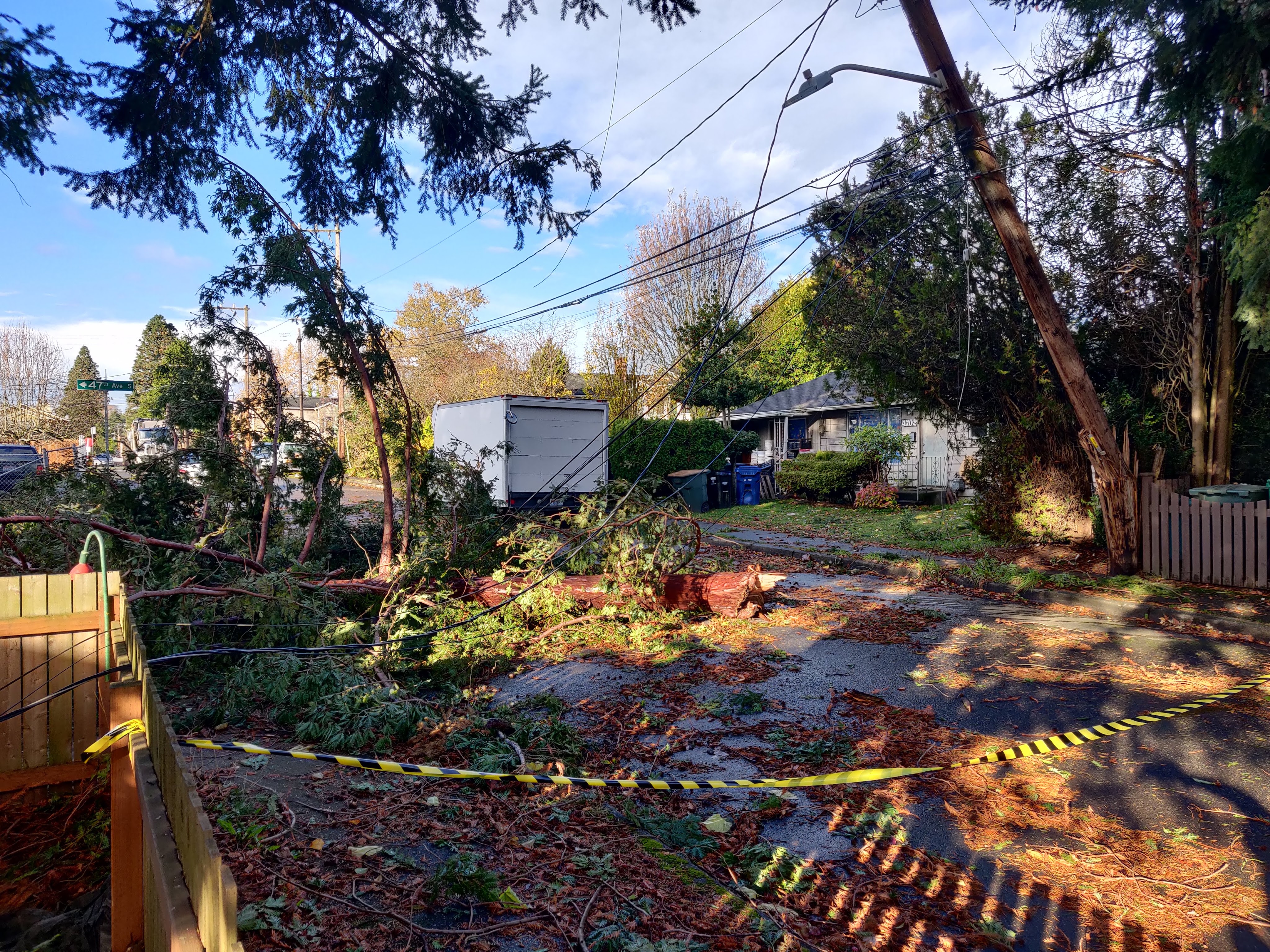
Several weeks ago, Seattle was hit with a bomb cyclone which brought gusts of wind over 70 mph. Seattle fared better than many surrounding towns but we had the top ~50′ of a redwood snap off next to our house. Luckily, it fell away from us and managed to avoid all the cars, fences, and other homes near us. It fell directly in the street and caused no private property damage (Seattle City Light was clear to make the distinction when they were repairing the power lines).

Surprisingly, all the lines held strong while supporting this massive chuck of timber. The utility pole was not so lucky. We were without power for two days while they replaced the pole, then reran/replaced the lines. It was an impressive undertaking that involved cutting and removing most of the old pole to place a new one in the same hole, then reattaching the power lines and lashing a small section of the old pole to the new one so they didn’t have to mess with the phone or cable lines on the old pole. At the end, there was a lot of old cabling that they needed to dispose of. I offered to take several pieces in the hopes of turning them into more art for the fence.

The first piece I tried to make with the twisted steel cable was a crab. It did not turn out how I’d hoped. The twists in the cable meant that i couldn’t get smooth bends where I wanted them. City Light also left a few insulators. Dom pointed out that these looked a bit like the top of jellyfish. I thought the twists in the cable might work well for such a sea creature. I’m still not certain I like how it turned out, but I’ve added it to the fence. I even added a small (very simple) fish that the jelly had just caught. It might change but for now, this is what it looks like.

The other addition to the fence was a snail that Avery and I blacksmithed in the garage a few years ago that never found a happy home. Hopefully it is content here as we continue to add random metal to the fence.

Posted in Maker | Tagged , , | Leave a comment

The Memory Palace

Title: The Memory Palace: True Short Stories of the Past

Author: Nate DiMeo

Completed: Dec 2024 (Full list of books)

Overview: Such a great collection of stories. Many were familiar to me from all the episodes of the Memory Palace podcast I’ve heard over the years but it was wonderful to reexamine them. I even started reading a few of them to my 8 year old who has expressed zero interest in any other books I’ve been reading but was enthralled by the story of Betty Robinson. I also enjoyed hearing the stories about Nate’s life. He has a great way of telling stories.

I read this cover to cover but it certainly isn’t written or designed for that the be the only way. I expect this will be a book I go back to when I want short stories to read for ten-fifteen minutes. It’s definitely one of my favorite books of the year.

Highlights:

  • “Yes sir! It’s going to rain candy from the sky.” And so it did. Baby Ruths, in red-white-and-blue wrappers tied with string and strung up with tiny parachutes, floated down through the sky over Pittsburgh. Drifted past office windows. Draftsmen looked up from their tables as something caught their eye. Then ran over to the window. White parachutes by the dozens. Kids in the streets below, looking up, eyes wide, hands outstretched, the best thing they’d ever seen. Traffic stopped on Liberty Avenue.
  • The boy in the plane with Davis in Miami, who dropped candy on the crowd and just loved it. He loved it so much he became a pilot. He named his plane after his mother, Enola Gay, and dropped an atomic bomb over Hiroshima.
  • But a life isn’t lived in a census, as it is not lived in a grave. Hercules lived his as a free man for fifteen years. He doesn’t owe history an accounting of his days. Hercules was free of George Washington; George Washington should never be free of Hercules.
  • Carla never quit. You can go to YouTube and find a clip of her in a pink sequined leotard, doing a headstand atop an eighty-five-foot pole, with no net, as is the Wallenda way, from a TV special hosted by Steve Harvey. She is eighty-one years old.
  • The Kodak camera put the means of production of those most vital of things—our own images, our own histories—into our own hands. The circular photos from those first years, of people at play and at work, of the streets where they walked, of the trees and buildings that shaded and sheltered them, of children who were young once, are taken by people figuring out, for the first time, what you could do with a camera. What it did to your life to have pieces of it on a wall, or in your wallet, or to be found one day and wondered over when you’re gone.
  • It may be hard to think of butter art as fine art, but you are Iolanthe; you have not yet learned to see.
  • They targeted hotels first, where more rooms meant more money. And they persuaded them to turn the idea of luxury quite literally upside down. Before the elevator, the best rooms were on the bottom floor. You didn’t have to walk up. Four flights of stairs? Stick the pauper in the penthouse. But the Otis brothers persuaded hotels it should be the other way around. The first floor is by the street, with hoi polloi and their noise and their sweat and their fruit carts stinking in the sun and, worse, their horses and the things horses do. Wasn’t a king’s throne supposed to be higher than his servants? Wasn’t a lord supposed to lord over? Why shouldn’t the wealthy traveler be above it all? And the hotels bit. They built high. And the wealthy travelers liked the view. And when it came time to build their next office building, or expand their shirtwaist factory, they built higher still. And they bought elevators from the Otis Elevator Company.
  • The year is 1774. It is the eve of the Revolutionary War. The place is Plymouth, Massachusetts. They have recently organized a militia there. They have put up a liberty pole, which is essentially just that: a big wooden pole. But it is, of course, more than just that. It is a symbol of defiance against the Crown, a metaphoric middle finger, rising from the town green. The liberty pole tradition traces its roots to ancient Rome, where a group of senators celebrated the emperor’s assassination by sticking a red cap on top of a pole. The cap was the same type that was given to freed slaves to signal their new status; the senators, it seems, co-opted the cap to suggest that Rome, with Caesar’s death, had been similarly freed.
  • To this day, historians debate whether Thomas Faunce’s memory, at ninety-five, was accurate. And whether that specific rock—or any rock, for that matter—played any particular role in the Pilgrims’ arrival. But it is clear that it didn’t hold any real significance, practical or sentimental, to the Pilgrims themselves, because they basically wrote everything down, and no one ever mentioned it.
  • her all-wrong shoes, at the awkward way she crouches at the starting line (she hadn’t even known to crouch at the starting line). Mr. Price holds up his stopwatch and blows a whistle and Betty runs. It isn’t pretty, her form is ridiculous, but she is fast. She crosses the line 6.2 seconds after she started. It is one-tenth of a second faster than the women’s indoor world record.
  • She was an overnight celebrity, and not just the new favorite all-American girl: She was a new kind of girl. An athlete. A role model. And then the summer ended and she went back to high school.
  • Wasn’t it natural that a different person should have a different body? And when I read that, I find the image I have of her in my head starts to drift. There is something in her words that sounds like something anyone who has come to terms with aging, as best they can, might say. About living in a body that is changing, that can’t quite do what it used to, or at least not in the way it used to, and is realizing or wrestling with the notion that maybe the person they’re becoming won’t need that body to do all that, at least not in the same way, and maybe that’s okay.
  • with the data he gathered he was able to convince the stewards of America’s best idea of his own best idea: The wilderness should be wild. He told them that a forest wasn’t a zoo, that not every fire should be prevented, that predators should be repopulated, that the trash-heap shows should be closed, that if we were going to set aside corners of the continent for nature, then they should be natural.
  • He’d been piloting the Planter for months, moving Confederate soldiers and supplies up and down the coast. He knew where all the mines were around the channel out of Charleston, South Carolina. Hell, he’d been there when they’d laid them down. He could do it. He could. What if they just took the boat? It had started as a joke from one of the other enslaved men who worked on the Planter, but the joke stopped being funny.
  • Robert Smalls was famous among the furious rebels and fearful slaveholders and Southerners who were looking at the enslaved in their midst, wondering which among them might just take a boat of their own or grab the whip or burn the house down.
  • He returned home to Beaufort, where his mother had been born a slave. Where he had been born a slave in a cabin behind their master’s house. And then he bought that house. He bought the whole plantation with the money he’d gotten for taking the boat. He lived there with his family until his death in 1915.
  • He was elected to the South Carolina legislature and made the conditions he had negotiated into state law. He went on to serve five terms in the United States Congress, where he fought to try to desegregate public transportation and the military; to stop the tax code from favoring the wealthy and punishing the poor; to give women the right to vote.
  • She had dementia. Robert was the one to recognize her. She was the wife of the man who’d once owned him. Her husband had died some years before and here she was, confused. She said this was her home, but it was different somehow. So different now. Smalls took her in and she lived there comfortably until her death.
  • When I was growing up, it had echoed with stories, endlessly repeated at big Italian family dinners, and during the tail ends of Christmases, with the dying embers and the embarrassing uncle passed out on the maroon velour chair. For new audiences, the stories were stretched and embellished; for close family they were invoked, compressed like Mandarin proverbs until they could be summoned by a couple of brushstrokes: “Dad and the Studebaker,” “Mom’s Broken Finger,” “Janice Through the Bathroom Window.”
  • But then something popped up in my bloodwork. We got a call that said I had to go to the hospital as quickly as possible, where I was told I had nearly died. In fact, I had been nearly dying every day for quite some time.
  • There are moments as good as any other—that it might just be that there were limits to delight, that the literal feeling of singing “Cecilia” to a sea of people who are singing it back to you in Central Park might in fact be no more pleasurable or invigorating or enriching than stealing home in a Little League game or, for that matter, laughing with your friends, or having a great kiss, or any number of life’s quotidian joys, these things that are happening all around us, all the time, if we just stopped to notice them as they happened and remember them when they were done. I set out to do that: to notice and to remember. And to remember, you need a story.
  • Upon arriving in America, the boys enrolled at Princeton, from which they graduated first and second in their class, both with GPAs above 4.0, after which they were forever known in the family as the Smart Brother and the Dumb Brother.
  • Once again, a Pilgrim-looking fellow arrives in another new world to live in accordance with his principles, with the assistance of friendly natives. In that story, the Narragansett didn’t just welcome Williams but gifted him prime real estate. It may not surprise you that this story isn’t entirely true, and that, as with the émigrés up in Plymouth, the tangible assistance he did receive from the people that were there when he arrived wasn’t entirely altruistic. The Narragansett who agreed to let him settle the land at the mouth of the river did so out of strategic necessity. They wanted a physical buffer between their lands and those of the Wampanoag,
Posted in Lit Review | Tagged , , , , | Leave a comment

Mine!

Title: Mine!: How the Hidden Rules of Ownership Control Our Lives

Author: Michael Heller & James Salzman

Completed: Nov 2024 (Full list of books)

Overview: I have a difficult time not finishing books. Once I start them, even if I get bored, I usually finish. This was an exception. I got a little over a quarter of the way through it and was done. There are definitely interesting stories in it, but it feels like there are only a few that get repeated often. I think this would have been an amazing 5000 word article about how our understanding of ownership no longer aligns with the legal state of ownership and how companies are exploiting the ambiguity. Who owns the space where airline seats recline, the person reclining or are they trespassing into the space of the person behind them? This could be made clear by the airline but they prefer ambiguity so they can sell the space to both people. Interesting to think about but not for long.

Highlights:

  • we still believe our ownership online has remained unchanged, as if owning a virtual book were just like owning a hard copy. It’s not the same. The result: we pay Amazon an unearned premium because of our mistake. Despite the adage, customers are not always right. There is an increasing gap between what we feel like we own and what we actually own.
  • in Johnson v. M’Intosh, an 1823 Supreme Court decision that most lawyers read during their early days in law school. Being the first Christian European was what justified, as a matter of law, the claims of Spain to the Caribbean, Texas, Mexico, and California; of France to New Orleans, Canada, and much of middle America; and of England to New England and Virginia. But if that’s the case, why did the world not rise in protest when Neil Armstrong planted the American flag on the moon in July 1969? That should have made the moon just as much a U.S. territory as early America was a European one. The answer is that by the 1960s, countries had renounced discovery and conquest as the basis for deciding who was first. In 1967 the United States, along with the Soviet Union and dozens of other countries, signed the U.N. Outer Space Treaty explicitly rejecting first-in-time for extraterrestrial resources. So when Armstrong became the first human on the moon, he was not asserting American ownership there. Indeed, to make America’s intentions clear, in 1969 Congress felt compelled to pass a law stating that when a U.S. astronaut places a flag on the moon, it is “intended as a symbolic gesture of national pride in achievement and is not to be construed as a declaration of national appropriation by claim of sovereignty.”
  • For two centuries, America used a version of a reasonable prospect rule, giving patent monopolies to those first to invent—an open-ended standard that led to much litigation. Then in 2011 America switched to a bright-line first to file rule: regardless of how much progress competing inventors made, the patent went to whoever won the race to the Patent Office. America was the last country in the world to adopt the rule of capture for patents, following a debate in Congress that substantially tracked the majority and dissenting views in Pierson two centuries earlier.
  • In a now-classic experiment, they gave some students nondescript coffee mugs, then asked how much cash they wanted in exchange for giving them up; they gave others cash and asked how much they would pay to acquire an identical mug. The prices should have been similar. After all, the mug was nothing special. In this experiment, it shouldn’t really matter whether you start out holding the mug or holding the cash. But that’s not what happened. Time and again, sellers thought the mug was worth more than double what buyers would pay, $5.78 versus $2.21. Hundreds of clever experiments have shown this discrepancy using chocolate bars, basketball seats, lottery tickets, music albums, and more. Chimpanzees and capuchin monkeys also demonstrate this behavior.
Posted in Lit Review | Tagged , , | Leave a comment

Seattle from the Margins

Title: Seattle from the Margins: Exclusion, Erasure, and the Making of a Pacific Coast City

Author: Megan Asaka

Completed: Nov 2024 (Full list of books)

Overview: Two months ago, I posted “Since moving back to Seattle in 2017, I’ve been reading different books about the history of this place, including about the people here or biking here and even walking in Seattle.” Well, it’s time to add another book to that list. This one focuses on the people who have been pushed to the outside when building the city. I learned that the first large industry was hop growing which required lots of labor for harvesting for a month or two each year. This was the start of several large industries centered around Seattle needing seasonal, transient laborers who were mostly ignored or shunned the rest of the year.

Highlights:

  • In the 1920s, an academic study estimated that Seattle had one of the highest transient populations in the entire country.
  • In Lushootseed, the language of the region’s Indigenous peoples, Seattle was known as dzidzəlalič, or the place where one crosses over.
  • Though Seattle has its own ugly history of redlining, which deserves far more attention than it currently receives, the process of segregation started much earlier, with the founding of the city itself in the mid-nineteenth century, and did not involve the federal government. At that time, white settlers removed the Duwamish people and segregated them in the southern fringes of the city, eager to take their lands but also to make them available as workers. [25]  Settlers even blocked efforts by the federal government to create a reservation for the Duwamish on their ancestral homelands because it would interfere with the city’s access to a steady labor supply.
  • In Seattle, the north-south spatial orientation served to smooth over this tension between, on one hand, racial heterogeneity as demanded by capitalist accumulation and the ever-expanding search for labor and, on the other, racial purity as envisioned by white settlers. It allowed settlers to maintain an exclusionary white district while also accommodating an Indigenous and racially mixed labor force.
  • Segregation was not something imposed on the city by the federal government; instead it evolved from the first days of Seattle’s founding in the mid-nineteenth century. White settlers established the north for the purposes of wealth accumulation via land and private property, then sought to protect this space through violence, policing, and municipal law. They dispossessed and displaced the Duwamish, rendering them outsiders in their own lands, then excluded others deemed racially undesirable, including Asian migrants, interracial families, and single men. As Black workers began to arrive in growing numbers during WWII, they entered a racial geography that had already hardened around the division between white and nonwhite, north and south. Though Seattle’s Black community predated the war, Asians and Indigenous peoples outnumbered them in the city and the regional workforce.
  • But these settlers were not entering an empty land where they could simply arrive and impose their will. Their ignorance about the area’s terrain and maritime environment, as well as their low numbers, made them reliant upon the knowledge and labor of the Duwamish and other Indigenous peoples of the Puget Sound region. This gave Indigenous peoples the upper hand for a while, at least-and produced an early urban society characterized more by coexistence than outright domination.
  • Yesler looked to expand the mill’s operational capacity. Though Indigenous people continued to provide the bulk of the labor powering the mill, they were joined by other workers, many of them single men from outside the United States—Germany, Scotland, Peru, India.
  • In Seattle, settlers explicitly rejected the federal government’s efforts regarding “Indian affairs.” In 1866, nearly all the settlers in King County signed a petition against the creation of a Duwamish reservation along the Black River in south Seattle. Hundreds of Duwamish people had rejected the terms of the Point Elliott treaty, which created the Port Madison reservation across the Sound on Suquamish territory, and called for their own reservation located on their ancestral homelands near the fork of the Duwamish and Black Rivers. With backing from the Indian agent of Washington Territory, George Paige, the federal government appeared ready to move ahead with the Duwamish reservation when the settlers got wind of the plan and moved to squash it. As Paige noted in a report, “The white settlers in the neighborhood desire to have [the Indians] remain among them, that they may avail themselves of their labor, yet at the same time they are unwilling they should have a reservation where they are, because they, the white men, want to appropriate the valuable bottom land which they occupy.”
  • throughout the United States and Canada, settlers attempted to diminish the power of Indigenous nations by specifically undermining and controlling Indigenous women. [39]  In the Pacific Northwest, the Donation Land Claim Act allowed white men who married Indigenous women to claim double the amount of land until 1855, which made intermarriage and mixed relationships materially beneficial to white male settlers. By the 1860s, however, when much of the land had been appropriated and more white women had migrated to the region, the fluidity of early Puget Sound societies gave way to a social order more rigidly structured around race and gender hierarchies, and a hardening division between whiteness and nonwhiteness.
  • Situated at the convergence of multiple rivers, the lands that would become known as Seattle served as a crucial hub of Indigenous migrations. [2]  Though located within Duwamish territory, other Indigenous peoples up and down the Northwest Coast also had a presence in Seattle, whether for travel, resource gathering, or connecting with extended family. These migrations did not stop with the arrival of white settlers and the disruptions of urban displacement. Seattle’s role as “the place where one crosses over” persisted into the late nineteenth and early twentieth centuries and beyond.
  • In the 1850s, hop farms began to pop up along these waterways, claimed by some of the first settlers in Washington Territory. Ezra Meeker, who would later achieve worldwide recognition as “hop king” of the Pacific Northwest, first spotted the location of his Puyallup Valley hop farm on a canoe trip through the southern half of Puget Sound.
  • A portion of the workforce that year also included Puyallup tribal members, whose displacement from their ancestral lands had allowed the first hop farms to emerge and the industry to expand throughout the valley. The name “Puyallup” comes from the anglicization of the Lushootseed word spuyalǝpabš , meaning “people from the bend at the bottom of the river,” although over time the word also came to mean “generous and welcoming to all who enter our lands.”
  • Growers used the expense of housing as an excuse to not hire white pickers, whose so-called standards of living would require better accommodations. One grower declared that he “could not take care of white men even if [he] could afford to hire them,” adding, “The season is too short to warrant any outlay for that purpose, while Indians and Chinamen take care of themselves.” [54]  The temporary encampments further guaranteed that hop pickers left town at the season’s end, while white workers could stay on after the harvest or find work in the surrounding community.
  • The town of Squak (known today as Issaquah) and its surrounding valley emerged as a major hop-growing center largely because of the railroad. In the early 1870s, Seattle settlers had banded together to fund the Seattle & Walla Walla railroad line as a response to Northern Pacific’s decision to locate its western terminus in Tacoma. The work progressed at a snail’s pace and was headed for disaster when Henry Villard, a railroad baron and financier, decided to buy the company and rename it the Columbia & Puget Sound Railroad. Villard’s interest in the line stemmed from his ownership of the Oregon Improvement Company, which operated several highly profitable coal mines east of Seattle.
  • the Oregon Improvement Company, which operated the mines, discharged its Chine se workforce. By October, agitation had spread to Tacoma; it erupted in early November when white mobs expelled the entire Chinese population from the city. Seattle followed suit a few months later. On February 7, 1886, a group of white men rounded up the city’s Chinese residents and forced them onto a ship leaving for S an Francisco.
  • The hop business was a potentially lucrative source of revenue for the railroad, which had just completed work on its transcontinental line. Committee members in Tacoma convinced local schools to extend summer vacation so white children could pick hops alongside their parents. Though missionaries and Indian agents had demonized Indigenous parents for taking their children to the hops harvest, accusing them of negligence and using it as further justification of parental unsuitability, authorities applauded white parents’ and children’s efforts to save the harvest and respond to these “emergency” circumstances.
  • By 1910, lumber employed two thirds of the workers in Washington State. [2]  If hops had laid the foundation for Seattle’s role in the regional economy, the lumber industry cemented the city’s status as “the main clearinghouse for the migratory labor hordes” of the Pacific Northwest and far beyond.
  • their wealth and prominence were achieved through the direct exploitation of their fellow countrymen. Contractors charged various fees and commissions from the laborers they  procured first an initial fee for job placement, then a monthly fee paid to the company via a foreman who managed the workforce. [43]  Contractors also charged workers for food and supplies, which often came directly from their own mercantile or grocery businesses. Furuya developed a particularly lucrative trade supplying Japanese labor camps around the region with Japanese food products and other items imported from Japan. The end result was a highly coercive system of economic dependency that was, in the words of one Japanese lumber worker, “no good for the workingman , just good for the boss.”
  • companies favored some settlers over others, and spent considerable time and money recruiting those they considered the most desirable. [46]  Scandinavians were among the groups frequently targeted by railroad companies for permanent settlement. The Northern Pacific, for example, “became one of the most aggressive lines” in attracting Scandinavians to Minnesota, sending promotional materials and recruiters back to Europe to emphasize similarities in climate as a key regional selling point.
  • The gold rush brought other changes to Seattle’s economy and geography, such as a booming retail business outfitting miners with clothing, supplies, and equipment, but housing continued to shape the physical landscape even after the craze died down. By 1905, Seattle’s hotels and lodging houses numbered over four hundred. “The city lacks neither sufficient high-class hotel accommodations or facilities for handling those who are looking for a cheaper shelter,” a local newspaper reported, dubbing Seattle “a city of hotels.”
  • The Diller Hotel, located on First Avenue and University Street, was one of Seattle’s original first-class hotels. Built in 1890 by Leonard Diller, who migrated to Seattle from Ohio in 1876, the 80-by-111-foot brick building contained 140 guest rooms, each with private  bath, hot water, and a telephone. The Diller also featured a hotel cafe, complimentary stationary, and an elevator that whisked guests up and down its four stories.
  • For a time, Seattle operated as an open town, with an official red-light district located south of Yesler; the neighborhood became known as the Tenderloin, after a similar district in San Francisco.
  • stories reveal the wide gulf between what Filipino migrants expected of their life in the United States and their lived experience in a racially hostile society. As one man put it, “Here… you cannot win “
  • Though Seattle’s urban landscape had been divided by race as well as gender from its origins in the 1850s, the 1920s witnessed a new era characterized by more explicit forms of segregation, such as restrictive covenants placing entire neighborhoods out of reach for nonwhite Seattleites.
  • The Japanese had long played a crucial role within the urban and regional economy, as intermediaries who served and employed the itinerant, racialized workforce of the Pacific Northwest. As the resource-based economy declined, the Japanese were no longer useful and became disposable once again, their fates ultimately linked with the workforce they had relied upon and, at times, treated with disdain.
  • The local motivations for building Yesler Terrace have not been critically examined. Often celebrated in local memory as a positive contribution to the city and evidence of Seattle’s open-mindedness about race, Yesler Terrace started first and foremost as a slum clearance project that targeted undesirable people, and the spaces they inhabited, as roadblocks to urban progress. [4]  In that way, Yesler Terrace was not exceptional; it repeated a familiar historical pattern that stretched back to Seattle’s founding in 1853, prioritizing white families at the expense of all others.
  • government signs began appearing around Seattle ordering all persons of Japanese ancestry to depart the city. They had less than one week to prepare. By the end of May 1942, not a single Japanese person remained in Seattle. Nearly ten thousand city residents, the majority US citizens, were gone seemingly overnight.
  • The longer history of the U Village mall thus reveals its creation not as an open, accessible retail space for down-on-their-luck Seattle families, but as an engine of segregation and white wealth accumulation built upon colonized lands and racialized displacement. As the story of University Village makes clear, we cannot understand Seattle’s present without radically reconceptualizing the city’s urban past. This book has sought to reframe the early history of Seattle as a history of displacement, focusing on the laborers who built the city and then were excluded and displaced as they tried to create stable lives for themselves.
Posted in Lit Review | Tagged , , , | Leave a comment

2025’s First Mistake 5k

** Don’t miss the Second Annual First Mistake 5k **

Life is full of bad ideas. You will likely make many mistakes during 2025, let this race be (one of) your first. What could be better than a free race on Jan 1? Let’s check-off as many mistakes as possible now. You know that outfit you haven’t worn since high school? That would be perfect for this race. Maybe eat a big greasy breakfast 30 minutes before the start. Did you party hard on New Years Eve and go home with a stranger? Bring that mistake with you, especially if they aren’t a runner. It’s gonna be “That Kind of Fun”.

  • When: 9am on Jan 1, 2025
  • Where: Chief Sealth Trail at Henderson, just east of Rainier Beach Link Station
  • Route: 5k with 600′ vertical, map. Modified “Default Route” for those who know
  • Cost: Free (see “What to Bring” below)
  • Registration: Use this Fancy Form
  • Prizes: Yes, everyone gets a finisher metal (but no, not a medal… see “What to Bring” below)

What to Bring

Aside from the usual running gear and water, please bring a canned beverage. This can be soda, beer, coffee, wine, NA cocktail, sparkling water, or whatever. As long as it’s in a metal can and you can drink it, it’s perfect. All the cans will go into a cooler. When you cross the finish line, you get to pick out any remaining can as a prize. Congrats on your surviving first (and possibly second or third) mistake of the year.

Aid Stations

No, it’s not that kind of race. If you need water, snacks, or other things while running, you’ll want to bring them with you. There might be “Mistake Stations” along the course where runners are offered the opportunity to make more mistakes. Anyone want a tall glass of warm milk just before the worst hill climb? How about a haircut from a rando with a set of clippers? Chili pepper roulette? We’re still working on these. If you have ideas or want to set up a station, reach out to Rainier Beach Run Club. Reposting this here because I’m helping organize the event and want to promote running in South Seattle.

Posted in Running | Tagged , | 1 Comment

Lockpicking and Other Mischievous Ways to Learn Engineering

Over the summer, I presented at WA-ACTE Summer Conference Presentations on Robotics and Lock Picking. It’s now Fall Conference time and I’ve decided to update my lock picking presentation. You can find the slides here but I outline some other details below including where to get picks, what bike lock I’d recommend, guides to getting started learning to pick locks, and links to 3D printable designs. If there’s anything I forgot, email me or ask me in the comments below.

Where to get picks

I have two places I like to get picks (at least the ones I don’t make). The first place I went to was Sparrows. They make good picks that are priced well. Recently, I’ve started getting picks from Covert Instruments. I had the Genesis Set and FNG at my presentation. FNG comes with the two most useful picks and the transparent lock I used as a demo. Picks from either Sparrows or Covert Instruments are going to be great. I would not order from Amazon since the quality is all over the place.

What bike lock I’d recommend

Over the years, I’ve used a bunch of different bike locks, including two that I’ve found on the street while riding (pick them up, decode the combination, reset the combo to something I’ll remember, use it for years). As I mentioned in the presentation, using an inexpensive padlock for an expensive bike is not a good idea. Students learn to pick most Master Locks very quickly. Like most security discussions, bike locks come down to compromises. Usually, the smaller, lighter locks with standard keys provide less protection. If you’re riding a junker bike to the store and only need to lock it up for five minutes, these are probably fine. For my more expensive bikes, I like U Locks for Kryptonite and Abus. They are relatively small and not too heavy, but strong enough and use disk detainer locks which are much harder to pick. For our family’s new electric bike, weight was less of an issue and we wanted something big enough to go through the frame and wheels, so we went with the Kryptonite Evolution. We got the 6′ version that weights just shy of 10 lbs and is not something I want to peddle around without electric assist.

Guides to getting started

There are a bunch of videos and illustrations online showing you how to pick locks. A quick YouTube search will pull up tons. I like written guides and the one I recommend most students start with is a classic, the MIT Guide to Lockpicking. It covers how locks work, how picking works, what materials to use to make picks, and what shapes work best for picks. Another good guide comes from the Art of Lockpicking site which also offers simple animations

Links to 3D printable designs

Several of the pieces I had were 3D printed. The designs are typically free to download, but sometimes they require an email address to set up an account. The demo lock came from Covert Instruments which offers several other printable pieces. I print on a Prusa MK4 and haven’t had any trouble with any of the designs Covert Instruments offers. Printables and Thingiverse both offer designs as well.

Again, if you have questions about picking (either as a hobby or in class) feel free to contact me. Good luck and happy picking.

Posted in Biking, Education, Maker | Tagged , , | 3 Comments

The Infernal Machine

Title: The Infernal Machine: A True Story of Dynamite, Terror, and the Rise of the Modern Detective

Author: Steven Johnson

Completed: Sept 2024 (Full list of books)

Overview: Years ago I read Ghost Map by the same author and enjoyed his storytelling. This book appealed to me because of my growing interest in anarchist theory and fascination with the rise of national policing around the time of prohibition. It told a more complete story of Emma Goldman than other stories I’ve read about her. It’s also interesting that many of the early anarchists dealt with debate about when (if ever) violent acts are justified that came up in Force and Freedom just before the Civil War. Both groups eventually turned towards violence. The anarchists seemed more easily convinced that violence could help them achieve their goals, but in retrospect, may have convinced more people to oppose their message.

Highlights:

  • The anarchists maintained that there was something fundamentally corrosive about organizing society around large, top-down organizations. Human beings, its advocates explained, oftentimes at gunpoint, had evolved in smaller, more egalitarian units, and some of the most exemplary communities of recent life—the guild-based free cities of Renaissance Europe, the farming communes of Asia, watchmaking collectives in the Jura Mountains of Switzerland—had followed a comparable template, at a slightly larger scale. These leaderless societies were the natural order of things, the default state for Homo sapiens. Taking humans out of those human-scale communities and thrusting them into vast militaries or industrial factories, building a society based on competitive struggle and authority from above, betrayed some of our deepest instincts.
  • Nobel gave his invention two names. One was a variation on his earlier product’s branding, with an emphasis on its newfound stability: Nobel’s Safety Powder. But it was the other name that stuck: Dynamite.
  • Kropotkin had embarked on the trip under the spell of Darwin’s recently published The Origin of Species, with its radical new account of natural selection operating through the competitive struggle for reproductive success, quickly paraphrased as the “survival of the fittest” by Darwin’s ally, the sociologist Herbert Spencer. But in the extreme conditions of Siberia, Kropotkin witnessed a different kind of struggle—not the struggle between different organisms but rather the shared struggle against the environmental conditions themselves. “Real competition and struggle between higher animals of the same species came very seldom under my notice,” he later wrote, “though I eagerly searched for them.” Instead, Kropotkin saw abundant evidence of a different kind of interaction: networks of cooperation among and between species, what Kropotkin would later call “mutual aid.”
  • The Haymarket Affair sparked an immediate crackdown against the radical groups; Parsons and Spies were both arrested, along with six others, and accused of being accessories to the murder of the officer killed by the bomb. During the trial, key evidence was supplied by the lead Pinkerton undercover agent, Andrew C. Johnson, who claimed firsthand knowledge of the anarchists’ murderous plot. In response, Albert Parsons denounced the Pinkertons as “a private army…at the command and control of those who grind the faces of the poor, who keep wages down to the starvation point.” In the end, the jury sided with Johnson, and all eight were condemned to death. Four of them—including both Spies and Parsons—were executed, despite the fact that no evidence ever directly connected them to the infernal machine that had exploded during the rally.
  • It is conventional wisdom—in the United States, at least—to say that we live in an unusually polarized political climate today. But measured against the landscape Emma Goldman and Alexander Berkman encountered as young adults, even the much-lamented divisions of the Trump era look far less severe. The polar opposites might be louder now—thanks to the amplifiers of social media and cable news—but they sit on a much smaller globe of political possibility. Berkman and Goldman were living in a world where one side of the spectrum thought it was appropriate to execute people who objected to a seventy-two-hour week of life-threatening work—while the other side of the spectrum thought that we should abandon both governments and corporations and reinvent society along the lines of Swiss watchmaking collectives. Those were the distant poles of the debate. What we would now call the Overton window—the space of potentially valid political beliefs—was far wider than anything in American politics today.
  • colossal failure for the workers. “After five months out on strike, they were forced to accept the company’s harshest terms, including a twelve-hour day and a wage cut of almost one-half,” the historians Paul and Karen Avrich write. “Pinkerton spies were installed in the mill, grievance committees were done away with, and workers’ meetings were banned. Total victory, as Frick had foreseen, lay with the company. He had proved that a modern corporation, combined with the authority of the state, could destroy the strongest union in America. Not until 1936 would another union emerge in the steel industry.”
  • There was a noticeable absence among the twenty-one nations represented at the Rome conference in 1898: the United States of America. The lack of an American presence reflected more than just the geographical separation between the two continents. The notion of a trained detective versed in statistics and anthropometry serving as an agent of the law was simply a foreign idea to most Americans.
  • Kroptokin sensibly began his counterattack against the social Darwinians with a close look at the biological record: the insect colonies, the deer, and the seabirds of Siberia. But by the time Goldman showed up for tea in Bromley, Kropotkin had moved on to sociology. The closing essays in Mutual Aid offered an extended paean to the triumph of the “free cities” of the medieval era, which were to Kropotkin the pinnacle of human social organization.
  • The fundamental economic unit of the free cities was not the industrial corporation or the feudal estate; instead, the defining unit was the artisanal guild, the elective associations of craftsmen: carpenters, weavers, painters, jewelers, musicians, scholars. Grounded in useful labor and expertise, sustained through shared resources, the guilds and the free cities that contained them offered a golden ratio of individual liberty and communal belonging that echoed the ancestral hunter-gatherer communities, only now updated with technological wonders and achievements in art and architecture. That was the natural equilibrium that the hydra of state capitalism had demolished, with its vast hierarchies and deadening, robotic labor,
  • The fixation with the guilds and associations of the medieval town is a quality of the anarchist movement that is little remembered today. What lives on is the image of the bomb-throwing terrorist, willing to kill innocent civilians in the name of some imagined revolution to come. But there was also a strangely quaint, nostalgic quality to the movement—most apparent in Kropotkin himself—a longing for a simpler, more pleasant form of life.
  • Imagine a twentieth century where multinational capitalism is challenged not by a totalitarian, militaristic Soviet Union but instead by a sustained mass return to the guilds and small-scale industries of free cities. That may seem preposterous to us now, but it might well have been within reach, back in 1895.
  • The body count from the infernal machines was a footnote compared to the violence of the factory system, after all.
  • Goldman, dressed only in a kimono, found herself surrounded by a dozen police officers. At first she pretended to be a Swedish servant with limited English skills. The ruse initially succeeded. In an exchange that bordered on slapstick, one of the officers held up a picture of Goldman, demanding: “We want this woman. Where is she?” “This woman I not see here,” the diminutive Goldman protested. “This woman big.” After searching the apartment, the officers were on the brink of leaving when one of them stumbled across a fountain pen engraved with Goldman’s name. Even that clue was not sufficient for the cops to realize that the very suspect they were seeking was standing right in front of them. “By golly, that’s a find!” the lead detective declared. “She must have been here and she may come back.” Exasperated, Goldman finally turned to the detective and ended the charade. “I am Emma Goldman.” “Well, I’ll be damned,” he uttered in shock. “You’re the shrewdest crook I ever met.”
  • Throughout his two terms, Roosevelt would petition endlessly for the creation of a proper national detective force, an American Interpol. Each time, Congress would rebuff him, wary of consolidating too much power in the federal government. Lawmakers argued that “spying on men and prying into what would ordinarily be considered their private affairs” went against the “American ideas of government.” Others maintained that a “central police or spy system in the federal government” would be “a great blow to freedom and free institutions.”
  • In time, the young library clerk would make a name for himself in a different field. But the lessons he drew from the Putnam system—the unexpected power of systematized card catalogs and file cabinets—remained an animating principle in the mind of John Edgar Hoover for the rest of his career.
  • on the morning of April 20, two National Guard units commanded by a Rockefeller deputy began laying down machine gun fire across the tent cities outside Ludlow. Some of the strikers managed to escape into the hills, while others huddled in underground bunkers that had been dug for precisely this situation. That night, the Guard swept into the tent city and set it ablaze.
  • Berkman envisioned a procession that would follow Caron’s coffin through the streets of Manhattan, winding its way to the ultimate ceremony site in Union Square. But Arthur Woods worried that a funeral procession taking over a large swath of the city risked making martyrs of the would-be bombers. He and Mitchel were able to convince the board of aldermen to change the laws, making it a requirement that all parades receive police approval.
  • There were an astonishing number of bomb-throwing anarchists in the world at that moment in history, but even when you added them all up, they were an asterisk next to the victims of the Triangle fire, or the Ludlow Massacre, and countless other industrial accidents or labor conflicts that characterized the era. The invention of dynamite had meant that the government and the corporations no longer had a monopoly on devastating violence. But they were still its greatest practitioners.
  • Robert Moses had not yet streamlined the flow of automobile traffic between Manhattan and the suburbs of Long Island;
  • Every country in Europe has recognized the right of conscientious objectors—of men who refuse to engage in war on the ground that they are opposed to taking life. Yet this democratic country makes no such provision for those who will not commit murder at the behest of the war profiteers. Thus the “land of the free and the home of the brave” is ready to coerce free men into the military yoke. We oppose conscription because we are internationalists, anti-militarists, and opposed to all wars waged by capitalistic governments.
  • delivered by mail to the offices of Seattle mayor Ole Hanson on the morning of April 27, 1919. The war had ended six months earlier with the final armistice signed by Germany, but Hanson was in Colorado promoting the final Victory Loan campaign to raise money to support peacetime rebuilding in Europe. And so the Gimbel’s box was opened by an assistant who, in a stroke of enormous good fortune, happened to be holding the box upside down as he unwrapped it. The bomb inside the box had been wired with a detonation device similar to the one Erich Muenter had deployed in the Capitol bombing: rigged so that removing the top of the package would shatter a small vial of sulfuric acid, which would then drip down onto the dynamite caps and instigate the explosion. Opening the box the wrong way up inadvertently foiled the plan, causing the acid to spill out onto the floor and leaving the dynamite undetonated.
  • the infernal machine at Attorney General Palmer’s home had been only one of nine explosives that had detonated that night. The anarchists had targeted a church, several judges, immigration officials, industrialists, a city mayor, and a state congressman. All the bombs exploded within minutes of the D.C. blast—in Boston, New York, Pittsburgh, Cleveland, Philadelphia, and at suburban residences in Massachusetts and New Jersey. In the history of terrorism on American soil, only the 9/11 attacks compare to the June 1919 bombing campaign in the scope and complexity of the operation.
  • the Editorial File System was a genuinely national database. In just two months, the Radical Division collected fifty thousand index cards documenting radical activity across the country. Hoover had weaponized library science in the service of subduing the revolutionary threat.
  • On Saturday, September 28, Goldman was released from prison. She was transported to New York and brought to the Federal Building in Lower Manhattan, where she secured a $15,000 bond for her release on the deportation order. There was still the matter of the $10,000 fine for the original crimes under the Espionage Act. For that, she had to sign an affidavit testifying that she possessed insufficient financial assets to pay the fine. The agent gave her a suspicious look. “You’re dressed so swell,” he said, “funny you claim to be poor.” “I am a multimillionaire in friends,” she replied.
  • what you can never destroy is anarchy. Its roots are too deep; born in a poisonous society which is falling apart, it is a violent reaction against the established order. It represents the egalitarian and libertarian aspirations which are opening a breach in contemporary authority. It is everywhere, which makes anarchy elusive.
  • The ideological battle of the twentieth century ended up being fought between three worldviews that all relied on top-down authority: state capitalism, state communism, fascism. In part because markets themselves have elements of decentralized order that command economies do not, much of the planet ultimately embraced the least centralized of the bunch. But a large-scale society truly organized around the lateral entanglements of mutual aid? The world never got to run that experiment.
  • How would the twentieth century have played out if Kropotkin had been adopted instead of Marx as the founding father of revolutionary leftism? If the radical vision had not been central planning and the Gulag, but rather a return to the hill towns and watchmaking collectives of the free cities, only this time with clean drinking water and electricity?
  • Kropotkin’s friends petitioned Lenin to temporarily release the anarchists currently imprisoned in Moscow so that they could pay tribute to the man who had long been anarchism’s most persuasive advocate. The bureaucracy responded with a declaration that there were no anarchists in Moscow prisons, a statement straight out of Orwell’s 1984.
Posted in Lit Review | Tagged , , , | 1 Comment