Chasing the Perfect Loaf

I’ve been baking bread for years now and have gotten some recipes that work well for me… But every so often, I decide the loaves are not good enough and I start experimenting with my process.

Recently I’ve been working on higher hydration breads again. My sourdough usually runs around 72% hydration but I keep seeing people online turning out amazing breads at 80% or higher. I tried making sandwich rolls using a recipe that calls for 100% hydration and was blown away by how well they turned out. This was just what I needed to increase my confidence to try higher hydration in my sourdough again.

This time I increased the hydration to about 78%. The dough was still easy to work with and seemed strong enough. When it baked, I got plenty of oven-spring and generally a good looking loaf. The crumb was similar or maybe slightly better than my lower hydration loaves. Unfortunately, just like previous bakes, I didn’t get the ear I was looking for on this one. I tried again. Same results. The loaf wasn’t bad, but it just wasn’t significantly better. The tradeoffs were slightly better crumb for slightly worse crust (and no ear).

I’ve since gone back to my lower hydration recipe and the ear has returned. Like so many other projects that I work on repeatedly, I’ve gotten to a local maxima. I keep trying changes, but they rarely make the process any better. I would like to think that I’ll get to the point of accepting the loaves I make, but I recognize that I’ll probably always strive for that little improvement, even if I end up going in the wrong direction for a loaf or two. After all, there’s always the possibility to improve on the next one.

Latest loaf of bread, after going back to my “regular” recipe
Posted in Cooking | Tagged , | Leave a comment

Running without racing

Many people I’ve run with over the years keep an eye on their next race. Whatever the distance or strange quirk that entices them, there is a race they are dreaming about. Some are dedicated to the training and pushing their body to the limit while others are excited about traveling to the start line. My interest in races comes and goes, but it’s been mostly gone since 2019.

Looking back, 2018 and 2019 were great years for my racing. In December of 2018, I signed up for a local 5k with work friends. I didn’t train specifically for the race, but was running fast enough that I won a 5k for the first time ever. It wasn’t a huge event, but there were over 200 runners and, for a guy who barely made my high school varsity XC team, that felt amazing. I started off 2019 with new minimalist shoes which worked my calf muscles more and slowed me down a little. I still managed to run a decent 8k and half marathon. In July, I ran a larger 5k. This one had over 1500 runners and I managed to take 3rd behind two NCAA runners visiting from Georgia. Another exciting finish, but I only signed up for the run because work had a bunch of free entries. It certainly wasn’t a race I’d been dreaming about.

I ran a couple of other races that year and they fell into two categories: ones that felt fast, but weren’t that interesting; and one that had held my interest for about a year… but felt so slow. I ran a Ragnar Trail race on Mt Rainier in place of my brother who signed up before moving across the country and I ran a 5k that a friend organized. These were all fun races and I’m certainly glad I did them, but in my mind one of the best parts of a race (or travel… or anything that you plan months in advance) is the excitement of anticipation. It’s what drives the months of planning, preparing, and focus. The only race of 2019 I was anticipating was my first 50 miler and I’d been thinking about it for almost a year.

There were about 80 of us toeing the line at 6am. When the gun went off, I was feeling good, plus a mixture of excitement and nervous, so I went out a bit too fast. Over the first 10 miles, I went back and forth with another guy as the front runner. I knew it was too fast but I was also realizing my legs weren’t going to be the issue, so why not keep going? I was still running my new minimalist shoes. By now, I was used to how they worked my calves. I had trained on roads and some dirt trails. I was ready for the distance. I was not ready for the gnarly gravel that made the trail we ran. By mile 5, the bottoms of my feet were starting to hurt and shortly beyond the 10 mile mark, I watched the other runner drop me as I slowed. There was a lot more walking that day than I expected. By mile 20, it was obvious that I was not going to be anywhere near my hoped-for pace, but I still wanted to finish. The last quarter mile was on a soft forest trail so I managed to look strong at the end. It was a rough day, but like the other races that year, I’m very happy I did it. Even though the race hadn’t gone how I hoped, the excitement of anticipation had kept me going and given me focus which is what I most look for in an adventure or race.

Since then, there hasn’t been a race that got me excited. I’ve done a couple of friendly 5ks but all that excitement of anticipation has been focused elsewhere… mostly with kayaking. Now I’m starting to look around again to see what race might cause that spark that gets me excited again. I’m not sure if it will be running, kayaking, biking, swim-run, or something else entirely. Until I find it, I’ll keep running with friends at group runs and looking for that unique race that I’ll be able to look forward to for months.

Posted in Running | Tagged , , , | 2 Comments

American Sirens

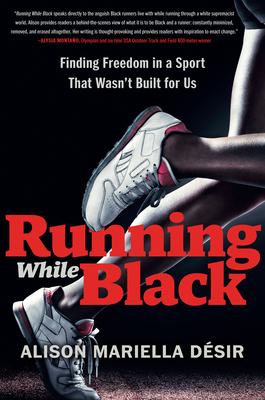
Title: American Sirens: The Incredible Story of the Black Men Who Became America’s First Paramedics

Author: Kevin Hazzard

Completed: Jan 2023 (Full list of books)

Overview: Everything we take for granted had to start somewhere and it’s fascinating to me that emergency medicine, as we know it now, started just before my lifetime. It seems obvious, if someone is hurt, you go to them, provide care, and get them to more care quickly, but until the 1970’s, that second step was mostly missing. This is a amazing look at the history behind the first paramedics including the push back they got from established medicine, racist politicians, and a skeptical public… Then after overcoming it all, they were mostly forgotten.

Highlights:

  • What they [the 1968 Kerner Commission] reported back—that recent violence in Black communities was rooted in racism, police brutality, and poor prospects for advancement—probably shouldn’t have taken so long to find. “What white Americans have never fully understood,” the report declared, “but what the Negro can never forget, is that white society is deeply implicated in the ghetto. White institutions created it, white institutions maintain it, and white society condones it.”
  • “What we are searching for is some method… of lessening the effects of bigotry and hatred.” Specifically, the goal was to patch holes that systemic racism had cut into the public health safety net.
  • Asked why he’d left a union job to join the civil rights movement, McCoy said, “A person does not get into the movement. The movement is in a person.”
  • They were men who existed on the margins and were looking for a way to get ahead, gambling on a long shot. Their ages ranged from eighteen to sixty. Nearly half hadn’t completed high school. One had just a sixth-grade education.
  • Pittsburgh was in the midst of a ballooning heroin epidemic and a corresponding surge in overdoses. But looking around, people noticed heroin-related deaths were climbing in white neighborhoods even as they were dropping in Black ones. The reason was simple. Safar had taken a drug then used only to reverse anesthesia in operating rooms—Narcan—and issued it to his medics.
  • The invisible line separating the Hill from downtown was now the threshold at which an emergency vehicle carrying emergency medical technicians on their way to an emergency situation had to begin operating in all ways nonemergent. No more sirens downtown. This was something new. Hunt first raised the idea, but Flaherty made it law. The idea was to stop Freedom House’s “reckless driving of ambulances,” which they claimed not only imperiled drivers and pedestrians but also disrupted the business community.
  • Just the year before, in 1972, the Beetle had finally beaten out the Model T to become the best-selling car of all time,
  • Eugene Key said he once saw a cop drawing a chalk outline around a guy lying on the street. Cops did this with someone killed in a shooting or a stabbing or a wreck, so that even after the body was gone, investigators could piece together the crime scene and figure out what happened. But this man was still alive. Key pointed this out, but the cop just shrugged. “Yeah,” he said, “but not for long.”
  • The only way to get respect from someone who doesn’t want to give it is to walk right over and take it.
Posted in Lit Review | Tagged , , , , | Leave a comment

Jaahnavi Kandula

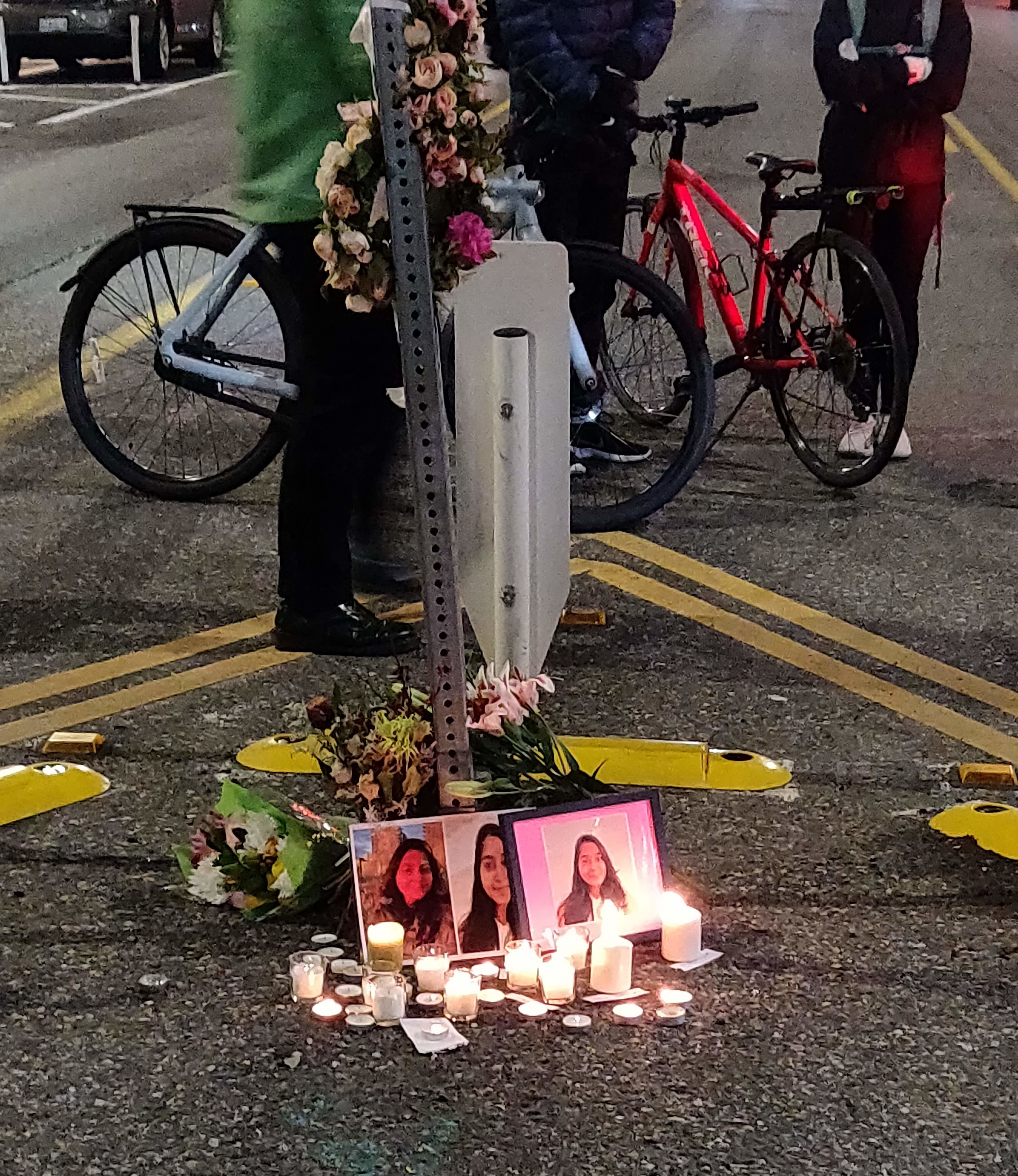
As I pedaled up 4th, I knew I was getting close, not because I saw other bikers, but because there was a police helicopter hovering a few blocks ahead. I rode into Westlake park to find about 20 other cyclists preparing for the Critical Mass ride to remember Jaahnavi Kandula. The helicopter made conversation difficult so I just stood there getting cold with strangers. Eventually I got used to the noise and could chat with others around me. Many were there for their first Critical Mass ride ever. It’s amazing how well the police can encourage different people to come together…

Monday evening, Jaahnavi was using a crosswalk when a Seattle Police officer, driving to a call, struck and killed her with his SPD SUV. Details have been slow to come out this week but there’s a lot here that shines a negative light on SPD and other city organizations.

The number of bikers continued to grow as we got closer to our 7:00 roll out time. As we took to the streets, there were around 100 riders including a few on skateboards or Onewheels. We were easily able to shut down the street as we rode from Westlake Park to the intersection where she was killed.

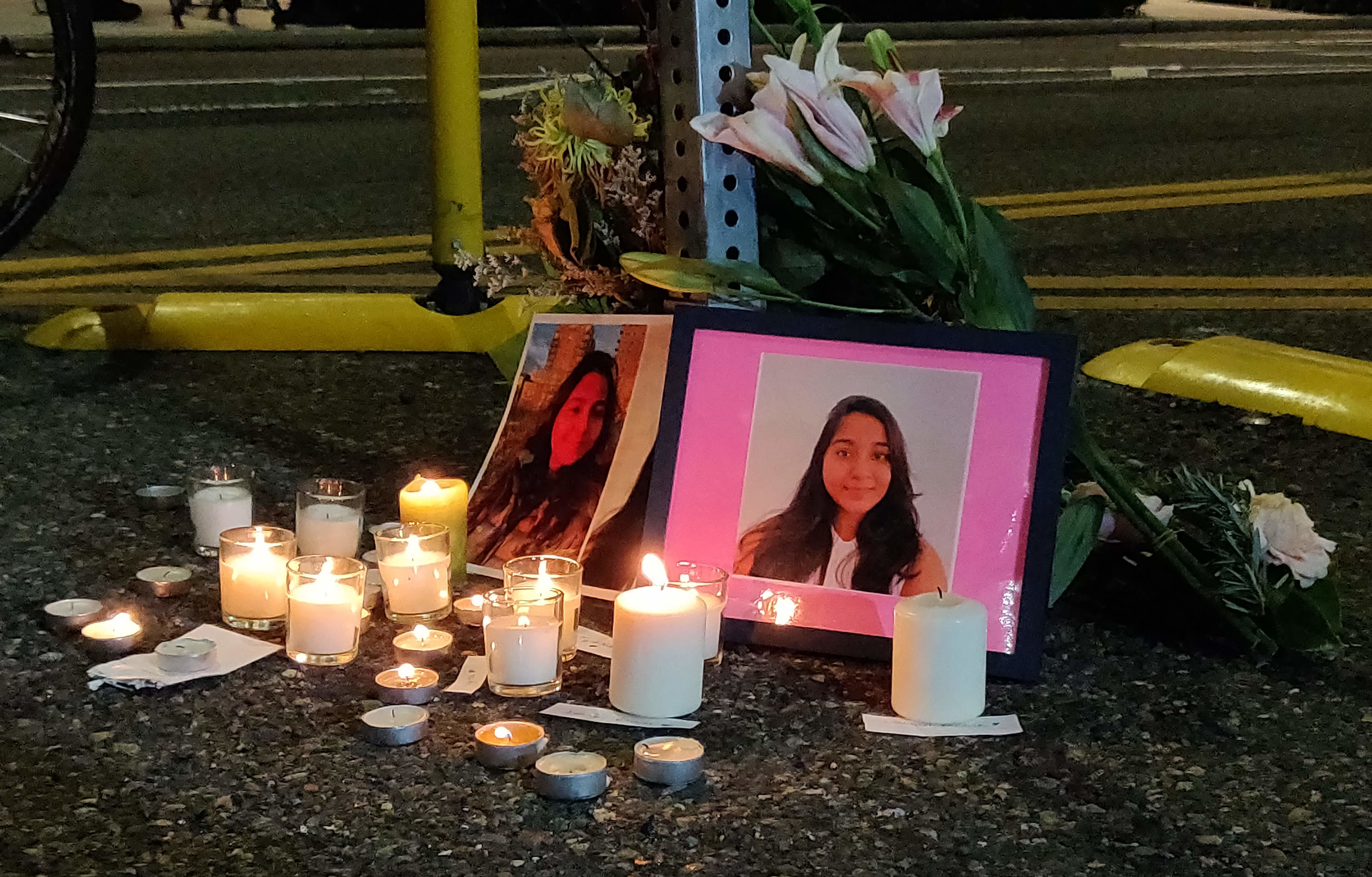
We had a two-minute moment of silence and set up a vigil. Eventually the police helicopter that had been over us for about an hour, decided we weren’t that interesting and left a different silence in its wake. People started talking and asking what it will take to finally get police and drivers/cars to stop killing people. There was hope that this would be the first and last vigil of the year, but no one really believed it would be. The only thing we can do is to continue to draw attention to each injury and death to try to change public opinion enough to create real change.

Many drivers seemed to be extra alert tonight, especially around the intersection where she was killed. When it was time to head home, I was starting to have hope that change was coming. Perhaps this would be the event to draw enough attention to change the tide.

The rain started to fall on my ride home. I was cruising down 12th when a van in front of me slowed and I rolled into their blind spot. Concerned, my hands were already gripping my brakes when they started to turn into my lane. I slowed quickly enough to avoid them and they decided not to turn after all. As the dark van continued forward slowly, I decided I would be safest if I passed them now, when they had no opportunity to turn. Glancing over, I saw it was an SPD van with two officers up front and realized it is going to take a lot more for our city and culture to change.

Good bye, Jaahnavi. I wish we’d had a chance to meet.

Posted in Biking | Tagged , | 2 Comments

Seventy48 Training Begins… again

Last year I learned about the Seventy48 and started training for it without really knowing what to expect. I went in a bit nervous but had a great time and decided to do it again.

Since Avery, my adventure buddy, is starting to outgrow the back hatch of my kayak, we decided it was time to get a tandem kayak. This will make kayak camping easier, but it also means that when I do the Seventy48, I don’t have to do it solo. Avery is still too young to complete a 70 mile kayak adventure with me, but my dad isn’t. He got me into sea kayaking when I was younger and has done some epic kayak trips in Alaska, but never anything this long.

Avery testing out the new kayak. She likes this much more than sitting in the back hatch of my boat.

Last year’s training plan seemed to work out well. I had a bit over 100 miles of total training with my longest single day around 27 miles. The plan for this year is about the same with maybe a few more 15+ mile training sessions.

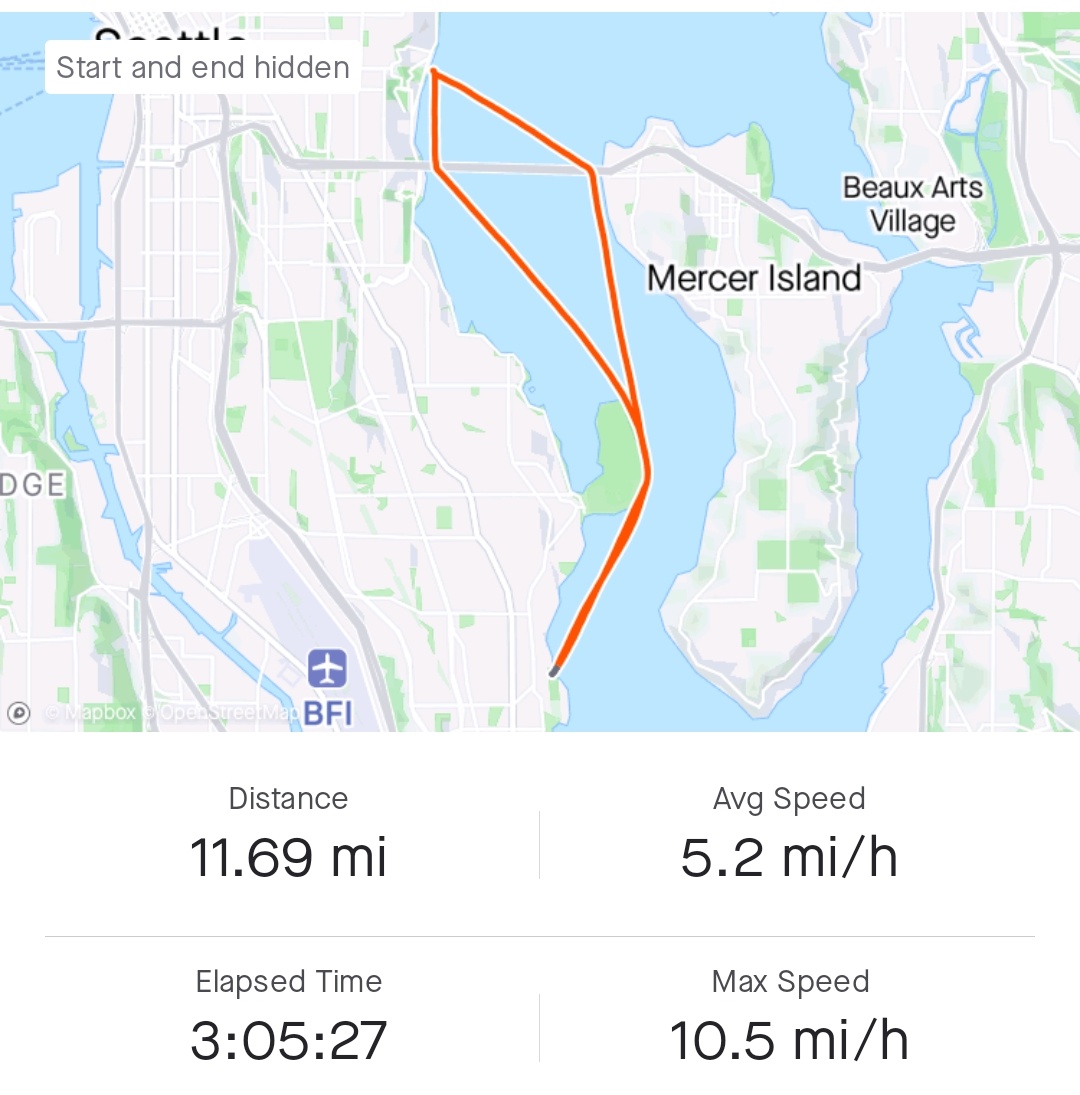
As of last week, Team Drowned Chipmunk is officially registered for Seventy48 2023 so it must be time to start training. Yesterday we went out for the first official training session. We’re both still getting used to the boat (neither of us have much experience in a tandem) and I tried a bent shaft paddle. We did a little under 12 miles on the water with a stop at the half way point to grab coffee at Leschi. Overall, the trip went well. We kept a strong pace. We still need to figure out some of the gear (I don’t think I’ll use a bent shaft paddle again), but we’re in a good position to be ready by June 3. Anyone else doing it this year? We’ll see you on the water.

Posted in Adventures | Tagged , | 2 Comments

Leadership and Self-Deception

Title: Leadership and Self-Deception – Getting Out of the Box

Author: The Arbinger Institute

Completed: Jan 2023 (Full list of books)

Overview: This came up in a conversation with a coworker. She recommended it as a quick read and it was. It’s written in the same style as other overly didactic books where rather than trying to show you the points they are trying to make in 2000 words, they tell you a first-person story of someone learning the lessons they want you to learn. This approach takes over 100 pages, but I guess it’s more interesting. The main point comes down to “you should treat all people (and especially coworkers) as actual people, not objects that help you get what you want.” It has a some good ideas to reflect on, but like several other books I read over the last few years, I would have liked it twice as much if it had been half as long.

Highlights:

  • Either I’m seeing others straightforwardly as they are—as people like me who have needs and desires as legitimate as my own—or I’m not. As I heard Kate put it once: One way, I experience myself as a person among people. The other way, I experience myself as the person among objects.
  • we see them in terms of the self-justifying images we’ve created. If people act in ways that challenge the claim made by a self-justifying image, we see them as threats. If they reinforce the claim made by a self-justifying image, we see them as allies. If they fail to matter to a self-justifying image, we see them as unimportant.
  • However bitterly I complain about someone’s poor behavior toward me and about the trouble it causes me, I also find it strangely delicious. It’s my proof that others are as blameworthy as I’ve claimed them to be—and that I’m as innocent as I claim myself to be. The behavior I complain about is the very behavior that justifies me.”
Posted in Lit Review | Tagged , , , | Leave a comment

Four Lost Cities

Title: Four Lost Cities: A Secret History of the Urban Age

Author: Annalee Newitz

Completed: Dec 2022 (Full list of books)

Overview: I heard Annalee speak at ToorCamp this summer and thought this sounded like a fascinating read. The four cities existed across several millennia yet each went through a similar rise and fall. Annalee points out that the common explanation these days, promoted by Jared Diamond’s Collapse, that the cities were abandoned because of environmental changes is only part of the story. Each city was also going through social and political changes at the time. And, despite the population leaving each of the cities, they make the point that none of these civilizations really collapsed. Each went through a slow population decline, but the people continued their culture in different places. Each culture continued to evolve and change over time as all cultures do.

Highlights:

  • Popular accounts of the city’s demise suggest that Romans shunned the buried city out of superstition and fear, quickly losing track of where it had once stood. Nothing could be further from the truth. Pompeii’s demise was followed by one of the greatest relief efforts in ancient history. Emperor Titus toured Pompeii twice after the eruption to assess the damage, discovering that the once-lush landscape was entombed in thick, superheated ash, oozing toxic fumes. Pompeii was unsalvageable. Titus and his brother Domitian, who succeeded him, used the sprawling empire’s wealth to rebuild the lives of people whose homes were lost. They allocated money to survivors, and paid workers to construct homes for them. Archaeologists have recently uncovered new evidence of the empire relocating refugees to nearby coastal towns like Naples, expanding neighborhoods and roads to accommodate them.
  • Ironically, it took the invention of a city for people to conceive of being alone, away from the crowd. Put another way, the concept of privacy had arrived, and with it the concept of a public.
  • As people left nomadic bands to form agricultural communities, their populations grew in size. Suddenly, a community wouldn’t be an extended family of people whose faces you knew by heart. In a village of 200 people, or a city of thousands, even neighbors might be strangers. People needed more than personal connections to feel part of the group. “[They] needed huge monumental art to create commitment and remind people constantly of their collective identity,” Benz told me. You might say that people went from identifying with each other to identifying with a special, shared location.
  • the city begins and ends with the small acts of many people, who imbue their houses with “increased practical and symbolic importance.”
  • The figurines themselves may not have been objects of reverence, but the act of creating it could have been a magic ritual. Seeking guidance or good fortune, Dido would quickly mold one from the clay next to the field where she harvested wheat. Once it was dry, she could have used it in a ritual that drained its power away. Afterward, she’d throw the clay figure off her roof along with waste from yesterday’s meal. If people at Çatalhöyük used the female figures like this, it’s clear why people threw them away so often. Making them was more important than keeping them.
  • People today are attracted to cities because they feel an affinity for subcultures or groups that don’t exist in smaller communities organized mostly around families.
  • There are also glossy corporate towers, massive churches, imposing government buildings, and thousands of shops in every configuration. Today’s cities are places where we can see social and economic inequality built into the landscape.
  • Along with incentivizing women to have as many babies as possible, the Julian Laws also meted out harsh punishment for women deemed “promiscuous.” Famously, Augustus exiled his own daughter in 2 CE when she refused to stop publicly engaging in the ancient world’s equivalent of free love.
  • “I’m interested in the part of the rock that is now gone,” he told me. “The shape that’s worn away—that’s what people did.” This is especially true when it comes to public spaces where many people were doing roughly the same kinds of things. “If you take the hundred thousand interactions with the stone in aggregate, all over the city, the absence is thousands of people making the same decision. Now, suddenly, you have a picture of a system of traffic at a place like Pompeii where we had zero evidence ever before.”
  • And yet, despite over two centuries of researchers excavating Pompeii, very few people understood the world inhabited by Murtis and Amarantus until recently. Partly that’s because data archaeology has given us new tools to explore the lives of nonelites. But it’s also due to a more fundamental problem with the way we study history. Though people of the 19th and 20th centuries treasured Pompeii, returning to it repeatedly for further excavation, there were parts of its culture they wanted to forget. When they came upon sculptures of genitalia or dirty graffiti, they locked these things away in “secret cabinets” because it was too hard to step outside their Christian values and look at those artifacts with Roman eyes. Only in 2000 was the “secret cabinet” in the Naples Museum opened to the general public. Roman sexuality is so alien to modern people’s sensibilities in the West that it was practically illegible. Museum curators in previous centuries treated lucky penis charms like pornography, and historians didn’t consider prostitutes worthy of study.
  • Naples is a noisy city, full of narrow cobblestone streets that roar with cars and motorcycles careening uphill from the Bay of Naples at terrifying speeds. These downtown roads were built for the kinds of mule-drawn carts that dominated the ancient and medieval Roman worlds, but now pedestrians fight for space alongside metal machines that Murtis and her friends at the lupanar could only dream of.
  • At Sambor Prei Kuk, kings of the Chenla Empire worshipped the Hindu god Shiva, unlike the Angkorian kings who preferred Vishnu.
  • In one temple, we found fresh baskets of incense, paper flowers, and a golden parasol sheltering a statue of the Buddha. But the centuries-old Buddha was also a modern touch. It had been built on top of an ancient lingam shrine that symbolizes the power of the Hindu god Shiva.
  • Jayavarman II explicitly wanted to build a Hindu empire. Inscriptions carved after his death recount a coronation ceremony where he declared himself the Khmer’s godlike ruler in a ritual that borrowed concepts of divine kingship from Hindu traditions. But Stark and Carter think the picture is a lot more complicated than a sudden infusion of Indian Hinduism. “It’s not Indianization—it’s globalization,” Carter said, noting that influences came from many parts of Asia. “Plus,” she added, “by the time Angkor arises, there’s a thousand years of indigenous cultural development in Cambodia.” The local people in places like Battambang were just as important to Angkor’s development as ideas from abroad.
  • The khñum debt slavery scenario sounds brutal until you consider that most capitalist cultures in the West use a similar system. In the United States, it’s not unusual for people to graduate from college with so much debt that they have to work their whole lives to pay it off. Others take on debt to pay for a house or buy a car. Though technically all of us can choose what kind of work we do to pay off these debts, it’s rare to find anyone who is doing the exact kind of work they’d like to do. Many of us feel like we’re being told to dig ditches by some distant corporate authority, or risk losing everything. Still, we keep working instead of rising up against the banks, for complicated reasons. Maybe we don’t want to rock the boat because our lives are relatively comfortable, or maybe we need health insurance to pay for a child’s hospitalization, or maybe the corporations seem too powerful to defeat. Those feelings might have kept khñum in line, too.
  • He’s discovered that urban populations grow faster than their own infrastructure. West has found that doubling the size of, say, a city’s water canals would more than double its population. Due to the benefits of sharing resources at high density, urbanites need about 15 percent less infrastructure than you’d expect based on population size.
  • the Mississippians likely controlled land via kinship networks, the way the Hidatsa did, with many families sharing the same field. “American schoolchildren are taught that private, individual ownership of land was a concept foreign to Native Americans,” she writes. “Nevertheless, it is clear that families or extended kin groups held exclusive use rights to firmly demarcated plots of land for farming.”
  • The collapse hypothesis was nearly dead when Jared Diamond published his popular book Collapse in 2005. Based mostly on anecdotal evidence from cultures like the Maya and Polynesians on Easter Island, he argues that societies “collapse,” or fail, when they engage in environmentally unsound practices. His argument played into a lot of myths about how cities work, including the idea that cultures are wiped out when their high-density settlements disappear. As we’ve seen with the cities in this book, urban abandonment does not mean some kind of cultural death. Usually it means that city people have migrated elsewhere, bringing the values, art, and technologies of the city with them to new homes. Diamond is right to highlight environment as a contributing factor in urban dissolution, but that’s only one part of the story. Abandonment is most importantly a political process.
Posted in Lit Review | Tagged , , , | Leave a comment

What is Anarchism?

Title: What Is Anarchism? An Introduction

Author: Donald Rooum and Freedom Press, et al

Completed: Nov 2022 (Full list of books)

Overview: First hearing about anarchy through pop culture doesn’t really give you a good understanding of what the political philosophy is truly about. Over the years, I was more and more interested in learning about it so I would read an article here or there but not much more. Eventually, i looked into it a bit more and came across this book and the Conquest of Bread which I got as an audiobook earlier this year. This collection of articles covered many aspects of anarchist thinking and helped answer some of my questions. Some of it was a bit dated but the philosophy remains true, even if the language and examples they give are 100+ years out of date.

Highlights:

  • Anarchists believe that the point of society is to widen the choices of individuals. This is the axiom upon which the anarchist case is founded.
  • Many people confuse government with organisation, which makes them suppose that anarchists are against band leaders and architects. But organisers and leaders are not the same as bosses. Anarchists have no objection to people following instructions, provided they do so voluntarily.
  • Wherever Marxists have seized power, they have behaved like other people in power. Marxists accuse them of betraying the revolution, but anarchists think the pressures of power make all bosses behave in substantially the same way.
  • Anarchists are against the surrender of power, and therefore against democracy. Not just against the perversion of democracy (though that is often mentioned), but against the democratic ideal. They do not want people to give power to whoever they choose; they want people to keep their power for themselves.
  • Anarchists are disgusted by the idea of houses standing empty when people are homeless, and have always supported squatters movements. Several anarchist groups run squatters advice centres,
  • In times and in countries where the people believed in the need for government by one man (monarchy) the word republic, which is government by many, was in fact used in the sense of disorder and confusion
  • To become a convinced anarchist, and not in name only, he must begin to feel the solidarity that joins him to his comrades, and to learn to co-operate with others in the defence of common interests and that, by struggling against the bosses and against the government which supports them, should realise that bosses and governments are useless parasites and that the workers could manage the domestic economy by their own efforts. And when the worker has understood this, he is an anarchist even if he does not call himself such.
  • Unlike the politician, he does not regard dishonesty, brutality and avariciousness as natural characteristics of human nature, but as the inevitable consequences of coercion and frustration engendered by artificial law, and he believes that these social evils are best eradicated not by greater penalties and further legislation, but by the free development of the latent forces of solidarity and sympathetic understanding which government and law so ruthlessly suppress.
  • To a government, therefore, that talked to us of deference to political authority, and honour to be rendered to our superiors, our answer should be: “It is yours to shackle the body, and restrain our external actions; that is a restraint we understand. Announce your penalties; and we will make our election of submission or suffering.
  • What role does the government play in your existence? Does it help you live? Does it feed, clothe and shelter you? Do you need it to help you work or play? If you are ill, do you call the physician or the policeman? Can the government give you greater ability than nature endowed you with? Can it save you from sickness, old age, or death?
  • Consider your daily life and you will find that in reality the government is no factor in it all except when it begins to interfere in your affairs, when it compels you to do certain things or prohibits you from doing others.
  • anarchism means voluntary co-operation instead of forced participation.
Posted in Lit Review | Tagged , , , , | 1 Comment

Seattle Mystic Alfred M. Hubbard

Title: Seattle Mystic Alfred M. Hubbard Inventor, Bootlegger and Psychedelic Pioneer

Author: Brad Holden

Completed: Nov 2022 (Full list of books)

Overview: What an interesting life Hubbard lived! He seemed to bounce from one weird job to another (often conning at least a few people in the process) and usually at the cutting edge of a new field. I knew almost nothing about him before this book and now, part of me wants to chat with him… while the rest of me wants to keep plenty of distance. Either way, it was fun to learn about a bit more Seattle history.

Highlights:

  • curiously looking around at the intriguing inventory of transistors, vacuum tubes and assorted radio parts.
  • Olmstead had become quite affluent thanks to his bootlegging operation, which had grown to such an enormous degree that, for a time, he was Puget Sound’s largest employer.
  • Known as the “Whispering Wires Case,” due to the extensive wiretapping involved, the resulting legal proceeding would end up being the biggest Prohibition trial in history. Olmstead, seemingly unfazed, simply posted bail and returned to work—setting his liquor operation right back into motion again.
  • Aberdeen, a flourishing working-class town built around a thriving logging industry. While Seattle was awash with smuggled Canadian liquor supplied by Olmstead and others, Aberdeen’s liquor market was mostly controlled by competing moonshine operations that set up large-scale stills throughout the heavily forested hillsides.
  • The results were astonishing, with abstinence rates reaching as high as 60 percent. Best of all, LSD therapy was now viewed as an attractive, cost-effective form of mental health treatment.
  • Word soon spread about this Canadian hospital, which was now boasting recovery rates of up to 90 percent, and in no time at all, the rich and famous started arriving by the droves to receive help in overcoming their battles with the bottle or to receive some form of psychological care.
  • research showed that a properly guided psychedelic session provided peace of mind and a much greater acceptance of death for those with terminal illness.
Posted in Lit Review | Tagged , , , , | 2 Comments

Fermented Hot Sauce

If you like spicy foods and have never tried fermented hot sauce, it’s time to make a batch. It simple and produces such amazing flavors. I took a bottle into work and several co-workers asked how to make it. I planned to do it at work, but kept getting distracted with… well work. So, this is to show them, and anyone else interested, how to make it.

Grab 1-3 pounds of peppers. For this batch, I used all the peppers we grew in our garden this year, plus some smoked hatch chiles that were hotter than my co-worker had expected (thank Della). Cut off the stems and cut the larger one into smaller chunks (not really needed, but in my mind, it helps). Then throw them in a mason jar.

After you have a good layer on the bottom, throw in a few cloves of garlic. I lightly crush it, but you don’t have to do much. Keep adding peppers and garlic until you run out of peppers. The exact ratio isn’t too important, but I usually aim for about 10:1 peppers to garlic by weight.

Once all the peppers and garlic are ready, you need to get the total weight. I tare the scale with an identical mason jar then weight the full mason jar. Next you need to add 2% of the total of the peppers and garlic. This is the only critical step where you need to be exact. The wrong amount of salt can encourage the “wrong” microbes to grow which could mess with the flavor or make it unsafe to eat so double check.

Pour the salt into the mason jar with the peppers and garlic, then gently mash the mixture to release juices. Keep mashing until the liquid covers the peppers. If you can’t get enough liquid to cover the peppers, you can add a little water with 3% salt by weight mixed in (3g of salt mixed into 100g water, until it’s dissolved). These peppers had plenty of liquid so I didn’t need to add any brine. I added just over 14g of salt to 721g peppers/garlic.

This mixture needs to ferment for 1-3 weeks. During that time, you want to keep the peppers below the surface. You could fill a zip-lock bag with brine to weigh them down, but there is a much better option. These lids and springs make fermenting much easier.

The spring keeps everything below the surface and the vent on the lid allows CO2 to escape without building up pressure.

After a week, you can check it. It should smell spicy with sour notes, like kimchi. There shouldn’t be any fuzzy growth, but you might see small, matte white areas. As long as it’s not fuzzy, it’s probably kahm yeast which can be removed but doesn’t ruin the hot sauce. Once it’s sour enough (I usually ferment mine for about 10 days), it’s time to blend the peppers and all their liquid. You can strain it or leave it a little chunky. Either way, it’s ready to add to your dish. Enjoy!

Posted in Cooking | Tagged , , | 1 Comment